The articlegameplay, story, development, reception
Gameplay
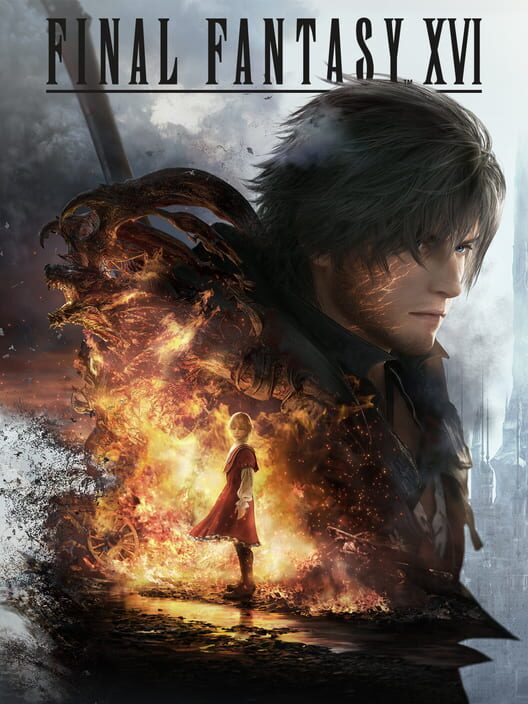
Final Fantasy XVI is an action role-playing game in which players take control of protagonist Clive Rosfield and a rotating party of AI-controlled companions through segmented open areas across the continents of Valisthea. Recurring Final Fantasy elements, such as the bird-like Chocobo and monster types, appear in the game. Following a story-driven prologue section, Clive is able to travel to different parts of Valisthea. The world is split between enclosed dungeon environments, town environments, and wider open fields, all selected from a map via a fast travel menu.
Travel within open zones is done either on foot or via Ambrosia the Chocobo. Clive's home base is a hideout, acting as a hub to talk to non-playable characters (NPCs), track Clive's relationships with different characters, interact with different shops such as potion sellers and blacksmiths to make and upgrade equipment, and accept side quests ranging from character requests to monster hunts. Information on locations, characters and terminology is stored in a database dubbed Active Time Lore, accessible to players at any time.
Combat takes place in the same area players navigate, entering battle once the enemy sees the party (or with certain enemies such as antelopes, upon Clive attacking them). Clive is the only controllable character, with other characters being AI-controlled and having their own attack and magic abilities. Another common companion is the dog Torgal, who responds to Clive's commands to perform special attacks or heal. While in battle, Clive can use normal attacks, a dodge, and use elemental abilities from Eikons, the game's version of recurring Final Fantasy summoned monsters.
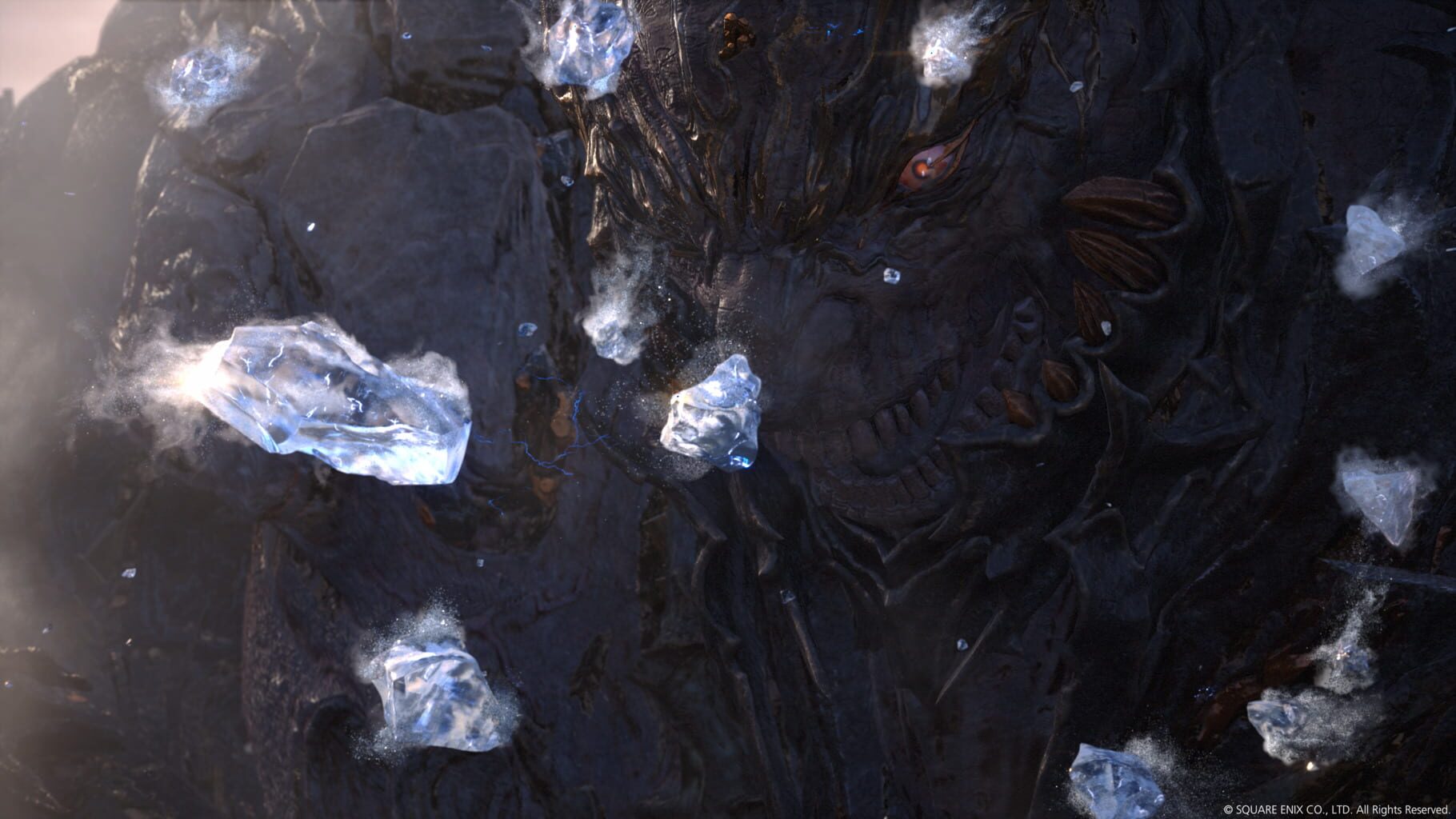
Clive can switch between different Eikon abilities during battle, stringing them together into different combo attacks. A core mechanic of combat is "Stagger", where the party deals specific types of damage which build up a stagger meter to stun an enemy for a short time and make them vulnerable to more attacks. During certain story sections, Clive has battles with Eikons and their wielders that have dedicated mechanics. After defeating them, Clive gains access to powers and fighting techniques themed around them.
The game starts out with two difficulty settings: a "Story" mode that offers accessories to simplify combat and strengthen the characters, and a normal mode. After completing the game, new options are available including New Game+ which carries character statistics and equipment into a new game, and a harder "Final Fantasy" mode which increases overall difficulty and changes enemy placements. There is also an arcade mode which grades players using a point system for combat, with harder Ultimaniac Mode challenges within that. In these modes, Clive can further upgrade his weapons, upgrade accessories in Final Fantasy mode, and challenge trials which place limits on Clive, such as only using one Eikon power in battle.
Story
Final Fantasy XVI is set in the fictional world of Valisthea. Scattered throughout the two continents of Ash and Storm are colossal magical crystals, known as the Mothercrystals, which provide aether energy to the various populations and drive civilization with shards mined for commercial use. There are also humans that can use magic without crystals known as Bearers who are subject to prejudice and slavery, their overuse causing them to gradually petrify. Key to Valisthea's current politics are the Eikons, magical creatures of incredible power that are utilized by hosts called Dominants. There are eight Eikons, one for each of the elements – Phoenix (fire), Shiva (ice), Ramuh (thunder), Leviathan (water), Titan (earth), Garuda (wind), Odin (darkness), and Bahamut (light); a seemingly impossible second Eikon of fire, Ifrit, drives the main plot by disrupting this balance.
The core nations of Valisthea are the Grand Duchy of Rosaria, the Holy Empire of Sanbreque, and the Dhalmekian Republic on the Storm continent, the Kingdom of Waloed which dominates the Ash continent, and the neutral Crystalline Dominion sitting between Ash and Storm. An outlier is the Iron Kingdom, an isolated nation off the coast of Storm overseen by the Crystalline Orthodox. In the backstory an ancient people, humanity's ancestors the Fallen, once dominated Valisthea before a cataclysm destroyed their civilization, leaving ruins across the land. By the game's events, Valisthea is suffering from a depletion of aether dubbed the Blight which withers all life, driving the nations into conflict with each other.
Because of their ability to manifest Eikons, Dominants play a key role in the nations' politics and military. Depending on where they are born, Dominants are hailed as political leaders, tolerated due to their power, or suffer abuse and are either killed or used as weapons of war.
The game's protagonist is Clive Rosfield, firstborn son of Rosaria's ruling family who is passed over as successor when his younger brother Joshua becomes the Dominant of Phoenix; Clive can acquire and wield the power of multiple Eikons. A future companion of Clive's is his childhood friend Jill Warrick, the eventual Dominant of Shiva who spends much of her life as a political hostage. During his travels Clive is joined by his hound, Torgal; and Cidolfus Telamon, Dominant of Ramuh who provides shelter for Bearers and Dominants, and is an incarnation of a recurring Final Fantasy character. Other prominent characters include Barnabas Tharmr, king of Waloed and Dominant of Odin; Benedikta Harman, a Waloed spy and Dominant of Garuda; Hugo Kupka, key political figure in the Dhalmekian Republic and Dominant of Titan; and Dion Lesage, crown prince of Sanbreque and Dominant of Bahamut.
In his teenage years, Clive serves as Joshua's bodyguard, being a Bearer and blessed with some power from the fire Eikon Phoenix. The brothers live with their parents Duke Elwin and Duchess Anabella, with Jill as their ward. The brothers accompany Elwin to a ceremony to awaken Joshua's powers when they are ambushed by Sanbreque soldiers. Elwin's death triggers Joshua's destructive awakening as the Phoenix, and an Eikon named Ifrit emerges moments later and kills the Phoenix, with Clive swearing revenge. Anabella, who despises Clive's lack of blessing, betrays Rosaria to preserve her bloodline and has Clive enslaved to Sanbreque's army.
Thirteen years later, Clive is sent behind enemy lines during a fight between the Dhalmekian Republic and the Iron Kingdom to assassinate the latter's Dominant, revealed to be an enslaved Jill. Upon recognizing her, Clive deserts to free Jill, and the two are rescued by Cid, who agrees to help Clive search for Ifrit's Dominant. Tracking word of an unknown Dominant, they fight Benedikta, from whom Clive takes the power of her Eikon Garuda. A defeated and disturbed Benedikta is then attacked by bandits and transforms into a raging Garuda, which in turn triggers Clive to transform into Ifrit and kill her. While Clive briefly despairs at the fact that he is Ifrit and the one who killed Joshua, Cid encourages him to keep searching for the truth behind his transformation.
After Clive and Jill see the full oppression inflicted on Bearers and their sympathizers in occupied Rosaria, they join Cid in a quest to destroy the nations' Mothercrystals, which are causing the Blight by draining aether from the land. They infiltrate Sanbreque's capital, but within its Mothercrystal are faced by a being called Ultima, who mortally wounds Cid before the Mothercrystal is destroyed. When Ultima attempts to possess Clive, Joshua−who survived Ifrit's attack due to the Phoenix's powers−redirects Ultima into himself. Hugo, who was in love with Benedikta, is manipulated by Barnabas's agents into seeking revenge against Cid for her death.
Five years later, Clive, now using the title of "Cid" and carrying on Cid's mission, destroys the Iron Kingdom's Mothercrystal with Jill, who takes revenge on her enslavers. With Sanbreque having occupied the Crystalline Dominion for its Mothercrystal, Anabella has Dion replaced as heir to the throne with Olivier, her son by Sanbreque's emperor Sylvestre. Hugo invades Rosaria to lure out "Cid", prompting Clive to mutilate Hugo in a fight and reveal himself as Benedikta's killer. Desperate for revenge, Hugo transforms into a raging Titan.
Having gained full control of Ifrit, Clive kills Hugo and destroys the Dhalmekian Mothercrystal.
Under Joshua's advice, Dion stages a coup against Anabella, but in the process, Dion inadvertently kills Sylvestre and is transformed into a raging Bahamut by Olivier, revealed to be a vessel for Ultima. Clive destroys the Dominion's Mothercrystal as he reunites with Joshua, helping him defeat Bahamut. Now aware of Ultima, Dion kills Olivier, causing an unhinged Anabella to kill herself in despair. Barnabas later confronts Clive and reveals Ultima's plan to shape Clive into "Mythos", a vessel fo
Development
Final Fantasy XVI was developed by Creative Business Unit III, a development division within franchise developer and publisher Square Enix. The staff included members from the massively multiplayer online role-playing game (MMORPG) Final Fantasy XIV, and multiple veterans of the Ivalice universe. Producer Naoki Yoshida, who worked on Final Fantasy XIV as both producer and director; main director Hiroshi Takai, known for his work on the SaGa series and The Last Remnant; creative director and lead writer Kazutoyo Maehiro; lead gameplay designer Ayako Yokoyama; lead system programmer Yusuke Hashimoto, a former design engineer for Level-5; and art director Hiroshi Minagawa, with characters designed by Kazuya Takahashi. The logo, portraying the Eikons Phoenix and Ifrit in battle, was designed by long-time illustrator Yoshitaka Amano.
Concept work for the game began in 2015 after Square Enix CEO Yosuke Matsuda approached Yoshida to develop the next mainline Final Fantasy game. Yoshida, who was finishing up production on the Final Fantasy XIV expansion Heavensward, understood the decision, as Creative Business Unit I had begun work on Final Fantasy VII Remake, but he needed to balance his work between Final Fantasy XIV and XVI. To lay the groundwork, Yoshida assembled a small planning team made up of himself, Maehiro and designer Mitsutoshi Gondai. Yoshida decided to become producer as his duties as both producer and director for Final Fantasy XIV were too time-consuming to take on a second large-scale project.
Takai, who had also worked with Yoshida on Final Fantasy XIV, was selected as main director due to his experience with the series, his popularity among the development team and his experience with visual effects. 4 of Heavensward, when Takai and Maehiro had found replacement staff for the next expansion Stormblood. The team received development support from Tai Yasue's Kingdom Hearts team in Square Enix Creative Business Unit I and a team at PlatinumGames led by Takahisa Taura.
When creating both the world design and story, the team took criticism from Final Fantasy XV (2016) into account, specifically its open world design and story delivery problems. Takai's main goal for the game was an action-based combat that was easy to use and a mature, dark fantasy narrative that would tackle difficult themes. Yoshida wanted the game to reach "players of all generations", rather than cater to specifically children or adults. He also wanted to distance the game from stereotypes commonly associated with the franchise, such as an anime-inspired art style and a story focusing on teenagers. It was initially developed as a PlayStation 5 exclusive, with a PlayStation 4 version being considered but abandoned so as not to limit the team's ambitions.
Due to the COVID-19 pandemic, the staff needed to move to remote work, and production ended up half a year behind schedule due to communication issues with both Square Enix's head office and outsourcing companies. By late 2020, basic work on development and game scenarios was complete, and work was continuing on "large scale" resources like boss battles and development tools. By April 2022, development was in its final stages, with the team finalising side quests. It was fully playable from start to finish by June of that year, with development focusing on both polishing the game and voice recording for different languages.
Initially planned as a two-disc release, the team managed to fit the game onto one disc to lower production costs and issues with mastering. Following release, the production team disbanded into other projects.
When choosing the game's combat system, Yoshida conducted surveys within the Final Fantasy community, finding a division between fans of action-based and more traditional turn-based combat. After considering the potential impact on sales and modern gaming trends, he opted for a real-time action-based battle system. Yoshida admitted that this approach alongside other gameplay decisions risked polarizing series fans, but he believed that trying to please every fan by incorporating every element possible would "run the risk of creating a half-baked compromise of a game". During the game's early production, the growing team had a system of designing gameplay tests and completely scrapping those that did not work, with Square Enix's upper management getting frustrated with the team's slow pace.
The team decided against an open world, as it would have extended development time beyond a practical limit. Clive was made the only controllable character, with other party members driven by AI to simplify the player's control needs, though commands were included to allow for limited control.
Outside the Kingdom Hearts team, Square Enix had little experience designing action combat. Yoshida sought out Ryota Suzuki, a Capcom veteran who had worked on the Devil May Cry series, as battle designer. The combat was designed around the idea of turning the mechanics of Final Fantasy V into a real-time battle system. The Eikon battles all had unique mechanics that were not reused in other fights.
One of the earliest completed Eikon battles was with Garuda, with its foundation remaining mostly unchanged throughout production. There were no loading screens related to these setpiece battles, with gameplay and dialogue mixed into the final sequences. During the first half of development, an Eikon-based job system was intended for Clive, but it was dropped due to its restrictions on Clive's in-game appearance. Classic Final Fantasy jobs were used as a design inspiration for enemies and some NPCs.
Yoshida brought Maehiro on board due to liking his writing style and world-building. While he accepted, Maehiro was also busy working on the Heavensward scenario and only started full work in 2016. The initial narrative drew inspiration from the early seasons of Game of Thrones, with other inspiratio
Reception
Final Fantasy XVI received "generally favorable" reviews from critics, according to review aggregator website Metacritic. According to OpenCritic, 91% of 205 critics recommend the game.
Regarding the story, Michael Higham of GameSpot praised the writing for its handling of darker themes and found the cast enjoyable, and IGN's Mitchell Saltzman was highly positive about the story and characters, and lauded the lead performances. Game Informer's Wesley LeBlanc enjoyed the wider narrative, and Edge noted the grand scope of the narrative despite it being at odds with the game structure. Jordan Middler, writing for Video Games Chronicle, found the story well told and its cast likeable after a slow start filled with worldbuilding and unfamiliar terminology. Iain Harris of GamesRadar+ described the setting as a throwback to early series games and noted its environmental themes, but noted some poor dialogue.
Eric Van Allen, writing for Destructoid, noted the story's ambition but felt some of its themes were poorly resolved. Eurogamer's Edwin Evans-Thirlwell praised Clive's storyline and the narrative's examination of series themes, though noted a tone of "wanton backstabbing and ambient misogyny" among the supporting cast. Similarly, Zach Wilkerson of RPGFan found the female characters underdeveloped, though praised the narrative and the cast overall. Giovanni Colantonio of Digital Trends found the story lacking after shifting away from Clive's revenge quest, additionally finding few of the characters memorable, but praised the overall lore.
A point raised by some critics was a perceived lack of ethnic diversity and representation.
Higham praised the graphics and cinematics as adding to the overall story and design, and both Edge and Wilkerson lauded the detail and variety of the game's graphics. Middler lauded the overall visual design, but noted some stilted animation for side characters in some cutscenes. Talking about the visual effects used in battles and Eikon setpieces, Harris felt they sometimes obscured the action for players. LeBlanc noted a lack of detail or variety in NPC designs and felt the visual effects got in the way of gameplay at times.
Both Saltzman and Higham noted an unstable frame rate. Soken's score for the game met with high praise.
Higham described Final Fantasy XVI as the series' most drastic gameplay shift to date, praising the variety of ability combinations possible later into the game. Colantonio was pleased by the scale and spectacle of Eikon fights and enjoyed the combat despite it being driven by the story; he hoped the series would continue refining these elements in future installments. Allen called the gameplay "flat out good", while Harris called it potentially divisive but still enjoyable due to its action focus. Edge enjoyed the opening parts and combat system, but complained that the pacing slowed in later parts.
Evans-Thirlwell noted the wide variety of special abilities and customization elements to complement the basic combat mechanics, while LeBlanc called the battle system "[his] favorite action combat system to date" despite pacing issues. Saltzman highlighted the focus on staggering enemies and prioritizing combos as the strongest part of the combat system. Wilkerson praised the customization available to expand the combat options for new and experienced action game players, but felt the difficulty too easy overall and noted a lack of enemy variety. Middler praised the action combat, positively noting its brisk pace and lack of unnecessary filler would allow players to speed through the campaign.
Several reviewers positively compared the scale and spectacle of Eikon battles to setpieces from God of War III and Asura's Wrath. Recurring criticism was focused on the lack of mechanical depth, and uninteresting side quest design.
Final Fantasy XVI was the best-selling retail game in Japan during its week of release, with just over 336,000 physical units being sold. In the United Kingdom, the game was the best-selling title during its first week, but had notably lower physical sales than Final Fantasy XV. During its first month on release in the United States, the game was the second best-selling title behind Diablo IV. During its first week, Final Fantasy XVI sold over three million units.
Reports and statements from Square Enix noted that despite strong sales the game did not meet the company's higher expectations, with this and other factors contributing to the company's share value falling. President Takashi Kiryu blamed slow adoption of the console, and stated the company would continue marketing it. In May 2024, Kiryu stated that Final Fantasy XVI and other major titles had failed to meet long-term sales expectations. It was the 16th best-selling video game in the US in 2023.