The articlegameplay, story, development, reception
Gameplay
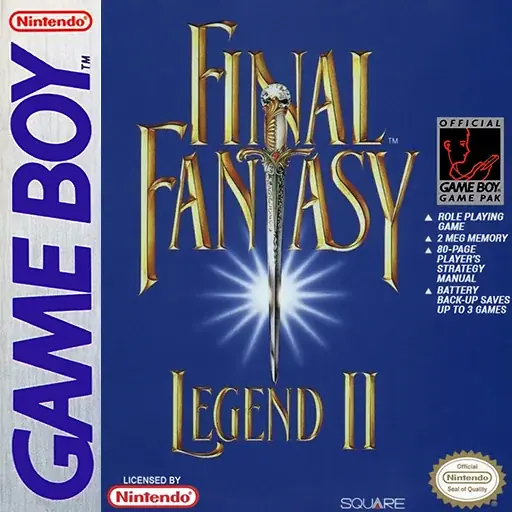
Final Fantasy Legend II, known in Japan as SaGa 2: Hihou Densetsu, is a role-playing video game. Set in a science fiction-based world, players take on the role of a four-person party with both humans and monsters able to be recruited. Most of the gameplay is carried over from the first game. The player navigates a party of four character through the game world, exploring areas and interacting with non-player characters (NPCs). Most of the game occurs in towns, castles, caves, and similar areas, all viewed from a top-down perspective.
The party slowly unlocks new worlds to explore, starting with the First World, and are able to save anywhere outside combat. Players can journey between locations via the world map, a downsized representation of the different worlds. Players can freely navigate around the world map screen unless restricted by terrain, such as water or mountains. During exploration, the party can talk with NPCs to gather information about how to progress the narrative, with notes being collected in a journal.
Like The Final Fantasy Legend, travel is occasionally interrupted by random enemy encounters. The game uses a turn-based battle system, where party members take turns using abilities such as attacks, spells, and items. At the end of battles, character statistics (stats) are raised randomly, with different upgrades between character types. Downed units are restored to one health at the end of a battle.
If all characters fall in battle, they can be revived by the character Odin in exchange for needing to fight him in the future. The party will find magical stones called MAGI that can be equipped for new abilities and upgrades.
Story
In a search for their missing father, the player-created protagonist seeks out the 77 MAGI stones formed when the statue of the goddess Isis was smashed. Teaming up with three other adventurers, the protagonist collects the MAGI from across a series of worlds connected by the Pillar of Sky. The protagonist's father is revealed to have belonged to a group called the Guardians, who fear bringing together all the MAGI will bring about catastrophe. When the protagonist finds all but one of the MAGI, the god Apollo extorts the gathered MAGI from the party by threatening their allies.
As one MAGI is missing, Apollo's attempt to use them goes wrong and all the worlds connected to the Pillar of Sky are struck by earthquakes. Descending the Pillar of Sky, the party restores Isis and with her help defeats the mechanical Arsenals acting as the Pillar of Sky's security system so Isis can restore the worlds unimpeded. The game ends with the protagonist going on a new adventure with their parents.
Development
Production on Final Fantasy Legend II began following the release and success of The Final Fantasy Legend (Makai Toushi SaGa) in 1989, also for the Game Boy. Kawazu had not anticipated a sequel, so the game initially refined the mechanics of the previous title. The staff included planner Hiromichi Tanaka, who Kawazu attributed with pushing forward production and polishing the final game. Kawazu had to wait for Tanaka to finish his work on Final Fantasy III, among other staff members who joined the project.
Production was further delayed as developer and publisher Square moved to new headquarters in Akasaka, Tokyo. After these delays, development moved faster than the first game, as all systems beside the world setting were identical. The game was developed by a team of ten staff, including Kawazu and Tanaka. Kawazu acted as director, writer, and a co-designer with Tanaka and Toshiyuki Inoue.
The "Teacher" character was based on Minwu, a player character from Final Fantasy II. Odin's role of reviving the player in exchange for a battle was implemented by Kawazu as a surprise for players. The Japanese cover art and character designs were created by Katsutoshi Fujioka, cover artist for the original SaGa. Fujioka also handled level design layout.
In a later interview, Kawazu felt the game was truly "complete" compared to the first game.
The music was co-composed by Nobuo Uematsu and Kenji Ito. While Uematsu had previously worked on the first SaGa, Ito had only just joined the company and this was his first title for Square. At the time, Uematsu was busy working on music for Final Fantasy IV, so Ito was brought in to create half the tracks. Composing for the game was a challenge for Ito as he had no experience with programming, needing to learn on the job.
His first completed piece was the track "The Land of Peace"; as he had no experience with the short looping tracks common at the time, the theme was notably long. Kawazu asked for tracks based on particular scenes and moods, keeping the console's memory limitations in mind. Despite precautions, the number of planned parallel sounds was reduced, and several tracks needed to be cut.
A compilation album featuring music from the three Game Boy SaGa titles, All Sounds of SaGa, was published in 1991 by NTT Publishing. The music was released in a soundtrack album in 2018 alongside music from the original SaGa and SaGa 3.
Reception
As of 2002, the game had sold 850,000 copies, making it the second best-selling title of the Game Boy SaGa releases. During its first two weeks on sale, the DS remake entered the top ten best-selling games, and sold 124,000 units. By the end of the year, the remake had sold nearly 156,000 units, becoming the 84th best-selling game of 2009 in Japan.
Japanese gaming magazine Famitsu found it easier and more enjoyable than its predecessor, but did not enjoy the removal of its experience point system. Reviewing the 1998 re-release, Dexter Sy of IGN found that the game had aged when compared to more modern role-playing titles, but cited it as the best of the series' Game Boy titles. RPGFan's Patrick Gann, writing in a 2000 review, lauded the title as the best of the Legend games, improving on the first game's systems and offering players greater variety in gameplay and exploration. Two reviewers in Go! complimented the game for humorous graphics and plot while saying it was "vey much like all the other RPGs."
Reviewing the DS remake, Famitsu approved of the redone graphics and gameplay elements, with one reviewer positively noting how easy it was to play. RPGamer's Michael Baker praised the changes to the game's progression system and graphics while remaining faithful to the original game overall. In their own review of the Collection of SaGa compilation, Jordan Rudek of Nintendo World Report praised the second game as better than the original game in terms of its mechanics. Nintendo Life's Mitch Vogel felt that all three titles in Collection of SaGa were very simplistic by modern standards, with none of them having aged well compared to other titles of their time. RPGamer's Elmon Dean Todd, in a standalone review of the game's Switch port, referred to it as one of the Game Boy's best RPGs, though he also felt that the game had aged poorly for modern tastes.
Legacy
During Nintendo Power's annual awards, Final Fantasy Legend II was nominated for "Most Challenging Game Boy Game" of 1991. GameDaily named it alongside the related Game Boy Final Fantasy titles as definitive games for the system. The sentiment was shared by gaming magazines Electronic Gaming Monthly and Pocket Games, the latter of which ranked the titles together 8th out of the Top 50 games for the Game Boy. In March 2006, the title was voted the 94th best game of all time by the readers of Famitsu magazine as part of its "All Time Top 100" poll.
Following the release of Final Fantasy Legend II, Nintendo asked Square to produce a new SaGa game for their in-development Super Famicom. The resultant game, Romancing SaGa, was released in 1992 under Kawazu, with Ito returning as sole composer. Due to continued demand for a new entry on the Game Boy, Square's newly-established Osaka studio produced Final Fantasy Legend III in parallel, releasing it in Japan in 1991 and in North America in 1993. Final Fantasy Legend III was the only SaGa game produced without Kawazu's involvement.