The articlegameplay, story, development, reception
Gameplay
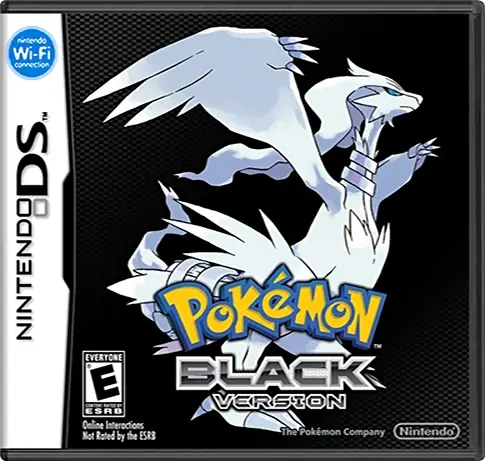
Pokémon Black and White are role-playing video games with adventure elements, presented in a third-person, overhead perspective. There are three basic screens: an overworld, in which the player navigates the main character; a battle screen; and the menu, in which the player configures their party, items, or gameplay settings. The player controls a Pokémon Trainer who begins the game with a single Pokémon and is able to capture more using Poké Balls. Like all other Trainers, the player can carry up to six Pokémon at one time.
However, the game also includes a network of PCs to store hundreds of Pokémon. PCs are found in certain buildings called Pokémon Centers, where the player can heal their Pokémon when they have low health or have fainted.
Pokémon can learn up to four moves, including attacking moves, healing moves, and moves that inflict status conditions on the opponent. They have six stats that affect battle performance: maximum hit points (HP), Attack, Defense, Special Attack, Special Defense, and Speed. Attack and Special Attack are distinguished from Defense and Special Defense by the types of moves being considered: generally, moves involving physical exertion are physical, while moves involving supernatural or elemental powers are special. Moves are classed as one of seventeen types: Normal, Water, Grass, Fire, Electric, Ghost, Bug, Fighting, Ice, Steel, Rock, Poison, Psychic, Dark, Dragon, Ground, and Flying; Pokémon can have one or two types.
Generally, most of a Pokémon's moves correspond to its typing. A Pokémon's type makes it vulnerable or resistant to others; for example, Fire-type Pokémon are weak to Water-type moves, while Grass-type moves do little damage to them and Electric-type moves do normal damage.
When the player encounters a wild Pokémon or is challenged by another Trainer to a battle, the screen switches to a turn-based battle screen where the Pokémon fight. During the battle, the player may use a move, use an item, switch the active Pokémon, or flee. However, the player cannot flee a battle against another Trainer or against certain wild Pokémon that are stronger than the player's. When a Pokémon's HP is reduced to zero, it faints until it is revived.
If an opposing Pokémon faints, all of the player's Pokémon who participated in defeating it receive experience points. After accumulating enough experience points, a Pokémon may level up, increasing its stats. Many Pokémon evolve into other forms after certain conditions are met, usually after reaching a certain level threshold or by having a certain item used on them. At the "Day Care" location, the player can breed two of their Pokémon—usually, a male and a female—to create Eggs that hatch into baby Pokémon at level 1.
Pokémon Black and White takes place in the Unova region, based on New York City. As with all regions, Unova consists of a number of cities and towns connected by "Routes". Random encounters may take place in tall grass along routes or in bodies of water. The player occasionally battles Trainers in cities and towns, as well as along routes.
In addition, eight of the game's cities and towns are homes to "Gym Leaders", powerful Trainers specializing in certain types of Pokémon; beating a Gym Leader gives the player a "Badge". All eight Badges are needed to unlock the Pokémon League, where the player faces off against the "Elite Four" and, finally, the Champion. Across Unova, items can be found on the ground or purchased from "Poké Marts". For example, Hyper Potions restore HP, Antidotes cure poisoning, and Revives revitalize fainted Pokémon.
TMs (Technical Machines) teach moves to Pokémon, and HMs (Hidden Machines) are a special class of TMs for important moves that allow the player to traverse the environment. The "Surf" HM move, for example, is used to cross bodies of water.
The graphics have been improved from Diamond and Pearl. The dialog boxes of previous games have been changed to speech balloons that appear over other characters' heads, allowing more than one character to speak at once. Japanese players can have kanji appear on screen, rather than only hiragana and katakana. During battles, the sprites of the Pokémon are fully animated and the camera changes position to highlight specific parts of the battle.
In addition to continuing the day and night cycle introduced in Gold and Silver, Black and White introduces a seasonal cycle, with the seasons advancing every month rather than being linked to the calendar. Outside areas appear differently depending on the season, such as changing of leaves in autumn or snow on the ground in winter. Certain areas are only accessible during certain seasons, and different Pokémon can be found in the wild in winter where others are encountered in the other seasons. The Pokémon Deerling and Sawsbuck change their physical appearance to match the seasons.
There are two new battle mechanics: Triple Battles and Rotation Battles. In Triple Battles, both teams must send out three Pokémon in a row at once; Some moves only allow Pokémon on the left or right side to attack the opponent's Pokémon on the same side or in the center. Changing position takes up one turn. In Rotation Battles, each side sends out three Pokémon at once, but they are arranged in a circle that can be rotated at will.
Black has more Rotation Battles than Triple Battles, and the opposite is true in White. Another introduction is Combination Moves: a starter Pokémon can be taught one of three moves, and using them together in Double or Triple battles produces more powerful attacks. In the wild, walking through darker-colored tall grass can trigger Double Battles against wild Pokémon rather than only Single Battles with lighter-colored grass.
Occasionally, the player can find rustling patches of grass and rippling water, where they can encounter either a rare Pokémon, a Pokémon more common in the opposite game version, or the highest evolutionary form of a Pokémon whose lower forms can normally
Story
Black and White are set in the Unova Region, part of a continental mass located far away from the previous regions, Kanto, Johto, Hoenn, and Sinnoh. Unlike the previous regions which were based on real locations in Japan, Unova is modeled after New York City, an idea developed by game director Junichi Masuda when he visited the city for the launch of Diamond and Pearl. One particular example of this is Castelia City, which serves as the region's central metropolis and had such inspirations as Skyarrow Bridge its "Brooklyn Bridge-style suspension bridge" and its "huge skyscrapers". Masuda also wanted to convey a "feeling of communities" in Castelia's streets.
Unova is host to large urban areas, a harbor, an airport, an amusement park, several bridges, and several mountain ranges. In addition to a diversity of new landscapes, the Unova region is also home to a diversity of people who vary in skin tone, language, and occupation. The region's Japanese name "Isshu" (イッシュ) is derived from the Japanese words tashu (多種, meaning "many kinds") and isshu (一種, meaning "one kind"); the many kinds of people and Pokémon seen up close look like only one kind of life from afar.
Like previous Pokémon games, Black and White both follow a linear storyline; the main events occur in a fixed order. The protagonist of Pokémon Black and White is Hilbert or Hilda (depending on whether the player chooses to play as a boy or a girl), who journeys through Unova to become a Pokémon Master. At the beginning of the games, the player chooses either Snivy, Tepig, or Oshawott as their Starter Pokémon as a gift from Professor Aurea Juniper. The protagonist's friends, Cheren and Bianca, are also rival Pokémon Trainers who occasionally battle the player; Cheren will choose the Pokémon with a type advantage against the player's, while Bianca will choose the Pokémon with a type disadvantage. The player's primary goal is to obtain the eight Gym Badges of Unova and ultimately challenge the Elite Four and the Unova League Champion to complete the main story.
In addition to the standard gameplay, the player will also have to defeat the games' main antagonist force, Team Plasma, a Knights Templar-esque group who claim that Pokémon are oppressed by humanity and seek to liberate them from their trainers. Team Plasma is led by N, a young man who was brought up alongside Pokémon and sees them as friends rather than tools for sport. Throughout the game, the player has some encounters with N, who claims that by capturing one of the Legendary Pokémon (Reshiram and Zekrom) of Unova and defeating the Unova League Champion Alder, he will be recognized as Unova's hero and will be able to convince the humans to part with their Pokémon. Depending on the game version, N will capture Reshiram in White or Zekrom in Black.
After the player defeats the Elite Four and enters the Unova League Champion's chamber, he or she finds that N has defeated Alder and become the newest Unova League Champion. Soon after, he summons a large castle surrounding the Unova League, challenging the player to find him to participate in one final battle. When the player finally reaches him, Reshiram in Black or Zekrom in White appears before the player, and the player must capture the Legendary Pokémon to prove their worth before challenging N. After his defeat, N laments the possibility that his ideals are mistaken, Ghetsis intrudes and angrily reveals that his true intentions were to use N to ensure that he would be the only human left with control over Pokémon and use them to rule the world, having groomed N as a child to be a pawn.
In his rage, Ghetsis challenges the player to a true final battle. After Ghetsis's defeat, he is arrested, allowing Alder to resume his position as the Unova League Champion and pardons N. N then thanks the player for helping realize his mistake about the nature of the relationship between people and their Pokémon and wishing them well before saying goodbye and leaving the castle on his dragon of choice to a far-off land, wanting to find more about the world.
In the postgame, Looker arrives in Unova and tasks the player with finding the remaining Sages of Team Plasma, so they can be brought to justice. The player can also challenge the Elite Four once again, and challenge Alder, ultimately becoming the new Unova League Champion. The player also gains access to the eastern portion of Unova, which contains Pokémon from the previous games in the series, as well as access to an area unique to each game version: the ultra-metropolitan Black City, home to powerful Pokémon Trainers; and the White Forest, home to humans and Pokémon living in harmony. Cynthia, the former Sinnoh League Champion, is also found in this area of the game and can be challenged. A non-player character named after Shigeki Morimoto, a Game Freak programmer, creature designer, and the director of the Pokémon HeartGold and SoulSilver games, can also be found and battled in the game.
Development
On 29 January 2010, The Pokémon Company announced that a new game was in development for the Nintendo DS to be released later that year. Director Junichi Masuda stated that several aspects of the series were being revamped for the new generation. On 9 April 2010, the Japanese website updated with the titles of the versions as Pokémon Black and White and announced a Q3 2010 release date. The games feature an improved visual style from other Pokémon games, with an increased use of 3D computer graphics than any other of the handheld series. It also has a special feature that allows the user to upload their saved game to the Internet, allowing them to do certain things on an official website.
On 3 August 2010, Masuda announced on his blog that the Black and White game versions will initially only contain brand-new Pokémon to evoke a feeling of it being a brand-new game, like when the original Pokémon games were first released. In all of the games following the first generation, there were a series of new Pokémon introduced interspersed with Pokémon from the previous generations. For example, Pikachu was introduced in Red and Green and was obtainable in Blue, Yellow and all subsequent main series games; however, Pikachu will not be obtainable in Black and White from the start of the game.
It was later confirmed that Black and White are region locked on the Nintendo DSi and 3DS.
Game director and composer Junichi Masuda stated that to keep the games fresh, he looks at every previous element to decide what to adapt to the new game, stating "people may not like what they like in the past, trend wise". He explained the new battle styles, stating that while triple battles take more strategy, rotation battles take more luck to win. Masuda stated that their goal when making the games was to make it fun for new players, but they also wanted to get players who have not played the series in a while to come back. He said that it was hard to find that balance to satisfy both kinds of players.
For the new players, there is good explanation in how to play, while for old players, they incorporated the C-Gear, which makes the ability to trade and battle easier. When asked about the decision to introduce over 150 new species of Pokémon, Masuda stated that they did this so old players would not be able to know what is a good Pokémon to use, and it would level the playing ground for new players.
Nintendo DS Pokémon Black · White Super Music Collection is a four-disc soundtrack featuring the games' music scored by Masuda, Go Ichinose, Shota Kageyama, Hitomi Sato, Morikazu Aoki, Minako Adachi, and Satoshi Nohara. The soundtrack was released on 20 October 2010, in Japan. Ichinose was in charge of directing all Pokémon voices for the game while Adachi produced all sound effects.
Reception
Pokémon Black and White have received largely positive reviews by critics, having an aggregate score of 87% on Metacritic, indicating "generally favorable reviews". Japanese magazine Famitsu Weekly awarded the game a perfect 40/40 score, becoming the 15th game to receive such a distinction, as well as obtaining the highest score ever given to a Pokémon video game by the publication. Game Informer's Annette Gonzalez remarked that "Pokémon Black and White do a great job building upon already solid features and taking them to the next level." com's Jamin Smith criticized the games for not innovating as much as some people would have liked, but stated that "rest assured in the knowledge that Black and White are damn fine games; the best the series has to offer."
Official Nintendo Magazine referred to them as "A beautiful refinement of a great series [...] the best Pokémon ever." Nintendo Power expressed that "the Pokémon series's latest pair of adventures is as addictive as ever." Edge acknowledged that "where next for Pokémon, Black and White don't suggest any answers, but they do remind us why we'd care in the first place."
IGN gave the games a 9/10, a higher rating than any of the other Nintendo DS Pokémon games. The review praised the games for renewing interest in the series, though criticized some of the new Pokémon designs, explaining that "aside from a weaker lineup of monsters (largely an aesthetic complaint), this is the best Pokémon has to offer on every level, renewing my waning interest in monster battling". Jeremy Parish of Retronauts criticized Black and White, commenting that he grew tired of it shortly after starting and feeling like it was too similar to all previous Pokémon games. He further went on to say that EVs and IVs, invisible mechanics in the game, are not necessarily beneficial.
By contrast, he noted that it would be great to new players. He also compared it to the Pokémon Mystery Dungeon games and Final Fantasy XIII, arguing that they all share the common element of being bad before they get good. Fellow Retronauts contributor Justin Haywald criticized the games' release on the DS, which had received two main Pokémon series games published before them. GamesRadar editor Carolyn Gudmundson stated "It may not break the Pokemon mold, but Black and White offers enough new content coupled with the series' classic, deep battle mechanics to make it endlessly playable.
If you could only play one game for the rest of your life, this would be a wise choice."
In August 2010, one month before the games' release in Japan, Pokémon Black and White gained a total of 1.08 million pre-orders, becoming the fastest game on the Nintendo DS to break the 1 million mark. In the first two days on sale, it sold more than 2.6 million copies, becoming the biggest launch in the series history in Japan. By 3 November, the games had sold over 4.3 million copies in Japan. As of 9 January 2011, the games became the fastest DS titles to sell 5 million copies.
Upon its release in the UK, White and Black took the #1 and #2 spots respectively in the UK overall sales charts, with White becoming the second fastest-selling DS game ever in the UK after Professor Layton and Pandora's Box, selling 13,000 more copies than Black. Combined, their sales became Nintendo's third biggest ever launch in the UK, behind Wii Fit and Mario Kart Wii, and the biggest opening weekend ever for a pair of Pokémon titles.
In the US, Black and White sold more than 1.08 million copies on day one, breaking the previous day-one record held by predecessors Diamond and Pearl of 780,000 copies. According to the NPD Group, Nintendo sold 1.3 million units of White and 1.1 million units of Black in March 2011, making them the #1 and #2 top selling games in the US for the month. In April 2011, Nintendo's financial earnings report confirmed that Pokémon Black and White had sold 11.5 million copies worldwide, making them the highest selling DS games for Nintendo in the 2010–11 financial year, and third overall, behind only the Wii games, Wii Sports and Wii Sports Resort. As of September 2017, the games' combined sales have reached 15.64 million.
Legacy
Sequels to Black and White, Pokémon Black 2 and Pokémon White 2, were released for the Nintendo DS in 2012.
The second part of the Pokémon Scarlet and Violet DLC The Hidden Treasure of Area Zero takes place in the Blueberry Academy, a terrarium off the coast of Unova.