
The articlegameplay, story, development, reception
Gameplay
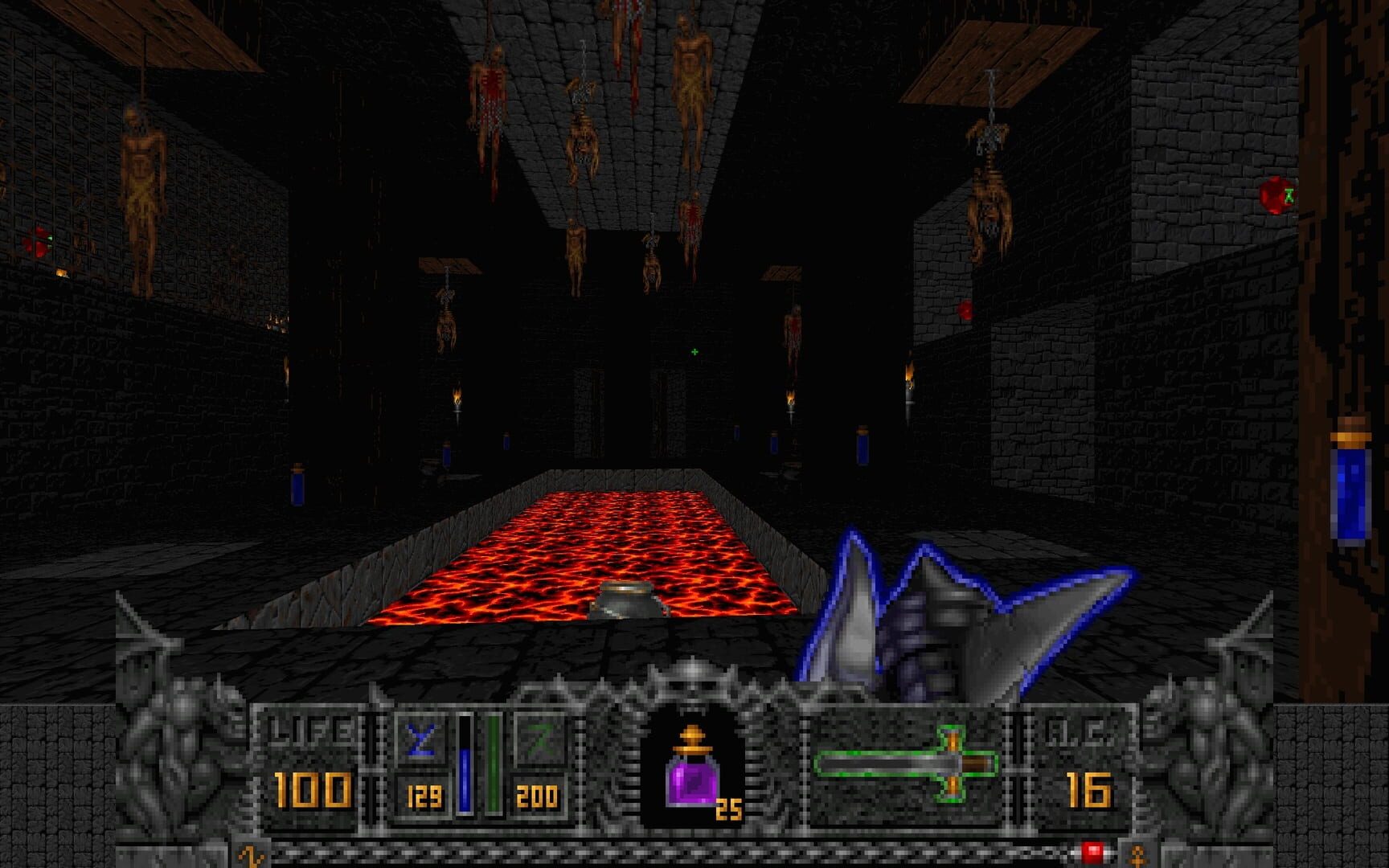
A new series feature introduced in Hexen is the choice of three character classes. Players may choose to play as a fighter (Baratus), a cleric (Parias), or a mage (Daedolon). Each character has unique weapons and physical characteristics, lending an additional degree of variety and replay value to the game. The Fighter relies mainly on close-quarters physical attacks with weapons both mundane and magical in nature, and is tougher and faster than the other characters.
The Mage uses an assortment of long-range spells, whose reach is counterbalanced by the fact that he is the most fragile and slowest moving of the classes. The Cleric arms himself with a combination of both melee and ranged capabilities, being a middle ground of sorts between the other two classes. Additionally, certain items, such as the flechette (poison gas bomb), behave differently when collected and used by each of the classes, functioning in a manner better suiting their varying approach to combat.
Story
Following the tale of D'Sparil's defeat in Heretic, Hexen takes place in another realm, Cronos, which is besieged by the second of the three Serpent Riders, Korax. Three heroes set out to destroy Korax. The player assumes the role of one such hero. Throughout the course of his quest, he travels through elemental dungeons, a wilderness region, a mountainside seminary, a large castle, and finally a necropolis, before the final showdown with the Serpent Rider.
Development
Like Heretic, Hexen was developed on NeXTSTEP. Hexen uses a modified version of the Doom engine, which allows jumping, looking up and down, network play with up to eight players and the choice of three character classes. It also popularized the "hub system" of level progression in the genre of first-person shooter games. Unlike previous games, which had relied purely on General MIDI for music, Hexen is also able to play tracks from a CD.
The game's own CD contained a soundtrack in an audio format that was exactly the same as the MIDI soundtrack, but played through a high-quality sound module. However, the most significant improvement was the addition of wall translation, rotation, and level scripting.
Reception
Heretic and Hexen shipped a combined total of roughly 1 million units to retailers by August 1997. Individually, the game sold over 250,000 copies.
Reviewing the PC version, Maximum remarked that Hexen sets itself apart from other "3D slashers" with its selection of characters and novel approach to level design, which "leads to your character choosing their path rather than being guided around a rather linear series of rooms, proving that 3D games have matured". They also commented that the gameplay is consistently intense due to the difficulty of the enemies, the variety of weapons and power-ups, and the sheer size and breadth of the levels. They gave the game 5 out of 5 stars and their "Maximum Game of the Month" award. A reviewer for Next Generation opined that "Hexen takes everything that was good about Heretic, and makes it even better."


