
The articlegameplay, story, development, reception
Gameplay
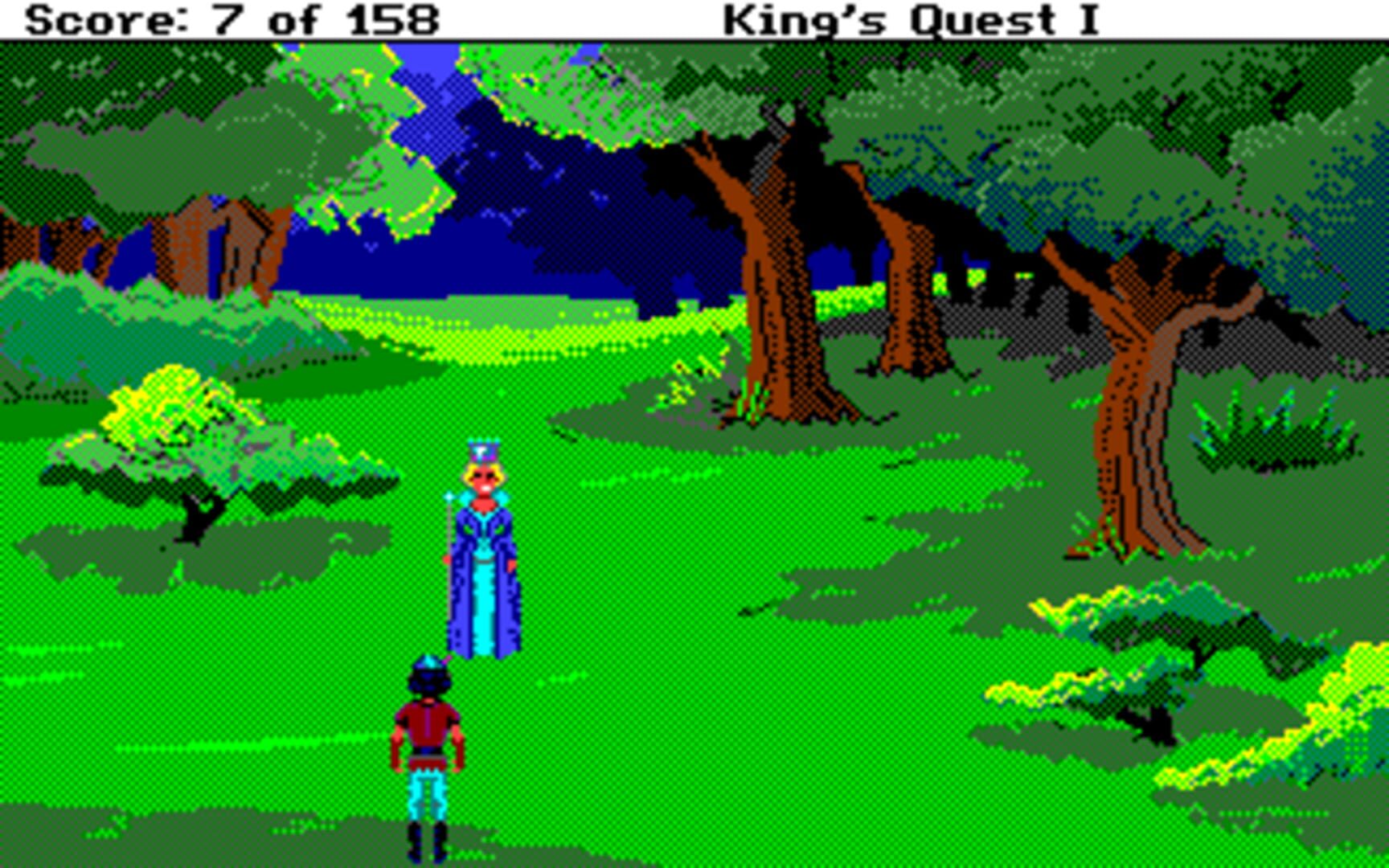
King's Quest is an adventure game set in the pseudo-medieval fairy tale-inspired fantasy realm of Daventry, in which the player controls the character Sir Graham to complete a quest for three magical items. The game world is divided into dozens of locations, or flip-screens, with one location visible at a time. These locations are presented in pseudo-3D as if viewed from the side, with the player moving Graham around the screen in front of and behind other elements of the location.
In addition to moving Graham, the player can interact with the objects, obstacles, and creatures within the location. , "use key on lock"). The allowable commands are contextual to where Graham is standing in the location the player is in; for example, "get stone" only has an effect if Graham is standing in a part of a screen where there is a stone present. Some locations have, sometimes randomly, other characters which, if they come near Graham, can take items, move Graham to a new location, or kill him.
Story
The original release version of the game has a minimal story, mostly told through the game's manual. The Kingdom of Daventry is suffering from recent disasters and hardship. King Edward calls his bravest knight, Sir Grahame, to his throne and tells him he has heard of three legendary treasures hidden throughout the land that would end Daventry's troubles if found: a mirror that shows the future, a shield that protects the bearer from all harm, and a never-ending chest of gold. If Grahame succeeds, he will become the new king.
In later releases, Grahame was renamed to Graham, and the backstory in the manual was expanded; that expansion was brought into the game in the 1990 King's Quest I: Quest for the Crown remake. King Edward the Benevolent was tricked three times in his reign by magical beings who stole the precious magical items of the kingdom, causing the kingdom to fall into ruin. At the end of his life, the dying King Edward sends for his bravest knight, Sir Graham, to retrieve the three lost treasures. As the king has no heir, if Graham succeeds, he will become the next king.
Development
Sierra On-Line was founded in 1979 by Roberta and Ken Williams as On-Line Systems, and over the next few years released several successful adventure video games while growing to nearly a hundred employees with US$10 million in revenue. In late 1982, it was approached by IBM to develop a graphical adventure game that would showcase the graphical capabilities of the upcoming IBM PCjr home computer, similar to Sierra's Wizard and the Princess (1980), but with animation and more complex graphics that would not be possible on systems like the Apple II. Sierra agreed; Roberta had already wanted to build on her experience with The Wizard and the Princess with a fully animated adventure game, in a pseudo-3D world. The PCjr supported 16-color Color Graphics Adapter (CGA) graphics, and had more computer memory than most previous home computers, which had limited adventure games to static images.
Sierra spent 18 months on the game, with Roberta as designer alongside a team of 6 programmers and artists. With funding from IBM of US$700,000 (equivalent to about $2,300,000 in 2025), it was the most expensive title Sierra had developed to date. IBM demanded secrecy about the project; Sierra referred to it as "BFC" in documents and never saw a PCjr prior to launch, instead using modified IBM PCs.
Reception
By 1986, Sierra reported that the game had sold over 100,000 copies, and by mid-1987 the combined sales of the game and its first two sequels surpassed 500,000. Retrospective reports have called it a bestseller, despite the commercial failure of the PCjr, due to the numerous ports to other platforms.
Reviews of the game were generally positive, and particularly so about the gameplay. A review by Computer Games called it a "revolutionary breakthrough", and Electronic Games similarly said it was a "positive revelation". Reviewers primarily focused on the advances of adding animation and graphics to adventure games, which previously had largely been text-based or relied on static images; Compute! praised the innovation and Family Computing said it was a "giant leap forward".
Legacy
Roberta Williams considers King's Quest to be the real beginning of Sierra as a company, as it formed the core of the kinds of games Sierra wanted to make. The game has also been credited with saving the company: a few months after starting on the project, the video game crash of 1983 eliminated much of the company's revenue. Sierra downsized to 30 employees and was in danger of closing. The funding for King's Quest from IBM not only helped keep the company going, but development showcases of the project convinced IBM to invest in additional games and software projects with Sierra, allowing it to re-hire many of the employees it had lost.
The reputation effects with retailers from having worked with IBM helped Sierra gain access to stores like ComputerLand that had been hesitant to sell games, and along with the reuse of the AGI engine for projects like the next few King's Quest games and The Black Cauldron (1985) led to success for the company in the following years. The series includes a further seven games by Sierra, beginning with King's Quest II in 1985 and concluding with King's Quest: Mask of Eternity in 1998.


