
The articlegameplay, story, development, reception
Gameplay
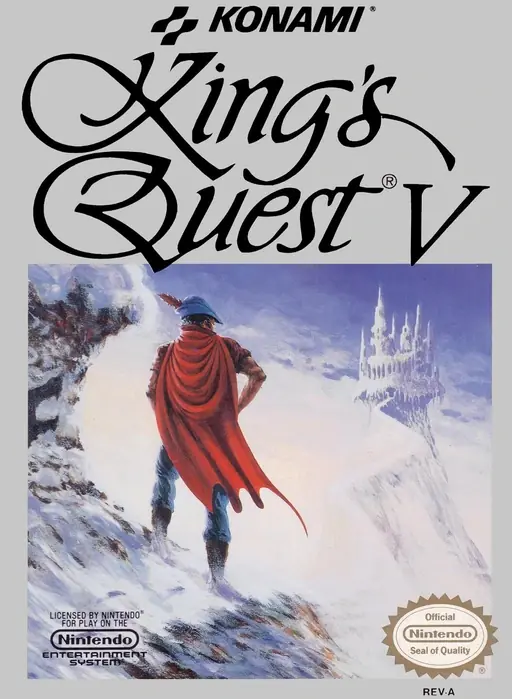
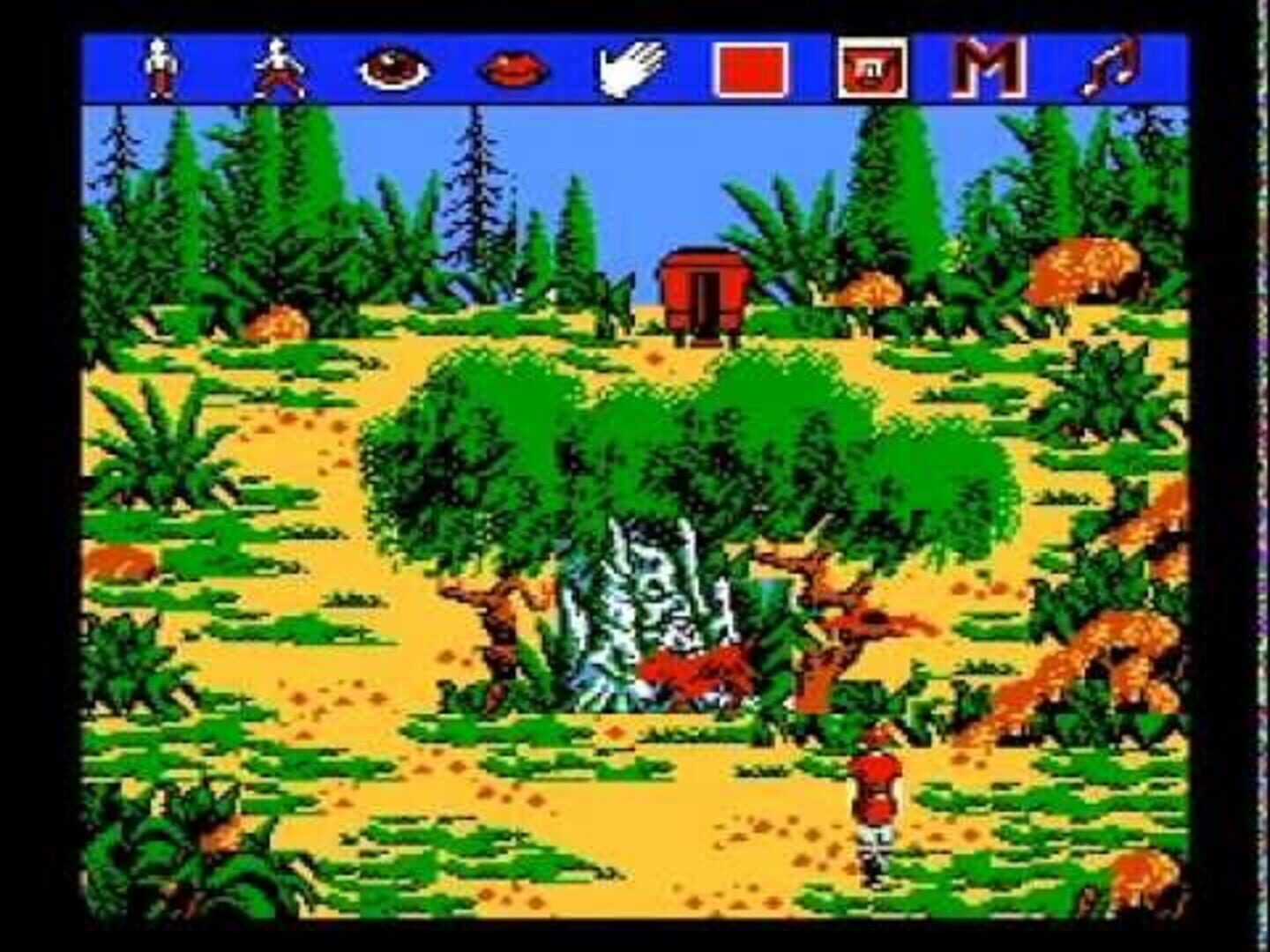
King's Quest V is a single-player adventure game set in the pseudo-medieval fairy tale-inspired realm of Serenia, in which the player controls the character King Graham to rescue his family from the wizard Mordack. The game world is divided into dozens of locations, or flip-screens, with one location visible at a time. These locations are presented in pseudo-3D as if viewed from the side, with the player moving Graham around the screen in front of and behind other elements of the location.
In addition to moving Graham, the player can interact with the objects, obstacles, and creatures within the location. This is done using an icon-based point-and-click interface: the player selects the walk icon and then a location to move Graham, an eye icon to be given a description of items or locations clicked on, or a hand icon to interact with an object. Many items can be taken and put in the player's inventory; most are used to solve puzzles or unlock new locations. The inventory icon lets the player use items contextually on an element of the screen.
Story
King Graham of Daventry returns from a walk in the forest to find his castle, and family within, have mysteriously disappeared. A talking owl named Cedric flies to him and explains that the evil wizard Mordack used magic to pull the castle out of the ground and send it flying through the sky, though he does not know why. Seeking to help him, Cedric uses fairy dust to fly Graham to his employer, the good wizard Crispin, in the land of Serenia. There, Crispin provides him with his old, weak wand and a piece of whitesnake, which allows its user to speak with animals and the natural world. He also orders Cedric to accompany Graham on his quest and lead him to Mordack.
While exploring Serenia, including a town, a dark forest, and a desert, and helping its inhabitants, Graham meets with a traveling fortune teller, who shows him a vision of his family shrunken and imprisoned within Mordack's castle. From the vision, Graham learns that Mordack is the brother of the wizard Manannan, whom his son Prince Alexander once turned into a cat. He also hears Mordack explain to Alexander that the spell can only be reversed by the one who cast it, and thus he kidnapped Graham's family in order to force Alexander to undo it. Alexander does not know how to do so, however, even though Mordack threatens to feed his hostages to Manannan.
Development
Sierra On-Line was founded in 1979 by Roberta and Ken Williams as On-Line Systems, and in 1984 released King's Quest, later termed King's Quest I, with Roberta Williams as designer alongside a team of six programmers and artists. She made the game world as a blend of common fairy tales that could be directly experienced as a game. It was followed by three sequels between 1985 and 1988, and after their release Sierra began working on a fifth title in the series.
The first three games in the series had used the same engine for the game to interpret and react to player inputs called the Adventure Game Interpreter (AGI), and for King's Quest IV Sierra had developed a new adventure game engine, the Sierra Creative Interpreter (SCI). The new engine allowed for higher quality animation and higher-resolution graphics, and additionally added support for sound cards which could provide more realistic sound effects and music, but like the AGI, all input was text-based. For King's Quest V, the SCI engine was enhanced to replace the text-based parser with an icon-based point-and-click interface. The game was designed by Roberta Williams, and built by a team of around fifty people over ten months, with Bill Davis as the creative director. It was Sierra's first game to have a development budget of over US$1,000,000 (equivalent to $2,464,340 in 2025).
Reception
King's Quest V was the best-selling computer game of January and February 1991, according to the Software Publishers Association, and remained in the top ten to the end of the year. It sold 300,000 copies by early 1992 according to Sierra, with Computer Gaming World confirming in February 1993 that the game had been certified by the Software Publishers Association as having sold more than 250,000 copies. By November 2000, PC Data reported that King's Quest V's sales in the United States alone had reached between 300,000 and 400,000 units. Prior to the 1992 release of King's Quest VI, Sierra said that the series had reached 1.5 million sales overall, which it claimed was the most of any computer adventure game series.
Opinions on the gameplay were mixed. Scorpia of Computer Gaming World said that the puzzles were easy and could be brute forced by trying every item in the player's inventory, but found frustrating the puzzles that required quick reactions or where a wrong choice or direction would instantly kill Graham, especially in the desert. Matt Regan of CU Amiga similarly said that the game's puzzles were a mix of trivial and impossible. The reviewer for Dragon, Leslie Mizell of Game Players, and Paul Presley of The One Amiga found the game challenging and good for players of multiple skill levels.
Legacy
According to Sierra On-Line, combined sales of the King's Quest series surpassed 3.8 million units by the end of March 1996. King's Quest V won "Best Fantasy Role-Playing/Adventure Program" at the Software Publishers Association awards in 1991. Computer Gaming World named the game as its 1991 Adventure Game of the Year, and in 1992 named it to the magazine's Hall of Fame for games readers rated highly over time. In 1996 it named King's Quest V the 94th best game ever.
The King's Quest series, which has been described as Sierra's "flagship series", includes a further three games by Sierra, beginning with King's Quest VI in 1992 and concluding with King's Quest: Mask of Eternity in 1998. King's Quest V has been released in several collections of games in the series in the 1990s and 2000s. It is also included in the modern King's Quest Collection on Steam and the King's Quest 4+5+6 collection released on GOG. In 1988, Silicon Valley Books published The King's Quest Companion, a combination hint guide and novelization by Peter Spear of the games in the series. Updated editions were released through 1997 as further games were released in the series.