
The articlegameplay, story, development, reception
Gameplay
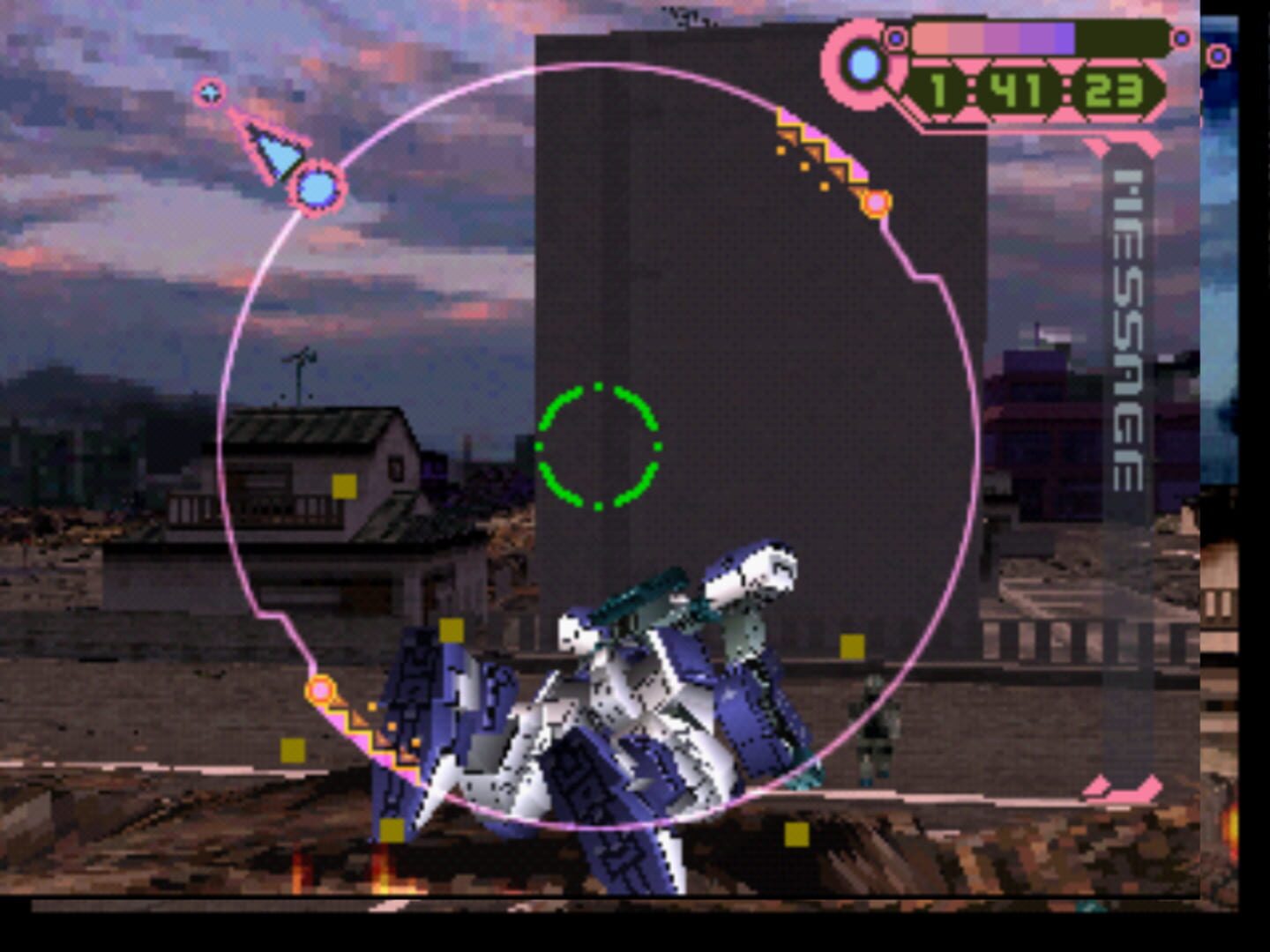
Love & Destroy is a third-person shooter consisting of a series of missions where the player uses a Battle Pod mech to eliminate either a single, large boss or a group of smaller enemies. These battles have a five-minute time limit and take place in large, 3D cityscapes through which the player can freely maneuver. The environments are highly destructible, allowing the player to demolish any building. The game supports DualShock controller functionality with the analog sticks mapped to movement and aiming.
The player can choose one of three mechs and its respective Q-Tron navigator for any mission. All of them come equipped with a basic vulcan cannon for targeting and firing at enemies from a distance, though each Battle Pod varies in speed and has a unique set of weapons. ViVi's "V-Silhouette" is the fastest but uses mostly weak, short-ranged melee attacks; LuLu's "L-Silhouette" is the slowest but uses mostly powerful, long-ranged projectiles; and KiKi's "K-Silhouette" has balanced speed and uses medium-ranged lasers that deal intermediate damage. One Battle Pod may present more of an advantage over another depending on the situation.
Story
The story of Love & Destroy opens in the near future when an extraterrestrial entity known as "Germ" descended from the sky and began feeding off human stress, quickly spreading across Earth and leaving mass destruction in its wake. After a few decades, humanity developed measures to counter the invasion with "Battle Pod" technology. D." (Synchronized Energy of Emotive Dynamics), a system relying on positive, sympathetic emotions to effectively utilize their offensive capabilities.
This would be best accomplished when each human pilot established a romantic connection with a robotic, female navigator called a "Q-Tron." After years of fighting, the plan ultimately proved unsuccessful and humanity was nearly wiped out. In a final attempt to salvage the planet's future, a scientist sends three Q-Trons, their Battle Pods, and an instructor back in time to present day Japan, just before the appearance of the Germ. It is there that they across the unnamed player character, a male highschooler whom they rescue when the Germ initiates its attack.
Development
Love & Destroy was developed by Inti Creates. Production was led by Arc Entertainment was a division of publisher Sony Computer Entertainment that was formed in 1997 and led by Ryoji Agakawa and Akira Sato. Sony's Japan Studio assisted on development. Prior to this, the subsidiary's staff was responsible for the Arc the Lad series of PlayStation role-playing games.
The producer of those games, Agakawa, would serve the same role for Love & Destroy. Love & Destroy is the second game by Inti Creates, which was founded in 1996 by a group of former Capcom employees. It was designed by Yoshihisa Tsuda, the lead designer of the company's debut title Speed Power Gunbike. Love & Destroy was directed by Makoto Yamaguchi, who stated that the most difficult aspect of its development was his seclusion from his workers due to himself rarely bathing during long work hours.
Reception
Critical reception for Love & Destroy has been mixed. It received a score of 19 out of 40 by the Japanese gaming publication Weekly Famitsu. USgamer journalist Jeremy Parish stated, "It basically feels like everything about 'cool '90s Japan' rolled into a single video game [...] Like some sort of harem anime meets Neon Genesis Evangelion meets Omega Boost."
GameSpot contributor James Mielke also compared its concept to Evangelion, equated its shooter gameplay to Armored Core, was impressed by its sense of scale, and described the game as "an impressive piece of software that, while not perfect, offers up some hectic fighting action." Bruno Sol of the Spanish magazine Superjuegos was less fond of the graphics and control in the battle portion, mentioning they did not live up Arc Entertainment's previous game The Granstream Saga. He admired the animation during the cutscenes and thought that the dating segments were the game's more interesting aspect, likening them to Tokimeki Memorial: Forever With You and the Yarudora series. Sol felt that Katsura's character designs did not meet the mangaka's standards, but speculated that they would be appreciated by the artist's fans nonetheless.


