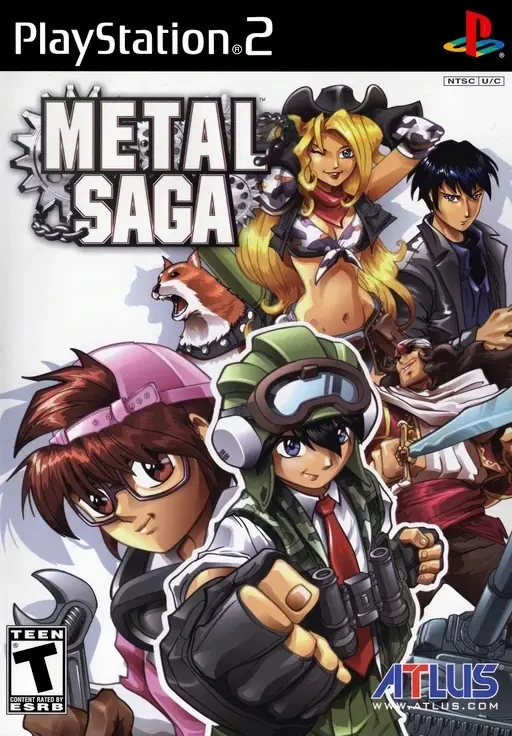
The articlegameplay, story, development, reception
Gameplay
The game mechanics are similar to that of most role-playing video games. Players travel between points of interest on an overworld map, during which point in time they can be attacked by randomly encountered foes. Within towns, players can rest, repair vehicles, sell items, and other typical activities. The "dungeons" in the title are usually caves or abandoned buildings. Such hostile locations are relatively small, with much of their complexity being due to their maze-like nature (and the lack of an auto-mapping feature).
, characters on foot are faster than those in tanks). Any canine member of the party acts on his or her own, automatically attacking foes at random. For the remaining characters, players choose among a limited number of actions. While characters do have some skills which can be used during combat, these cost money to use (rather than using a separate mana/skill point pool) and often cannot be used when within a tank.
Story
The title takes place in a post-apocalyptic world, though presenting a less serious take on the genre, compared to the harsher representations seen in role-playing games such as Final Fantasy VI or Fallout, or films such as Mad Max or Nausicaa. The environment of Metal Saga seems to be relatively unscathed, with a generally healthy ecosystem and no apparent areas of radioactive contamination, perhaps since the apocalypse (referred to as the Great Destruction) happened in the first place in an attempt to destroy humanity to actually save the planet. Rather than focusing extensively on mutants and ruffians, many of the enemies encountered are merely machines gone haywire. As a result, scavenging such machines and using scavenged parts to build equipment appear to be common activities.
Additionally, the game includes a good dose of militaristic qualities, with most of the game's battles being fought from within tanks, or other tank-like armored vehicles. In essence, the game has very little storyline and mostly non-linear gameplay. Like its predecessors, one may choose to take on whichever informal quests one wants, or none at all, but cannot choose to slaughter the entire population of a town on a whim. The title features more than half a dozen possible endings, several of which can be obtained less than an hour into the game. One ending can even be obtained minutes into the game, making it the shortest possible RPG.
Development
Since the first game was published in 1991 by Data East, the series was famous for having a "high degree of freedom". However, in 2003, Data East became bankrupt, and the trademark "Metal Max" was registered by Shinjuku Express, so this entry of the series had to use a new trademark — "Metal Saga". The series' producer, Hiroshi Miyaoka was not involved in the development from the beginning and said: "I thought that I could not make Metal Max anymore, I thought I was really dying".
The game was published in June 2005 in Japan, and in March 2006, a "Best" version of the game was published and was cheaper than the original. The game received a Lite/Demo version that was published in North America in April 2006.
Reception
Although the game's sense of humor, music and solid hours of gameplay won it some positive marks, the overall impression of the title was decidedly mediocre. Reviewers scoffed at the dated graphics, lack of plot, and missing feeling of progression. As a result, a considerable amount of time was often spent by reviewers and gamers alike simply wandering around, trying to figure out what to do next. While the game had all the classic trappings for the genre, complete with its own quirky style, it seemed to lack the polish required to stand-out. GameSpot noted that "Metal Saga has the makings of a good role-playing game, but there's nothing to tie it all together".
In Japan, Metal Saga received a respectable 30 out of 40 from Famitsu magazine. Media Create reported that it was the top selling game in Japan during its week of release at 63,219 copies. By the end of 2005, the Japanese version of the game had sold 99,374 copies in the region.