The articlegameplay, story, development, reception
Gameplay
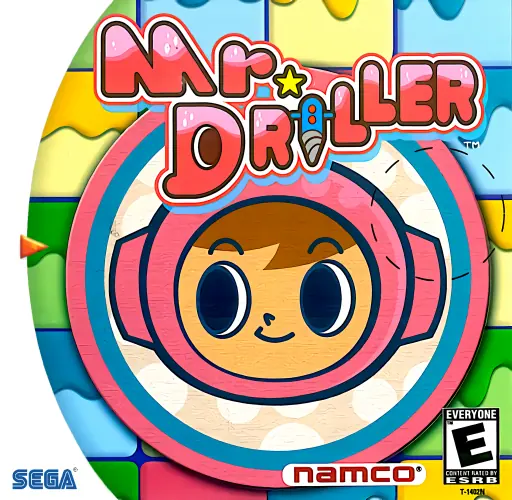
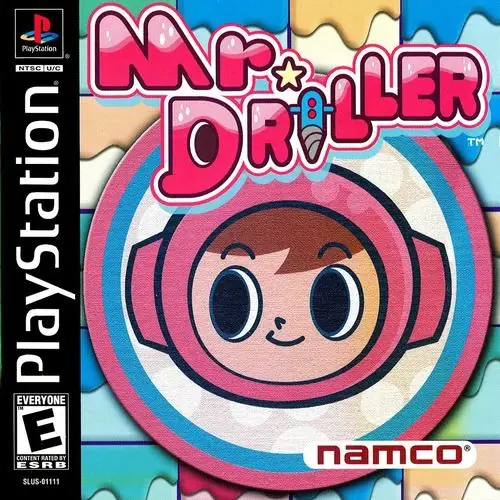
Mr. Driller is a puzzle video game, commonly described as a mix between Dig Dug and Columns. The player controls Susumu Hori, the titular "Mr. Driller", who must destroy all of the piling-up blocks before they take over the city of Downtown.
The objective is to make it to the bottom of the stage by destroying, or "drilling", colored blocks that litter the playfield. Susumu can move left and right to drill surrounding blocks, and can also jump up a block next to him by moving against it. Blocks can also be cleared if four or more touch each other, which can be used to cause chain reactions. Blocks will also fall if there is nothing underneath to support them, which can crush Susumu and lose a life if he is under them.
Susumu has an oxygen meter at the right-hand side of the screen, which constantly depletes as the game progresses — he can replenish 20% of his oxygen meter by collecting air capsules found throughout the game. The player will lose a life if his meter reaches 0%. If Susumu drills brown "X-Blocks", which take five hits to destroy, they will release toxic gases and drain 20% of his oxygen meter. If his oxygen drops below 30%, he will begin gasping for air, his face will turn blue, a skull-and-crossbones symbol will appear over his head, and an alarm will go off as a warning sign.
The home console versions of the game add two new game modes, a "Time Attack" mode where Susumu must constantly collect clocks to reduce his elapsed time, and a "Survival Mode" where the player must drill as much as they can before dying.
Development
Mr. Driller was designed by Yasuhito Nagaoka and produced by Hideo Yoshizawa, the latter being known for his work on the Ninja Gaiden series for Tecmo. Nagaoka based the concept of Mr. Driller on a Japanese children's game, where at a beach players had to stand a piece of wood in the middle of the sand and carve away the sand without knocking down the wood.
The idea of a person being in the sand pile instead of the wood intrigued Nagaoka, who believed it made for an interesting game idea. He also based Mr. Driller on Dig Dug, a classic Namco arcade game from 1982. , a tall and lanky character intended as the son of Dig Dug protagonist Taizo Hori.
Nagaoka was designing Dig Dug 3 as a title for home consoles, as arcades at the time were dominated by fighting games.
When Nagaoka showed the prototype game to Yoshizawa, he became immediately interested and joined the project as its producer. Yoshizawa convinced Nagaoka to make Dig Dug 3 an arcade game, believing it would become lost in a crowded home console market. Several changes were made when Yoshizawa joined the project, which included a faster pace, a new player character, and the game being renamed to Mr. Driller.
The characters and graphical style were designed by Namco artist Kaori Shinozaki, who had previously assisted in production of Klonoa: Door to Phantomile and LiberoGrande. Shinozaki wanted the characters and look of Mr. Driller to appeal to a wide audience. She used bright, pastel colors like pink and blue to create a bright, colorful world, and designed Susumu to be cute and marketable.
The development staff for Mr. Driller designed the game before they ever pitched it to Namco executives, and planned out a location test without any idea how well the game would perform. The game's development cycle, which Yoshizawa described as "the opposite of the typical game development and sales pitch", lead to a lengthy process that ended with the game being pitched directly to Masaya Nakamura, the president and executive chairman of Namco. His approval of the game lead to him being mentioned in the end credits.
Minoru Sashida, a graphic designer for games such as Techno Drive and Ace Combat 3: Electrosphere, designed the graphical interface and the overall look of the game.
The soundtrack for Mr. Driller was composed by Go Shiina, a then-new hire for Namco. As the company's other composers were more interested in working on larger franchises, Shiina was assigned to be the composer for Mr. Driller as nobody else signed on.
Shiina is known for his strange and unusual-sounding soundtracks, which Yoshizawa felt was a perfect fit for the game's style. He originally made the music sound like "pretty normal puzzle game music", which Yoshizawa rejected and encouraged him to do whatever he pleased for the music. When the finished product was presented to the sales department of Namco, executives estimated that 3,000 units had to be sold in order for the game to turn a profit.
Reception
The PlayStation, Dreamcast, PC and mobile versions received favorable reviews, while the Game Boy Color and iOS versions received mixed reviews, according to the review aggregation website GameRankings.
The game was praised for its visuals, addictiveness and soundtrack. The arcade version had exceeded Namco's expectations, selling over 3,000 arcade units shortly after its release.
Reviewing the PlayStation version, IGN stated that it is "quirky, different, and speedy arcade fun", praising its simplistic gameplay and "quirky" graphical style. IGN also praised its soundtrack, comparing it favorably to music composed by Capcom and Konami. NextGen commended the game's layer of strategy and controls. GameSpot applauded the PlayStation port for its "refreshing" gameplay, colorful graphics and catchy music, while AllGame praised its pick-up-and-play gameplay and "clean" character graphics.
GameSpot liked the mobile phone version's portability and addictiveness, calling it "a stellar mobile port of a great game", and praised the Game Boy Color port's faithfulness to the original. IGN highly praised the Dreamcast version for its fresh gameplay idea, addictive gameplay and cute visuals.
Criticism was drawn towards the game's lack of replay value and low amount of content. IGN noted that the game was not a "long-term kinda game", saying that it was only best played in short bursts. GameSpot echoed a similar response, criticizing the PlayStation and Game Boy Color versions for lacking any sort of replay value and being a "short-lived" experience, while AllGame disliked the poor amount of content and presentation, unfavorably comparing it to Puzzle Bobble. GameSpot also criticized the PlayStation version for not having a multiplayer mode, although noted that the $20 price point made this somewhat forgivable.
The Game Boy Color version was nominated for "Best Puzzle Game" at GameSpot's Best and Worst of 2000 Awards, which went to Samba de Amigo.