
The articlegameplay, story, development, reception
Gameplay
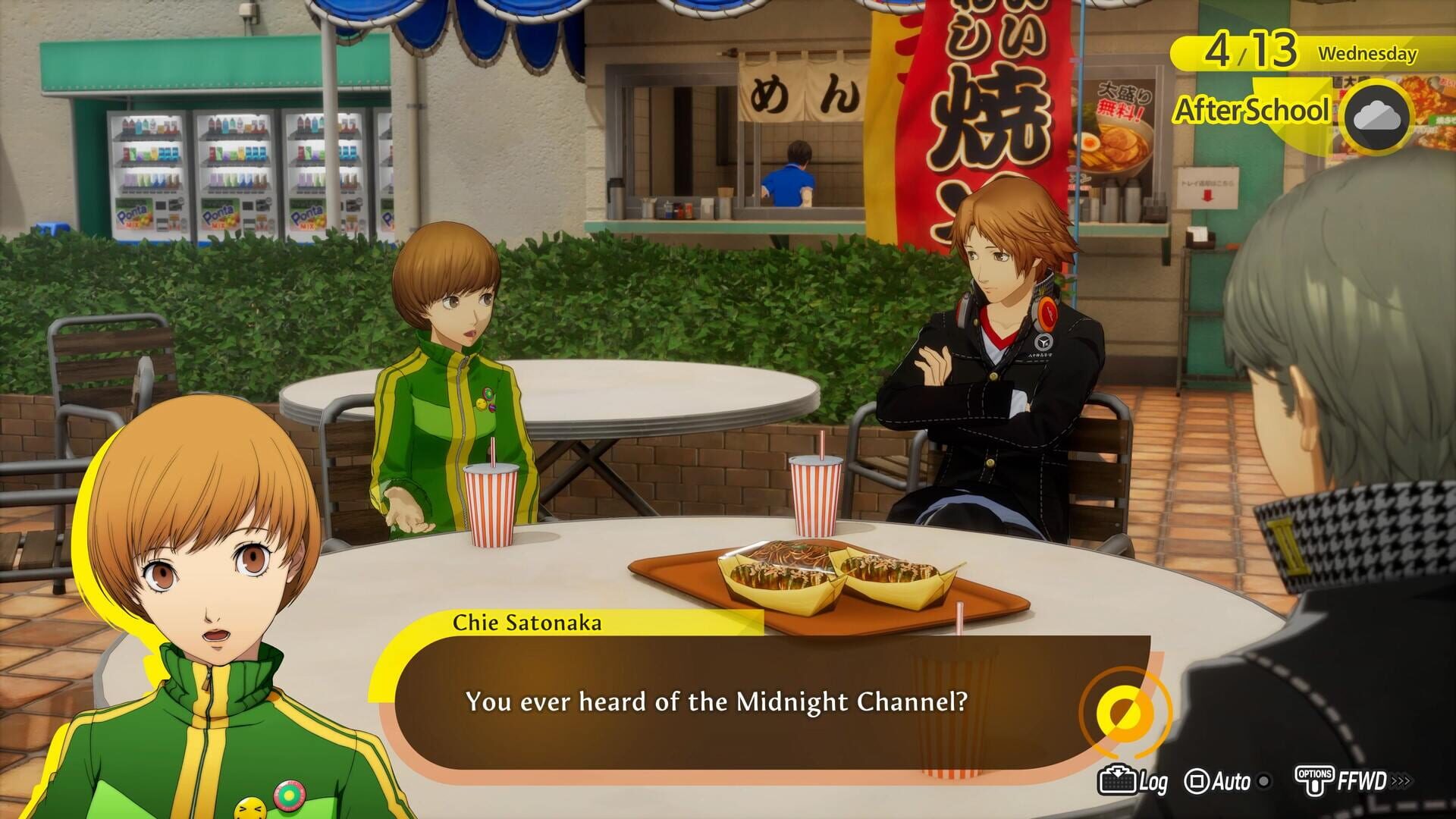
Persona 4 Revival retains the game's characteristic hybrid of traditional role-playing and social simulation gameplay, but is overhauled aesthetically, graphically, and mechanically to integrate systems and features that were created for subsequent entries since the original Persona 4's release, specifically deriving from quality-of-life improvements first implemented in Persona 5 (2016) and Royal (2019), Persona 3 Reload, and the adjacent game Metaphor: ReFantazio (both 2024). Revival is an adaptation of Persona 4 Golden, retaining that version's narrative and gameplay additions from the beginning, as opposed to Reload, which left out some of the additional content of Persona 3's enhanced releases. Among the changes to the user interface, a minimap is now displayed above the player's current area when roaming Inaba outside school, marking important locations they can visit such as shops, the job board and restaurants, among other locales. To initiate or advance Social Link routes during the daytime, the player can now view texts from the protagonist's phone as with the direct messages in Persona 5, and respond to characters who are available to meet with in a given period.
Within the TV World, the dungeons have been partially modified and enhanced with new features. When confronting Shadows, the protagonist is able to directly block their interception, leaving the Shadow open to attack whereby the player can gain a Player Advantage, or giving the party enough time to evade them, with the ability to sprint within dungeons also carrying over from Persona 5 and Persona 3 Reload. In battle, the Baton Pass ability returns from both of the aforementioned games, enabling the player to tag in other party members after exploiting an enemy's elemental weakness or landing a critical hit to continue an offensive chain. Revival introduces two new abilities during encounters. The "Send Flying" technique can be performed by any party member who attacks a Shadow inflicted with an ailment such as Poison or Confusion, enabling that condition to be spread to all other enemies in the encounter; During battle, filling a dedicated gauge through use of attacks and Persona Skills unlocks the ability to enter "Prime Time," a period where characters are able to use all their abilities at no cost to either their Health Points or Skill Points, or alternatively, the player can spend their entire gauge to invoke the "Series Finale," a cinematic area-of-effect attack that deals significant damage similarly to the series' traditional "All-Out Attack" finisher.
Development
In July 2022, Atlus conducted a consumer-led survey in Japan gauging interest in potential remakes and re-releases of past games from the publisher. 8% of participants. One of the top-voted games, Persona 3 (2006), received a high-definition remake for modern platforms titled Persona 3 Reload in 2024. Reload became the fastest selling title in the Persona series upon crossing one million units sold in a week, as well as the publisher's fastest-selling title as a whole until Metaphor: ReFantazio later that year.
The success of Reload created internal interest in immediately pursuing a similar project for Persona 4, which P-Studio producer Kazuhisa Wada considered a game that held a "personal place" in his heart for turning Persona into a successful, well-regarded franchise upon its original release. Wada believed that the positive response to Persona 4's prior releases when paired with Reload's success, presented the opportunity to bring the game to newer audiences by leveraging the accessibility in features and gameplay of the modern Persona entries, while also being careful to preserve the elements of the game returning players praised.
Persona 4 Revival remakes existing character models, environment design, and other assets to be more aesthetically consistent with subsequent games in the series, such as Persona 5 (2016) and the preceding remake Persona 3 Reload (2024). All in-game and animated cutscenes, the latter both from the original PlayStation 2 release and Golden, were overhauled, with in-game cutscenes in particular utilizing new camera angles and techniques. MAPPA produced Revival's animated cutscenes after previously collaborating with Atlus on Persona 5 Royal's opening sequence. ), Chie Satonaka (Anne Yatco), Yukiko Amagi (Brianna Knickerbocker), Rise Kujikawa (Abby Trott), Kanji Tatsumi (Daman Mills), Teddie (Laila Berzins), Naoto Shirogane (Amber Lee Connors), Marie (Ari Thrash), Ryotaro Dojima (Ray Chase), Nanako Dojima (Courtney Shaw), and Aika Nakamura (Judy Alice Lee).
Conversely, Tohru Adachi (Johnny Yong Bosch) retains his voice actor from the original PlayStation 2 release, while Margaret (Marisha Ray) and Igor (Kirk Thornton) retain their voice actors from more recent entries in the series. According to Wada, the decade plus gap since Persona 4 was released meant that scheduling time for actors like Laura Bailey and Troy Baker would be hard to do as they are cast in big games, being the original voice actors.
In-house Atlus Sound Team member Ryota Kozuka reprises his duties as Revival's main composer after first scoring the Episode Aigis: The Answer downloadable content (DLC) expansion for Persona 3 Reload, creating several tracks for the game such as a new intro theme and primary battle track, while also overseeing arrangements to the original score composed by Shoji Meguro. Shiori Sasaki serves as Revival's lead vocalist, replacing Shihoko Hirata from prior Persona media. Wada remarked on the importance of music to Persona 4's presentation, stating that a focus of the game's development was on the refinement of existing tracks and extending them to full-length while maintaining their core appeal, while also producing new compositions that better matched the reworked gameplay pacing.
Reception
IGN noted criticism of the game's reveal centered around the lack of game content shown and initial lack of Nintendo Switch 2 as a platform.