The articlegameplay, story, development, reception
Gameplay
Persona 5 is a role-playing video game where the player takes on the role of a male high school student, codenamed Joker, who lives out a single year while attending school in modern-day Tokyo. The game is governed by a day-night cycle and weather systems that determine general behavior, similar to a social simulation game. The year is punctuated by scripted and random events as Joker attends school, and outside of school he can have part-time jobs, pursue leisure activities, or create items for use in dungeons or in battle. Joker's activities in the real world affect his social statistics; increasing these values grants additional activities and options.
When in the real world, Joker can develop character relationships known as "Confidants"; an evolution of the "Social Link" system from Persona 3 and Persona 4. With this system, he can converse with and improve his relationship with other characters he meets, with some leading to possible romances. Improving Confidant ranks with party members unlocks various abilities for use in combat. Improving ranks with non-party Confidants grants other bonuses, such as access to new equipment or boosting experience point gains.
Alongside the normal school life is dungeon crawling gameplay of two different types within a realm called the Metaverse: story-specific dungeons called Palaces and a randomly generated dungeon called Mementos. Both are populated by Shadows, physical manifestations of suppressed psyches modeled after mythological and religious figures. Within the dungeons of Mementos, the party can fulfill quests received from Confidants and other non-player characters. While navigating, the party can use stealth to avoid enemy Shadows, and some areas hold puzzles that can be solved using Joker's "Third Eye" ability, which highlights interactable objects and enemy strength. Throughout Palaces are locations known as "Safe Rooms", where the player can save their game and fast travel to other safe rooms within the Palace.
As with previous entries in the series, the game uses a turn-based combat system. Battles can be initiated when the party runs into an enemy, or they can launch an ambush and gain an advantage in battle. In battle, the party has weapons and can summon Personas: manifestations of the main characters' inner psyche that are used mainly for special attacks. If a character strikes an enemy's weakness, they knock the enemy down and are awarded an additional turn.
If all enemies are knocked down, a "Hold Up" is triggered, during which the party can launch a devastating "All-Out Attack", demand money or items, or convince a selected Shadow to become one of Joker's Personas. Party members are knocked out when they lose all of their health points, and the game ends if Joker is knocked out.
New Personas can be gained from battle through successful negotiation, and different Persona types are represented through different arcana linked to Confidant links. Personas can be combined, or "fused" within the Velvet Room, a realm Joker visits throughout the story. In the Velvet Room, Personas can be fused through the "Guillotine" fusion process, with the resultant Persona inheriting skills and stats from its parents. More skills are passed on depending on how many skills a Persona has, and the strength of the resulting Persona depends on how advanced its associated Confidant link is.
Personas can be sacrificed by "Hanging" to grant experience points to another Persona or by being sent to the "Electric Chair" to create a high-end item. A Persona can also be sent into "Solitary Confinement" for multiple days to undergo intensive training and gain additional skills quicker than normal.
Minor online social elements are incorporated through the "Thieves Guild" feature, where players can see what activities other players did during any given day or aid other players in the Metaverse.
Story
Persona 5 takes place within the Persona universe, revolving around a group of high school students who harness Personas, physical manifestations of their inner psyche. The story begins on April 9 "20XX (2016)" and spans roughly a year. It is set in modern-day Tokyo and features several real-world locations, including Akihabara, Shinjuku, and Shibuya. A major setting throughout the game is Shujin Academy, a high school that the protagonist attends.
The second major location is the "Metaverse", a supernatural realm consisting of the physical manifestations of humanity's subconscious desires. In the Metaverse, people with corrupted desires form their own unique "Palace," which is modeled after their distorted perception of a place in the real world, along with a Shadow version of themselves (their true self) possessing a "Treasure" symbolic of their desires. Returning from earlier entries is the Velvet Room, a place that exists for the growth of Persona users and shifts appearance depending on the current guest; in Persona 5, it takes the form of a prison.
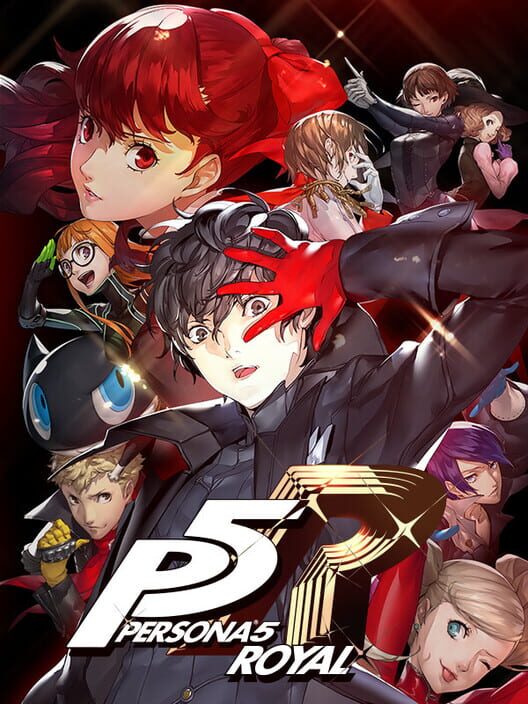
The player character is a silent protagonist, a commonplace feature in the Persona series, codenamed Joker. He becomes the leader of a vigilante group known as the Phantom Thieves of Hearts, who change the hearts of criminals and other malevolent people through the Metaverse. He is joined by school delinquent Ryuji Sakamoto, fashion model Ann Takamaki, and Morgana, a mysterious cat-like creature. As the game progresses, the group recruits more members, including art prodigy Yusuke Kitagawa, student council president Makoto Niijima, hikikomori computer hacker Futaba Sakura, and cultured corporate heiress Haru Okumura. Also interacting with Joker are high school detective Goro Akechi, public prosecutor and Makoto's older sister Sae Niijima, and Igor and his two assistants Caroline and Justine, who are residents of the Velvet Room.
Much of the story is told through flashbacks while Sae Niijima interrogates the protagonist. After preventing an assault, he is framed for assaulting the man responsible and put on probation for a year, resulting in expulsion from his school. He is sent to Tokyo to stay with family friend Sojiro Sakura and attend Shujin Academy during his year-long probation. After his arrival, he is drawn into the Velvet Room, where Igor, alongside his assistants, Caroline and Justine, warns him that he must be rehabilitated to avoid future ruin and grants him access to a supernatural mobile app. This leads him into the Metaverse, and the Palace of the school's abusive and lustful gym teacher and volleyball coach Suguru Kamoshida, along with a fellow student, Ryuji Sakamoto, who had been labeled as a troublemaker due to having been provoked by Kamoshida into assaulting him, resulting in Kamoshida breaking his leg in an implied self-defense and dissolving the track team due to the scandal.
After the protagonist and Ryuji are captured by the corrupt manifestation of Kamoshida, also known as his Shadow Self, he awakens to his Persona, Arsène, to save Ryuji from being executed. The two escape to the lower levels of the Palace, where they meet Morgana, a mysterious, small cat-like creature who knows much about the Palaces. Morgana informs the protagonist of the ability to change wicked people's hearts by stealing their "Treasure," the emotional root of their behavior and desires, from the Palaces ruled by their Shadow selves. Not long after, upon discovering the truth about Kamoshida's abuse towards other students in the Palace dungeons, Ryuji awakens to his Persona and resolves to stop Kamoshida.
The protagonist later confronts other fellow student Ann Takamaki, who was forced into a relationship with Kamoshida in exchange for her friend Shiho Suzui being on the volleyball team. When Ann doesn't come to Kamoshida's house one afternoon, he takes it out on Shiho in an implied sexual assault, causing her to attempt suicide. After which, the group finally decides to steal Kamoshida's heart and force him to confess his crimes, with Ann awakening to her Persona after accidentally stumbling into the Metaverse.
The protagonist assumes the codename Joker, and after changing Kamoshida's heart, he along with Morgana, Ryuji, and Ann form the Phantom Thieves of Hearts, to steal corruption from the hearts of adults to reform the city, and slowly learns of a broader conspiracy to influence the hearts of Tokyo. They are joined along the way by Yusuke Kitagawa, an art student whom they help to reform his corrupt teacher, Ichiryusai Madarame; Sae's sister Makoto, the president of the school's student council who is assigned to spy on them but joins after being blackmailed by a mob boss, Junya Kaneshiro, who they also reform; Sojiro's adopted daughter Futaba Sakura, an expert hacker who became a depressed hikikomori after the conspiracy murdered her mother and framed her using a forged suicide note; and Haru Okumura, a corporate heiress who rebels against her rich father, Kunikazu Okumura, and his attempts to control her life and mistreatment of his employees. Over time, the Phantom Thieves attract the attention of the public and the police, including Sae and celebrity junior detective Goro Akechi.
However, the Phantom Thieves' popularity plummets after a black-masked assassin frames them for the death of Haru's father. While pursuing the conspiracy, Akechi joins the group and convinces them to change Sae's heart in order to prove their innocence. After infiltrating Sae's Palace, Joker is captured by the police, and Sae interrogates him despite being removed from the case, at which point the story comes full-circle. Joker convinces Sae of the truth.
Akechi is revealed to be the assassin and attempts to kill Joker but the Phantom Thieves pull Akechi back into Sae's palace, where he kills Sae's cognition of Joker instead, leaving the real Joker unharmed. It's also revealed that the Phantom Thieves knew Akechi's true nature far ahead of time and only ag
Development
The game was developed by P-Studio, an internal development studio within Atlus dedicated to handling the Persona series. Preparatory development began in 2008 following the release of Persona 4, with full development beginning following the release of Catherine in 2011. Development lasted five years. Series director Katsura Hashino was only fully involved in development after Catherine was finished, later calling the latter game a test for the next Persona game's development.
Persona 5 would be Hashino's last game in the series as the leader of P-Studio, as he would afterwards form a separate internal team called Studio Zero. When production started, the staff consisted of around 40 people. During full production, this number expanded to 70 with 15 planners, 15 programmers, and between 30 and 45 designers. These included lead designer Naoya Maeda, who had previously done modeling work for the Trauma Center series.
The general development was a challenge for the team, as they intentionally changed their development structure due to the more powerful hardware they were working with.
While the final game retains the turn-based battle system from earlier entries, one of the early design drafts was for an action-based system incorporating real-time elements foreign to the series. This idea was ultimately scrapped, but real-time command elements were introduced into the battle system, allowing the gameplay to evolve without extensive changes to the core system. One major new addition was unique dungeons with locked layouts as opposed to the predominantly randomly generated dungeons of previous Persona games. This was done to better emulate the game's themes and provide veteran players with something different.
A returning feature from both earlier Persona games and the mainline Megami Tensei series was Negotiation. As it was considered a key part of the overall franchise by fans, Hashino decided to reintroduce it after being absent from the previous two mainline entries. The Negotiation system for Persona 5 was tied into the origins of Shadows as suppressed psyches within the Collective Unconscious. The "Hold Up" function was inspired by scenes in films where the antagonist would hold people at gunpoint and make demands.
These functions were incorporated due to the game being in part a celebration of the series' history. In-game weather and environmental elements were all designed to reflect the real world. Dungeon layout was split into three distinct types: the Tokyo overworld environments, "institutions" such as Joker's high school, and dungeon environments. Some segments take control away from the player aside from limited dialogue choices; this was chosen as it reflects the controlled environment of Japanese high schoolers.
While Catherine used the third-party Gamebryo game engine, Persona 5 uses a specially created engine. Hashino believed that the new engine would make rendering their ideas much easier, although it would result in a long wait by fans for the game. The event scene software was also developed internally by Atlus, with an estimated 1,160 scenes being included in the final game. The tools for developing and handling them were greatly expanded over the previous two entries so as to better utilize the more advanced hardware.
Character modeling, in general, was handled with a specially developed cel-shader which helped properly translate the character designs into the game, while also allowing for easy adjustment of shaders and lighting effects during fine-tuning. The characters were originally rendered realistically like in Catherine, but the team felt that it was "wrong" for the Persona series. With this in mind, the team did some trial and error before finding a style that satisfied them, doing something similar for the interface and menu design. In contrast to Persona 4, which has a general deformed look due to the PlayStation 2's hardware limitations on the variety of body shapes, the technology available to the team for Persona 5 enabled unique customization for all relevant character models.
Two different models were used for members of the main cast: a detailed model for real-time cutscenes, and a general-use model for general event scenes and gameplay. Persona 5 marked the first time a large number of Personas had been rendered in high definition, something which proved a grueling challenge for the team.
The original story concept was written by Hashino, while the scenario was co-written by Yuichiro Tanaka and Shinji Yamamoto. The initial concept was for a storyline that diverged from the established paths of Persona 3 and 4, with "self-discovery" and "journey" being its keywords. Originally using the concept of a backpacking trip around the world as a framing device for the story, Hashino decided to refocus on Japan in the wake of the 2011 Tōhoku earthquake and tsunami. More specifically, it has been noted that the Japanese government's actions in response to the earthquake and tsunami's fallout, along with Japanese citizens' reactions to how the government acted during that time, may have served as partial influences on the game's themes.
Following that crisis and seeing how people were bonding in the face of it, Hashino decided to have the story take place solely in Japan, with the journeying being done through the ever-shifting (dungeon-like) Palaces. Ultimately, the story's central concepts were inspired by equivalent social changes he saw in modern society, particularly in Japan. Hashino also described the central theme of the game as being about freedom and how the characters attain it. He wanted to make the game more "thematically approachable" for newcomers to the series, and to be an emotional experience that left its audience with a strong sense of catharsis and the inspiration to take on problems in their lives.
The narrative of Persona 5 was designed like an omnibus, with the antagonists pursued by the party changing regularly. The development team has c
Reception
Persona 5 received "universal acclaim" according to review aggregator Metacritic. Famitsu gave it a positive review, with the game garnering a near-perfect score. PlayStation Official Magazine – UK described it as "an unabashed masterpiece". IGN's Andrew Goldfarb said Persona 5 "stands out as an extraordinary, memorable experience and easily one of the deepest JRPGs of the last decade".
RPGamer said that "With Persona 5, Atlus has once again proven that it is the master of the modern JRPG. ". The game's graphical style and art direction also received significant praise.
The quality of the English localization was one of the few aspects singled out for criticism, with Polygon describing it as "aggravatingly mediocre". Another was its treatment of LGBTQ topics. Writing for Paste, Kenneth Shepard considered the game to be heteronormative and noted a "lecherous" gay couple who are treated as a joke. These scenes' dialogue were altered in the Western version of Persona 5 Royal, with its localization team advocating for the change.
Shepard and Polygon writer Laura Dale both opined that Royal's localization changes were at least a minor improvement, but the game was still broadly uninclusive to LGBTQ identities. There is mixed reception regarding the game's playtime, which writers from The Verge and Wired note may be too long for some players.
Persona 5 Royal also received "universal acclaim" from critics, according to review aggregator Metacritic, garnering an even higher score than the original. The game is the third-highest-rated PlayStation 4 game on Metacritic alongside Naughty Dog's The Last of Us Remastered. IGN listed it as one of the best contemporary role-playing games. Famitsu praised Royal's newer elements.
Michael Higham of GameSpot lauded the new music, characters, and the added third semester, saying that it solves one of the original game's shortcomings of ending abruptly. He concluded his review saying that Royal refines an already great game and builds on what was best about it with a great new story and that it is "an unforgettable and empowering RPG that should be recognized as one of the best games of our time." IGN's Leana Hafer said Royal is "a living master class in how to take an already amazing game and amp it up to the next level." She commended the improvements to the Mementos dungeons saying "The fact that Atlus has made Mementos feel so much more alive is a massive improvement by itself."
The game received a boost to pre-order sales following the delay of Final Fantasy XV, which was originally scheduled to release the same month as Persona 5. Sales went up on Amazon Japan by 450%, bringing it to second place in their best-seller charts behind Tales of Berseria. In its first week of release, the PS4 version reached first place with sales of 264,793 units, while the PS3 version reached second place with 72,974 units, resulting in total sales of 337,767 units. This made Persona 5 the fastest-selling title in the series' history, surpassing Revelations: Persona, and together with Pro Evolution Soccer 2017 pushed sales of the PS4 up significantly over the previous week.
It was later reported by Hashino that combined physical shipments and digital sales had reached over 550,000 units by September 2016. Within three weeks of its launch in Japan, the game became Atlus' best-selling game in the country.
Outside of Japan, it was the biggest debut for any Persona game to date, with packaged sales five times better than Persona 4. In the United Kingdom, Persona 5 debuted at number one on the all-formats sales chart, becoming Atlus's first title to top the chart and achieving what GfK Chart-Track described as "by far" the biggest launch for a Persona game in the country. It was also the first Japanese role-playing game to debut at number one in the UK since Ni no Kuni: Wrath of the White Witch in 2013. 5 million units worldwide.
By November 2017, that number had risen to over two million, which made it the best-selling game in the series. The success of Persona 5 contributed to increasing annual revenue for Sega, the owner of Atlus, in 2017. At the 2018 PlayStation Awards, it received the Platinum Prize for topping a million sales in Asia. 2 million units by December 2019.
Persona 5 Royal shipped over 400,000 units in Japan by December 2019. 6 million units worldwide by December 2019. In February 2020, Royal topped the Media Create sales charts in South Korea and Taiwan. In the United Kingdom, Royal debuted at number five on the sales chart.
6 million. 8 million Royal units).
When the game launched on additional platforms in October 2022, the Nintendo Switch version placed in second at 45,998 physical units sold, and PlayStation 5 version placed in seventh at 5,051 units during the week from October 17 to 23, according to Japanese publication Famitsu. In the United Kingdom, the re-release of Royal debuted at number six on the sales chart, with 79% of the launch week sales coming from the Nintendo Switch version. 3 million units. 2 million units.
The Persona 5 series including Royal, Dancing in Starlight, Strikers, and Tactica surpassed 10 million units sold by December 2023. 66 million copies by June 2026, bri
Legacy
Since its release, Persona 5 has been regarded as one of the greatest role-playing games of all time, and one of the greatest games of all time. Writing for Nerdist in 2017, Edwin Garcia opined that the game was "one of the best RPGs of the past few years" and asserted that it "belongs amongst the greatest of all time." Alex Donaldson of VG247 likened the game to other esteemed RPGs such as Chrono Trigger and Final Fantasy VII, and stated that it hearkened back to the genre's golden age. Citing it as "one of the best RPGs in recent memory" in a 2023 Inverse article, critic Willa Rowe claimed Persona 5 was the best heist game, praising the dungeon design's emphasis on heist planning and execution.
Journalists noted its influence on games such as Atlus' own Metaphor: ReFantazio (2024) and Sandfall Interactive's Clair Obscur: Expedition 33 (2025). Sandfall's lead director Guillaume Broche and Japanese game designer Masahiro Sakurai both praised the game's stylish UI design as among their favorite.
Persona 5 and Royal have appeared in various critic lists of the best games of all time. IGN included Persona 5 at #78 in its 2019 list of the top 100, and ranked Royal at #81 in their 2021 iteration. The publication also placed it at #50 in their list of the 100 best RPGs. USA Today's gaming section For The Win listed the game at #11, and GQ ranked the game at #64 in a similar list in 2023. A 2017 Famitsu reader poll ranked Persona 5 as the greatest game of all time.
A standalone anime special, Persona 5: the Animation -The Day Breakers-, aired in Japan on September 3, 2016. Created by A-1 Pictures, The Day Breakers is set during the events of the game and portrayed as a "sub event" separate from the main narrative. A manga adaptation of Persona 5 by Hisato Murasaki began serialization online from September 15, 2016. Persona 5: The Animation, an anime television series based on the game's events, was produced by CloverWorks and began broadcast in April 2018. Stage play adaptations under the title Persona 5: The Stage have been performed in Japan, with original music composed by Atsushi Kitajoh.
Persona 5: Dancing in Starlight, a rhythm game for the PlayStation 4 and PlayStation Vita, features the main cast of Persona 5 and was released in 2018. The cast is also featured in Persona Q2: New Cinema Labyrinth for the Nintendo 3DS, also released in 2018. Persona 5 Strikers, an action role-playing sequel to Persona 5 co-developed with Omega Force and featuring gameplay based on their Dynasty Warriors series, was released in Japan in 2020 and worldwide in 2021 for the Nintendo Switch, PlayStation 4, and Windows. A tactical role-playing game spinoff named Persona 5 Tactica was released in 2023.
A spin-off for Android and iOS named Persona 5: The Phantom X was announced in 2023, developed by Black Wings Game Studio and published by Perfect World Games; P-Studio is assisting in the game's development. The Phantom Thieves appear as characters that can be summoned via gacha by the player character of Persona 5: The Phantom X.
Joker appears as a playable character via downloadable content (DLC) in the 2018 crossover fighting game, Super Smash Bros. Ultimate. The game's director, Masahiro Sakurai, is a fan of the Persona series and stated that Joker was emblematic of the approach that he wanted to take with Ultimate's DLC, adding that he wanted characters that were unique and fun to use within the Super Smash Bros. environment. Other characters and series elements have also made crossover appearances in various other games.