The articlegameplay, story, development, reception
Gameplay
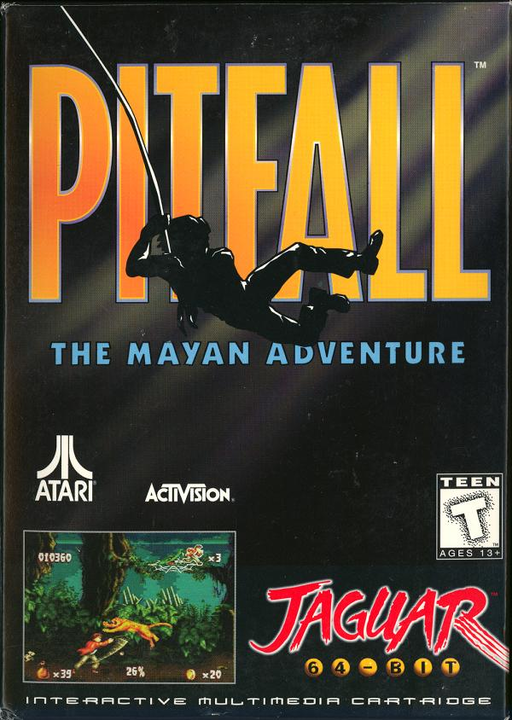
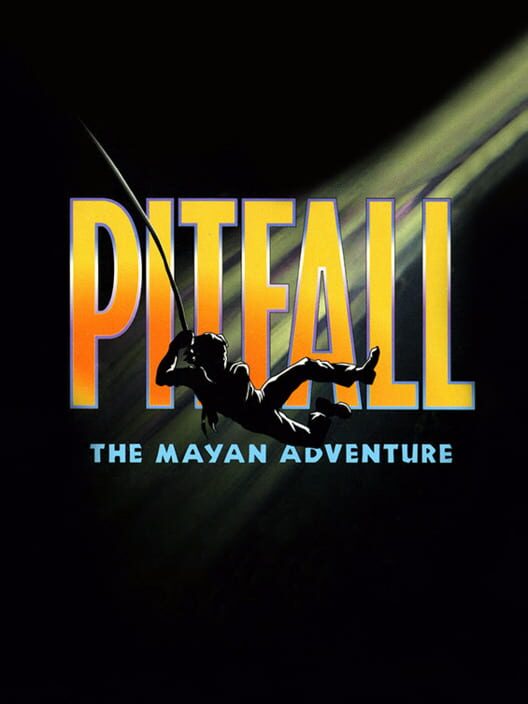
Pitfall: The Mayan Adventure is a side-scrolling action-platform game similar to Disney's Aladdin and The Lion King where the player takes control of Pitfall Harry Junior across the Mayan jungles of Central America to defeat the evil Mayan warrior spirit Zakelua and rescue his father from captivity. Prior to starting a new playthrough, players have the choice to change various settings at the options screen such as controls and difficulty.
Most of the early stages featured in the game are large, linear in nature, and populated with obstacles, enemies and environmental hazards, requiring the player to traverse the stage by running, jumping, climbing, swinging, shooting, or dodging enemies. Other areas that are featured later are more maze-like and exploratory, making the player take different routes to reach the end. On certain stages, a boss must be fought in order to progress further. All stages contain beneficial items, weapon ammunition to be collected, hidden letters that spell the word "Pitfall", and other secrets.
If Harry Jr. is killed, he respawns on the nearest checkpoint reached, but once all lives are lost, the game is over, though players have the option of resuming progress by either using continues or loading their saved game into the last stage reached (depending on the version that is being played), which also keeps the number of lives and items collected through.
The player character can move in four directions. Harry Jr. can fight enemies with his whip or shoot sling stones, boomerangs, and explosives. Charging a sling stone for a determined time period allows Harry Jr.
to perform a powerful shot against enemies. Harry Jr. can also crouch by pressing both down and the jump button, allowing him to traverse enclosed areas.
Story
Pitfall: The Mayan Adventure takes place after the events of Pitfall II: Lost Caverns, where Pitfall Harry had settled down following his days as an adventurer in order to raise his son, Harry Junior, but became a legend among people due to his feats. Inheriting his father's love for exploration, Harry Jr. grew up to become an adventurer and took on many quests on his own, prompting Pitfall Harry to miss his old adventure days. Both Harry and Harry Jr.
embarked on a journey towards the jungles of Central America to find lost Mayan treasures. After several days, both Harry and Harry Jr. have reached the center of the Mayan empire, hoping to uncover the treasure of Uaxactun. However, as soon as Harry Jr.
uncovers the relic, his father is captured by an evil Mayan warrior spirit named Zakelua, leading Harry Jr. to rescue his father from captivity.
Development
Pitfall: The Mayan Adventure was initially in development for the Super NES under the title Pitfall Harry: The Mayan Adventure and formed part of a string of franchise revivals by Activision along with other games from the Atari 2600 such as Kaboom! and River Raid. The three titles were showcased at Summer Consumer Electronics Show in 1993 featuring sprite-based visuals, with early promotional materials and previews for Pitfall Harry touting several features not found in the final release such as underwater and flying sections, as well as 32 stages.
Despite Pitfall being slated for a Winter 1993 launch, the three titles were delayed to 1994; Kaboom! and River Raid were eventually cancelled for unknown reasons, while the former remained in full development. Kroyer Films, an animation studio which worked on several projects like FernGully: The Last Rainforest (1992), was later brought to assist in the creation of Pitfall: The Mayan Adventure by providing hand-drawn animations and graphics. The game was showcased at Summer CES 1994, now under its final name and sporting hand-drawn visuals by Kroyer Films, while the lead platform transitioned from the Super NES to the Sega Genesis.
==== Animation ====
Bill Kroyer and his studio were approached by Activision CEO Bobby Kotick and his partner Howard Marks to produce animation work for Pitfall: The Mayan Adventure after seeing their previous endeavors, as Kotick wanted high-quality animation for the Pitfall project. Although they were seeking multiple studios to be on board, the company settled with Kroyer Films due to its being the only company which hosted ex-Disney animators and was capable of matching Disney's level of quality.
Activision provided several production materials such as concept art, layouts and storyboards to Kroyer Films in order to define how the main character should traverse the constrained levels, while animation required to be consistent in terms of size. Kroyer and his company interacted several times with the programming team at Activision, who explained to them how the process would work and later transposed the hand-drawn sketches lent by the studio into pixel art graphics. Kroyer stated that the project proved to be both different and challenging for his team, as the studio needed to draw a high number of actions and poses for the characters to perform in-game seamlessly with multiple frames of animation in order for players to not feel taken out from the experience, instead of scripted sequences as seen with their animated feature films.
During a meeting with Activision's creative team to showcase test animation and how the process went, a female worker told Kroyer that his team should make the main character younger. Once their task was completed, Kroyer Films was no longer involved with the project, which served as their only involvement with video games. Though Disney's Aladdin was released a year earlier for the Genesis in 1993, Kroyer claimed that neither he and his team were aware of its existence.
==== Audio ====
Both the music and sound effects were created by Soundelux Media Labs, who would later collaborate with Activision on MechWarrior 2: 31st Century Combat (1995).
Reception
Pitfall: The Mayan Adventure sold in excess of one million copies by June 1996.
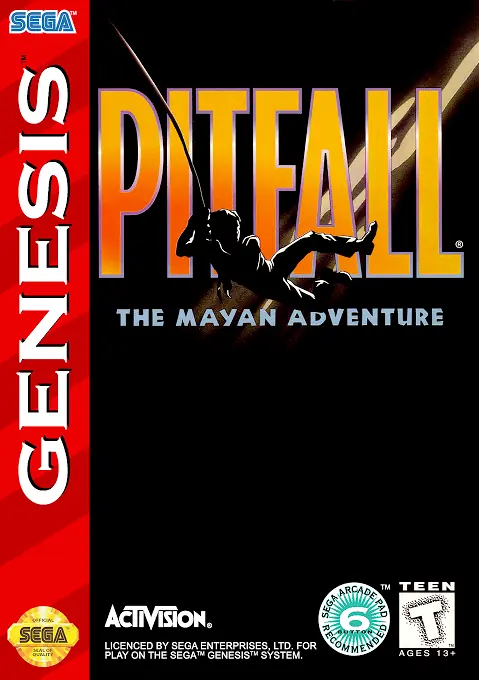
Reviewing the Genesis version, GamePro criticized the lag in the controls, elaborating that "the split-second lag time between his jump and your ability to control his movements again is the difference between a narrow escape and losing a life. The same problem occurs whenever he changes direction - he pauses, you can't control him, and Harry Jr. takes a hit." However, they praised the graphics, the intense action, the music, and the inclusion of the original Pitfall!, and gave the game an overall recommendation, particularly for hardcore platforming gamers.
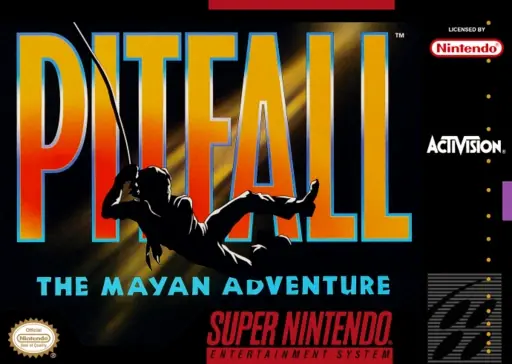
GamePro applauded the Super NES version as having "some of the best character animations ever seen in an SNES game." They also praised the distinctive enemies, realistic sound effects, and entertaining challenge. Next Generation reviewed the Super NES version of the game, and stated that "Run of the mill graphics and sound combined with gameplay that is, at best, tedious and uninspired, leave Pitfall interesting as a novelty, but not much else." Entertainment Weekly wrote that Pitfall: The Mayan Adventure was successful "mainly because the original Pitfall — a straightforward action game in which a stick-figure hero runs, jumps, and climbs up and down ladders — is far more adaptable to today's 16-bit technology.
In fact, this version plays like Indiana Jones in fast-forward, as Pitfall Harry Jr. executes his derring-do amid lush jungle backgrounds, stirring music, and pumped-up sound effects."
GamePro gave the Sega CD version a positive review as well. They remarked that the new levels, full motion video sequences, and improved graphics all add to the game, which they noted has the same high challenge, realistic sound effects, and difficult controls as in previous versions. Mike Weigand of Electronic Gaming Monthly commented of the Sega CD version that "Huge levels, excellent animations and nice sound effects make this one an action/adventure winner." In contrast, Next Generation ridiculed the additions to the Sega CD version as unimportant. They concluded that "The game is not bad, just not great."
Next Generation, while noting that the game is "a somewhat hit-and-miss side-scroller that has some cool features", judged the Windows port to be an "excellent" conversion which would satisfy gamers who wanted to play Pitfall: The Mayan Adventure but did not own a console system.
Nintendo Power complimented the good balance between action and puzzle-oriented gameplay and excellent graphics and sound. Their review said the game has poor hit detection which made fighting and collecting items difficult in some areas.
Reviewing the 32X version, the four reviewers of Electronic Gaming Monthly praised the large number of secrets but criticized the difficult controls and the lack of significant improvement from the Genesis version. GamePro dismissed the 32X version for this same reason, summarizing that "nothing has changed in this latest version of Pitfall." Next Generation concurred that the 32X version's improvements are too minor for the average player to even notice, and again opined that the game is "solid" but "average".
GamePro called the Jaguar version "a fun, colorful action adventure". However, they commented that it is identical to the Genesis and Super NES versions and inferior to the Sega CD version (due to the lack of the "densely layered" sound effects and orchestrated music), which they found disappointing given that the Jaguar is a more powerful system and at this point most people interested in the game would have already played it on another platform. Next Generation agreed the Jaguar version is essentially the same as previous releases of the game but gave it a more positive assessment than previous reviews in the magazine, concluding that it "maintains a feeling of quality game design from the very beginning, and is well worth checking out, especially if you're an old-school Pitfall fan."
In 1995, Total! ranked the game 48th on its Top 100 SNES Games summarizing: "It's a sort of Indiana Jones type of thing and plays like a dream. And for nostalgia freaks it contains a complete and accurate version of the old Atari classic."
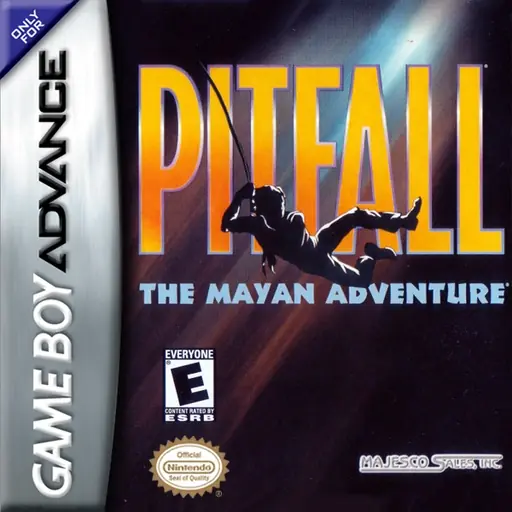
Next Generation reviewed the Game Boy Advance version of the game, rating it two stars out of five, and stated that "This isn't terrible, but there are plenty of better-playing alternatives."