The articlegameplay, story, development, reception
Gameplay
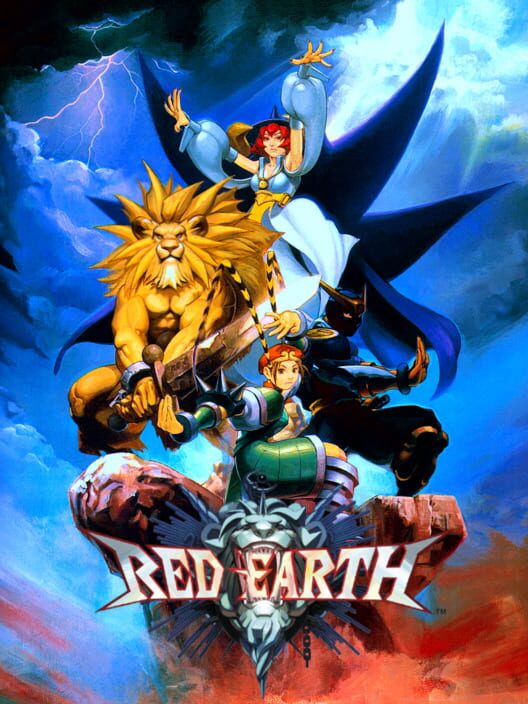
Red Earth features two different game modes: a single-player Quest Mode and a two-player Versus Mode. The Quest Mode essentially operates as the game's standard arcade mode and the player chooses from one of the four main characters to progress through their character's storyline while fighting against a series of eight computer-controlled adversaries in one-on-one battles. The game has a unique take on the fighting genre, as it combines elements from the beat 'em up genre, in that each fight is against a boss-style monster with a large health bar, none of whom are playable characters, and defeating each one gains the player character experience points which are used to improve the character's attack and defense and access new moves. A story arc develops before and after each fight as well.
In Versus Mode, two players fight against each other, each using any of the four main characters (including the same character as the other player). Red Earth uses a password feature that allows the player to play the game later on the same skill level their character reached when it ended the last time. The character is able to acquire new abilities depending on the skill level that has been reached.
The fighting system itself is similar to previous Capcom fighting games such as the Street Fighter series with a few key differences. First of all, the vitality gauge of each computer-controlled opponent fought by the player during Quest mode is displayed across the bottom of the screen, and is much larger than the player's own vitality gauge. Also, as the player lands hits on their opponents, various coins and treasure chests come out. Collecting coins provides experience points, while various items can be found in treasure chests such as orbs (used to perform super moves) and food (which replenishes the player's vitality). These elements make the game very similar to a side-scrolling action game rather than a traditional fighting game, similar to Capcom's own adaptation of the Dungeons & Dragons beat 'em up game.
Red Earth is one of the few Capcom games with fatalities. They include splitting the opponent in half, artery rupture, organ removal, and limb slicing. It also features multiple endings and hidden endings influenced by the player's actions, given choices (akin to Chun-Li's ending in Super Street Fighter II), amount of continues used, and the manner of killing enemies.
Development
According to Takashi Sado, Red Earth was made due to the growing popularity of fighting games in the 1990s. Although the game was inspired by Magic Sword and The King of Dragons, both made by Capcom, it was different from other fighting games due to the inclusion of a set of parameters and equipment so that casual players can keep up with more experienced players.
Reception
In Japan, Game Machine listed Red Earth on their February 1, 1997 issue as being the second most-popular arcade game for the previous two weeks.
The game was reviewed by Hyper magazine and rated 4 out of 5 stars.
Legacy
Some of the characters from Red Earth have appeared in other video games:
Tessa appeared as a playable character in SNK vs. Capcom: SVC Chaos and Super Gem Fighter plus a cameo in Leo's ending in Capcom Fighting Evolution. She also appears in Dr. Strange's ending in Ultimate Marvel vs Capcom 3.
Leo appeared as a playable character in Capcom Fighting Evolution. He makes a cameo appearance in Hawkeye's ending in Ultimate Marvel vs Capcom 3.
Kenji also appeared as a playable character in Capcom Fighting Evolution. He makes an appearance as a character card in the "Heroes and Heralds" mode of Ultimate Marvel vs Capcom 3.
Mai-Ling is the only one of the four main characters who hasn't appeared as a playable character in a crossover game, but she appeared in Pyron and Leo's endings in Capcom Fighting Evolution, in Tessa's defenses from Super Gem Fighter, and in the background of the Shanghai stage in Capcom vs SNK 2.
Hauzer not only became playable in Capcom Fighting Evolution, but also appeared in Ryu's ending in Super Gem Fighter and in Karas and Saki's endings in Tatsunoko vs. Capcom.
Hydron is the remaining playable character in Capcom Fighting Evolution.
Gi Gi appears in PTX-40A's ending in Tatsunoko vs. Capcom.
Several of the bosses from Red Earth appear in the background of a Red Earth-themed stage in Capcom Fighting Evolution. Gi Gi and Kongou appear in Jedah's ending in this game, and Blade also appeared in Leo's ending.
Kongou and Ravange also appear in Hsien-Ko's ending in Ultimate Marvel vs Capcom 3, along with Marvel's Thor Odinson, Hela, Jedah from Darkstalkers, and Orochi from Ōkami.
Tessa, Leo, Kenji and Mai-Ling appear as cards in the SNK vs. Capcom: Card Fighters series.
In Capcom's Dragon's Dogma: Dark Arisen, a certain piece of armor is called the "Cursed King's Belt" with the description of "a belt worn by an eliminator. The relic of a king who was cursed to live as a lion, it boosts the wearer's ability to stagger his opponents", a reference to the character Leo.
In Street Fighter V, according to the game's Japanese only Arcade Edition – Visionary Book II, a crystal ball owned by a Street Fighter character Menat, the "Left Eye of the Lion" was stated by the sixth mainline game's director Takayuki Nakayama to be created from a product of a god-beast believed to have once protected the phantom desert kingdom of Sangypt, Ravange's home territory.
The franchise was added to Teppen in January 2022.