
The articlegameplay, story, development, reception
Gameplay
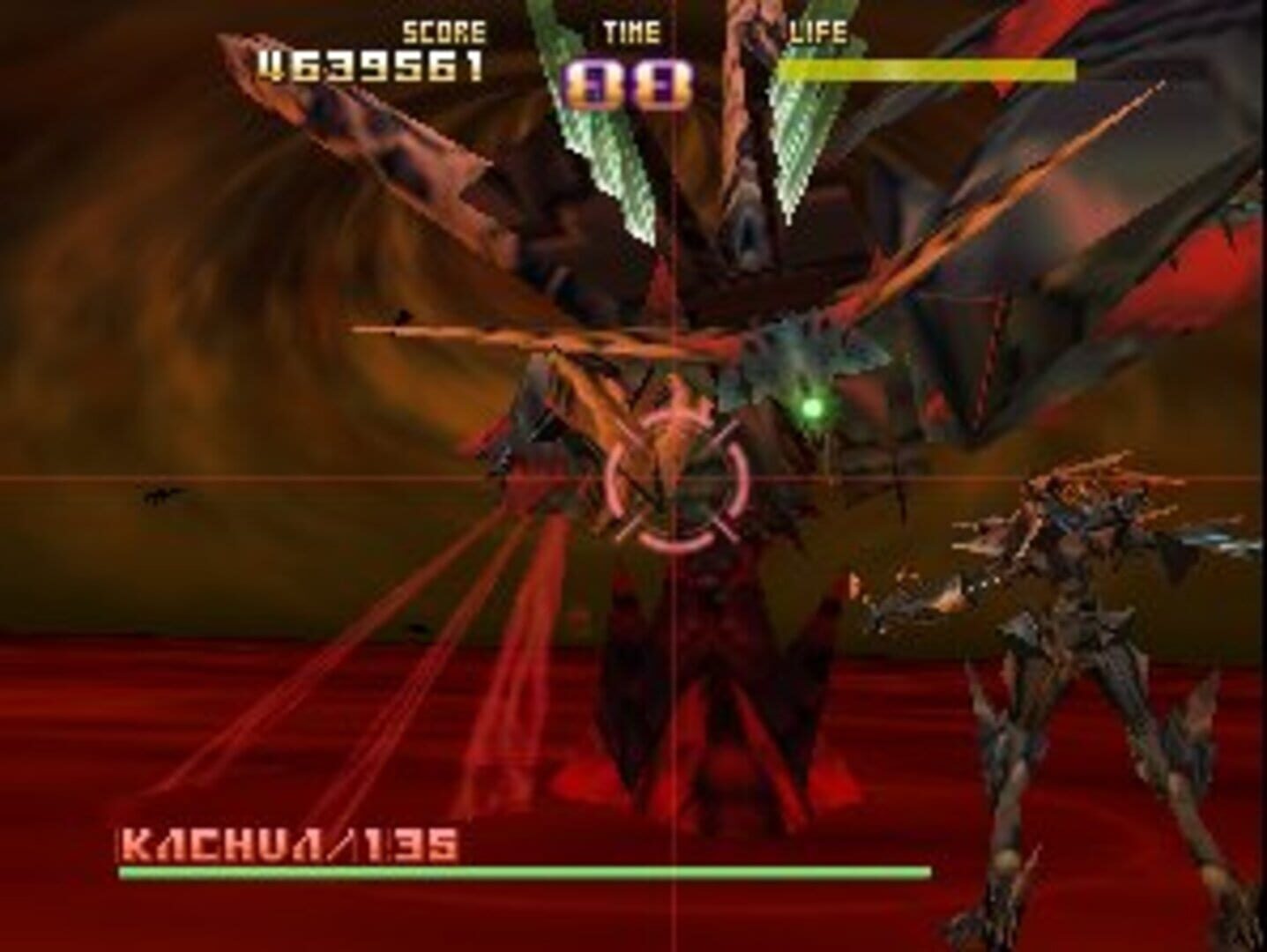
Sin and Punishment has been described as an arcade-style rail shooter and shooting gallery video game. The player character is controlled from a behind-the-back perspective, and can strafe left and right, double-jump, and perform a roll dodge. The character progresses forward through the level automatically due to the rail shooter format which drew comparisons from critics to the Panzer Dragoon series, Star Fox series, and Space Harrier. A targeting reticle is used to aim shots on enemies and projectiles and has two modes that the player can freely alternate between, a lock-on mode and a free aiming mode.
The lock-on mode will auto-lock onto visible targets, and the player can quickly move the reticle between targets. Alternatively, the free aiming mode gives the player full control of the reticle and a more powerful shot. The player character is also armed with a sword which can be used to damage or destroy nearby enemies, and redirect projectiles back at the enemies. The character can be controlled by a single player, or cooperatively between two players.
Story
Sin and Punishment is set in a dystopian near future of 2007, when humanity is struggling with a planet-wide famine. To solve this problem, scientists develop a genetically-engineered species to raise as food. These creatures are herded in northern Japan until they mutate and begin attacking the country's citizens. They are dubbed "Ruffians".
An international peacekeeping organization called the Armed Volunteers tries to stop the creatures, but they also oppress the Japanese people. Another group, led by a mysterious woman with unusual powers named Achi, rises up to defend Japan against the Ruffians and Armed Volunteers. Within her group are Saki and Airan, the male and female protagonists of the game. Between battles with the Ruffians and Armed Volunteers, Saki unintentionally morphs into an enormous Ruffian after falling into a rising tide of blood filling up Tokyo.
Development
Sin and Punishment was co-developed by Nintendo Research & Development 1 and Treasure. Development began in 1997 when Treasure submitted their original proposal to Nintendo. The inspiration to develop the game was the design of the Nintendo 64 controller. In the early days of the system's lifespan, Nintendo had suggested two ways of holding the controller, a left and right position.
Due to the success of Super Mario 64 which released alongside the console in 1996, many games followed in its trails and featured the same right positioning it used. Treasure president Masato Maegawa began discussing with his team how the left positioning was underutilized and could make for an interesting game. Nintendo expressed concern that the left positioning would feel unnatural to players at first, however Treasure was already expecting this. Nintendo was also developing a movement sensor at the time, which the team considered adapting, but ultimately decided against it as it would have lengthened an already dragging development process.
Reception
In Japan, the four reviewers in Dengeki Nintendo 64 complimented the games fresh style which they felt had a more mature appeal compared to other Nintendo 64 games. The reviewers found the controls complicated at first, but were shooting enemies regularly as they became familiar with them. Two reviewers found the game might be too challenging for the average player.
Although it was not localized for its original release, some western critics still imported Sin and Punishment for review. Fran Mirabella III of IGN found it to be a "tour de force" of arcade-style shooting action, and praised Treasure for their excellence at developing games in the genre. He concluded that it was one of the most unique and daring games on the Nintendo 64, as well as one of the best, but did make some complaints with regards to its short length. Jeff Gerstmann of GameSpot described Sin and Punishment as a technical and artistic achievement, but was even more harsh on the game's short length, and also felt the game was too easy.
Legacy
Retro Gamer included Sin and Punishment among their list of top ten Nintendo 64 games, highlighting the game's intensity and hardware pushing prowess, and IGN included it among their list of best Virtual Console games. Todd Ciolek of GameSetWatch described it as one of the best games in the sparsely populated shooting gallery genre along with Wild Guns (1994).
A novelization of the game was published in Japan in early 2001. A comic adaption was also printed in Dengeki Daioh magazine. The character Saki Amamiya re-appeared as an "assist trophy" in Super Smash Bros. Brawl (2008) and Super Smash Bros.


