Ludography
Solar Quest cover

1982 · Cinematronics · Arcade · Shooter

Solar Quest

The player controls a ship that can rotate to the left and right and thrust forward, similar to the better known Asteroids, and like that game the player also has a "hail mary" device, hyperspace. In the center of the screen is the sun, which pulls objects into it, in a fashion similar to Spacewar!. The screen wraps at the edges.

Waves of enemy spaceships appear in groups of up to eight. There are seven different types of ships, growing smaller to make them harder to hit. Each "phase" of the gameplay completes when each of the seven waves is destroyed. The spaceships are a collision hazard and normally fly around the screen randomly.

As the game progresses, they become more likely to attempt to ram the player directly. At higher levels, the ships gain weapons and attempt to shoot the player.

The player's ship is armed with two weapons, a cannon and a "nuke". The cannon fires a single shot in the direction your ship is pointed, and the game allows up to four shots on screen at once. The nuke destroys all ships in the area when it is triggered, which occurs with a second button press after being launched from the ship. The player's ship starts the game with three nukes and gains a new one every 10000 points.

Whenever an alien ship is destroyed, a "survivor" is left drifting in space. The player can collect the survivors by flying his ship over them. Alternately he can shoot them, or allow them to fall into the sun. The player is awarded with points for successful rescues, and eventually free ships.

The game is remembered fondly by many players, and Simon Burns of VoxelArcade called it "freedom under an overlaid blue sky".

Released
1982
Platforms
ArcadeVectrex
Genres
ArcadeShooter
Developers
Cinematronics
Publishers
Cinematronics
Modes
Single-player
Perspective
Bird view / Isometric
Themes
ActionScience fiction
Country
United States
Languages
English

About

Solar Quest is a monochrome vector arcade video game created by Cinematronics in 1981. It was designed and programmed by Scott Boden, who previously worked on Star Castle. It had a home release for the Vectrex system in 1982.

Keywords

  • vector graphics

Media

The articlegameplay, story, development, reception

Gameplay

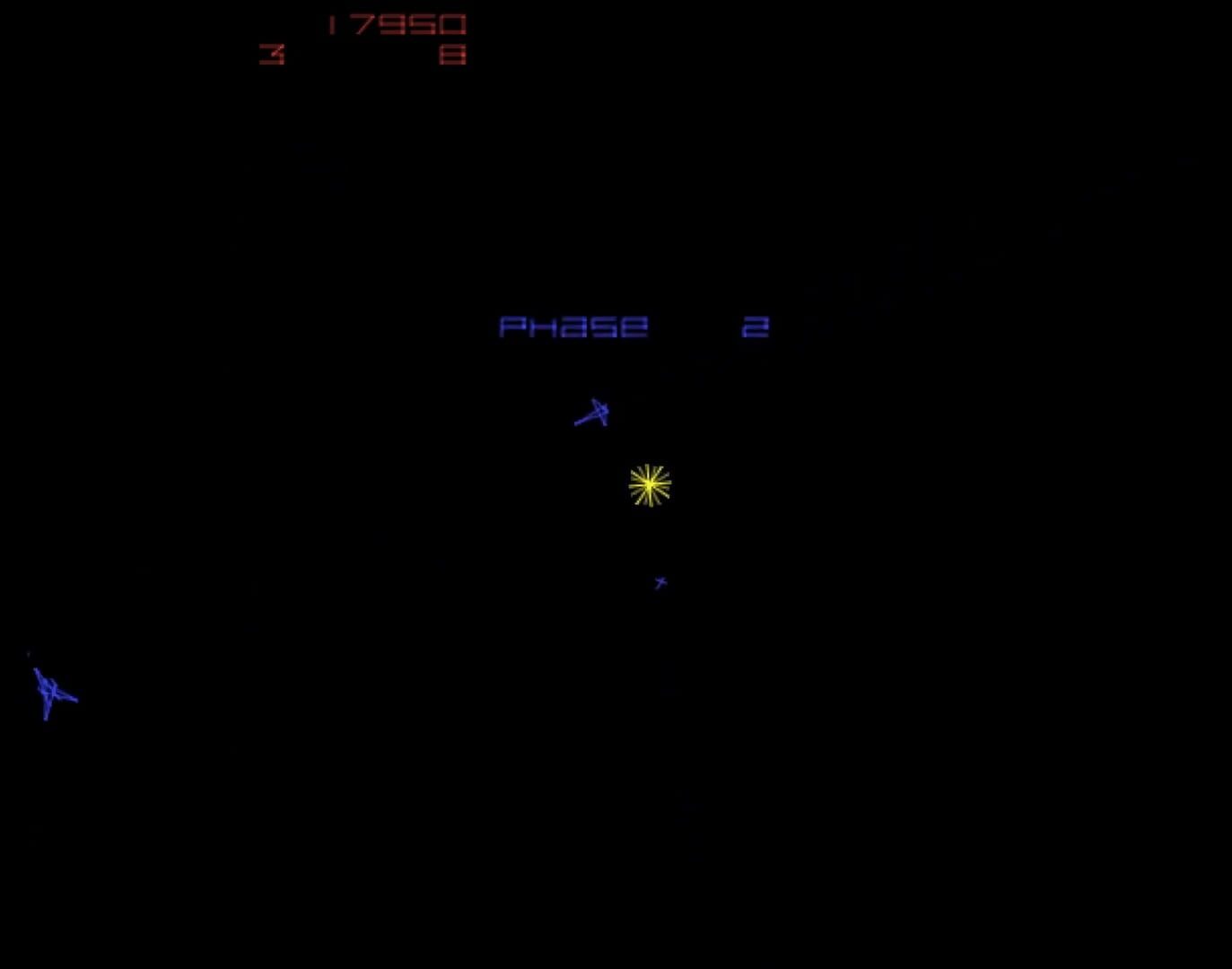
The player controls a ship that can rotate to the left and right and thrust forward, similarly to Asteroids; like that game, the player also has a "hail mary" device, hyperspace. In the center of the screen is the sun, which pulls objects into it in a fashion similar to Spacewar!. The screen wraps at the edges.

Waves of enemy spaceships appear in groups of up to eight. There are seven different types of ships, growing smaller to make them harder to hit. Each "phase" of the gameplay completes when each of the seven waves is destroyed. The spaceships are a collision hazard and normally fly around the screen randomly.

As the game progresses, they become more likely to attempt to ram the player directly. At higher levels, the ships gain weapons and attempt to shoot the player.

The player's ship is armed with two weapons, a cannon and a "nuke". The cannon fires a single shot in the direction your ship is pointed, and the game allows up to four shots on screen at once. The nuke destroys all ships in the area when it is triggered, which occurs with a second button press after being launched from the ship. The player's ship starts the game with three nukes and gains a new one every 10000 points.

Whenever an alien ship is destroyed, a "survivor" is left drifting in space. The player can collect the survivors by flying his ship over them. Alternately he can shoot them, or allow them to fall into the Sun. The player is awarded with points for successful rescues, and eventually free ships.

Development

Solar Quest uses the "classic" monochrome Cinematronics chassis introduced with Space Wars, and used a colored plastic overlay to produce a yellow sun, blue play field, and red scoring information at the top. The game was originally intended to be based on a true color display, but was released in monochrome.

Releases by platformdates and regions as published

Releases by platform
PlatformReleasedRegions
Arcade1 November 1981North America
Vectrex31 December 1983North America

Title IDsone per regional release, with its latest update

Title ids and disc serials by release
PlatformTitle IDRegionLatest update
VectrexVT 3104Worldwide—

Games like this

Collections1 collection

Platform libraries

Description adapted from its source, CC BY-SA 4.0.