
The articlegameplay, story, development, reception
Gameplay
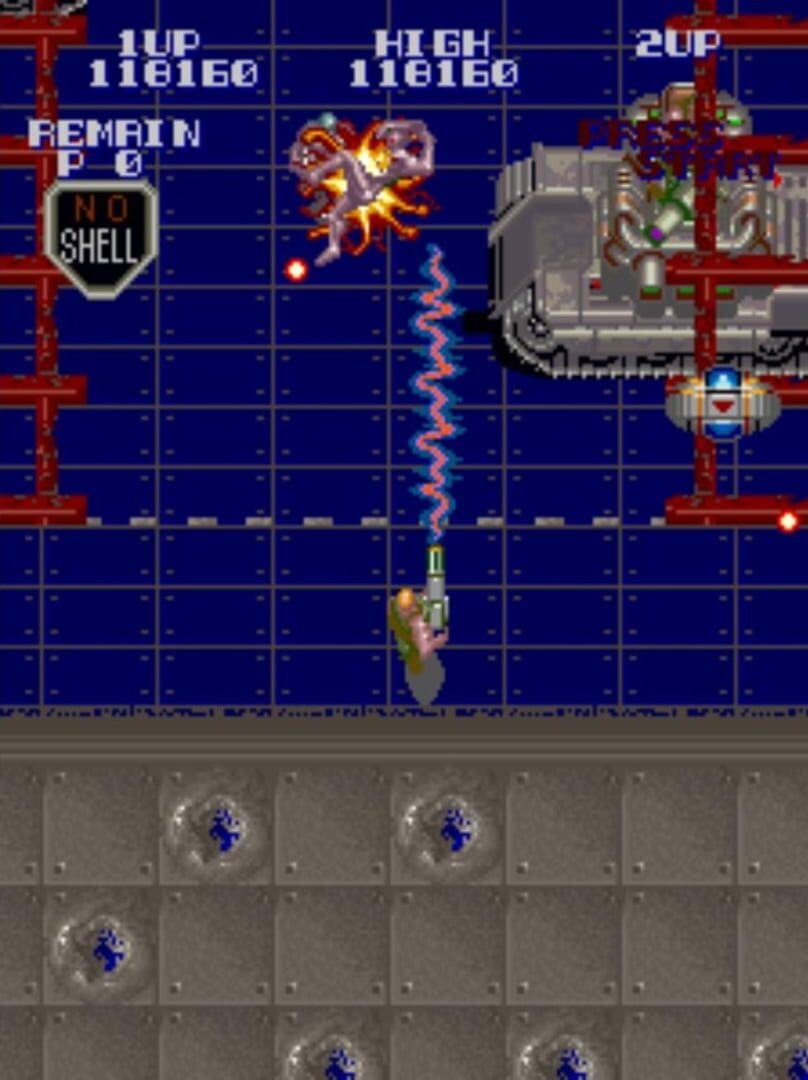
Like in the original Contra, the game can be played by up to two players simultaneously. The left player controls Bill (who wears green in this installment), while the right player controls Lance (who wears purple). The game retains the side-scrolling format from the previous game, discarding only the pseudo-3D and fixed screen segments. Instead, Super Contra features vertically-scrolling stages played from an overhead perspective, in which the player can move in eight directions. The controls remain mostly the same during the side-scrolling segments, with the only difference is that the player can now control the height of their jump by holding the joystick upwards or downwards while pressing the jump button.
The player can replace their default gun with one of four possible weapons by destroying the flying item capsules that appear throughout each stage. The available weapons include a machine gun, a spread gun, a bomb gun and a laser gun. This time, weapons can be upgraded by picking up the same power-up twice in a row, resulting in greater destructive power. The power-ups in Super Contra are represented by the actual guns the player's character wields instead of the Falcon-shaped letter icons from the previous game.
Story
A year after the battle with the Red Falcon Organization, Bill and Lance are sent on another mission. This time, the alien forces have taken over an allied military base, possessing most of its troops. Bill and Lance must not only fight against their former comrades-in-arms, but also a new mutated form of the same alien creatures they fought during their previous mission.
Reception
In Japan, Game Machine listed Super Contra on their March 1, 1988 issue as being the fourth most-successful table arcade unit of the month. The NES port Super C sold more than 500,000 units.
Super Contra received positive reviews. Allgame editor Aaron Kosydar described Super C as "an excellent game that a lot of hardcore gamers will never forget". Japanese game magazine Famitsu gave the Famicom (NES) version of the game a score of 25 out of 40.


