The articlegameplay, story, development, reception
Gameplay
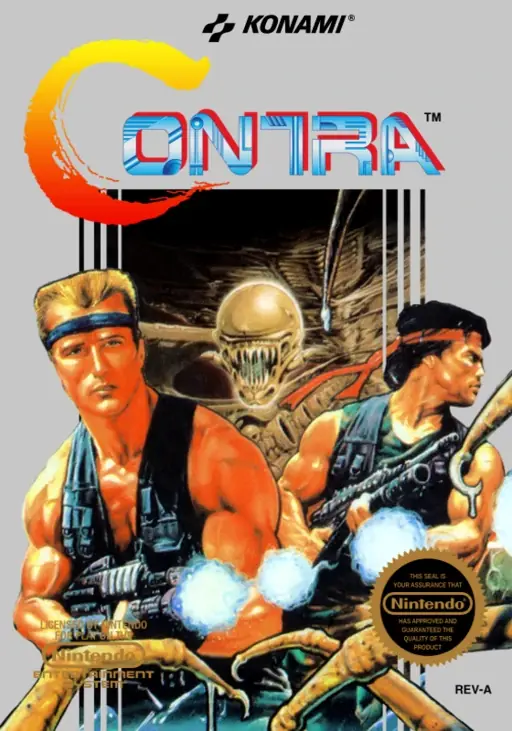
Contra employs a variety of playing perspectives, which include a standard side view, a pseudo-3D view (in which the player proceeds by shooting and moving towards the background, in addition to left or right) and a fixed screen format (in which the player has their gun aimed upwards by default). Up to two people can play simultaneously, with one player as Bill (the blond-haired commando wearing a white tank top and blue bandana), and the other player as Lance (the shirtless dark-haired commando with a red bandana).
The controls consist of an eight-way joystick and two action buttons for shooting (left) and jumping (right). When one of the protagonists jumps, he curls into a somersault instead of doing a conventional jump like in other games. The joystick controls not only the player's movement while running and jumping, but also his aiming. During side view stages, the player can shoot leftward, rightward or upward while standing, as well as horizontally and diagonally while running.
The player can also shoot in any of eight directions, including downwards, while jumping. Pressing the joystick downwards while standing will cause the character to lie down on his stomach, allowing him to avoid enemy fire and shoot low targets. When the jump button is pressed while crouching on a higher platform, the character will drop down to a lower level.
The player's default weapon is a rifle with unlimited ammunition that can be upgraded into one of four other guns. These can be obtained by destroying the pill box sensors and flying item capsules containing them, or by defeating the red-clad guards in the enemy bases. These consist of a machine gun that fires rapidly when the fire button is held down, a laser gun that shoots a powerful beam, a fireball gun that shoots its rounds in a corkscrew pattern, and a shotgun that shoots five individual bullets in individual directions. There are also two auxiliary power-ups that only appear in certain areas when the character is armed: a rapid-bullets upgrade that increases the firing speed of the gun's shots and a barrier that makes the character invulnerable for a limited period.
With the exception of the machine gun and the laser gun, each item comes in the form of a Falcon-shaped symbol marked with a letter representing its function (F, S, R and B). Though in the home versions of the game, machine gun and laser gun also come in the form of a Falcon-shaped symbol marked with a letter representing its function (M and L respectively).
The player loses a life if their character (Bill or Lance) comes into contact with enemies or their missiles, fails to complete a base stage before the time limit, or falls into a bottomless pit. When that happens, the character will revert to his default weapon on his next life. After losing all lives, the player can continue by inserting more coins (if necessary) and pressing Start, but only up to three times. A second player can join in anytime, but if one player loses all of their lives, they must wait until the other player loses their lives as well to continue together.
The arcade version of Contra consists of seven stages (the number of stages and level structures vary in later versions). The first stage is a side-scrolling level where the player character is dropped into the jungle and must fend off the enemy's initial line of defense until he reaches the entrance of the first base, where he must destroy a large sensor to enter the base. The game switches to a 3D view for the second stage, where the player character must fight his way through a series of passageways inside the base before time runs out (a display at the top of the screen shows the map of the base and the time remaining). The player must destroy a generator at the other side of each passageway in order to deactivate the electric current preventing access. The third stage is set in the core of the base in a fixed screen, where the player must destroy the enemy's defense system in order to expose the final target, a giant eyeball that shoots fireballs.
Stages 4 through 6 proceed similarly to the first three stages. Stage 4 is a vertically-scrolling level where the player must jump their way to the top of a waterfall until reaching the entrance of the second base, where the player must destroy a large diamond-shaped sensor guarded by a defense system in order to clear the stage. Stage 5 is another 3D stage set inside another base, while Stage 6 is another boss battle, this time against a pair of heads that split into two images each. The heads can only be damaged when their split images align together.
The seventh and final stage returns to the side-scrolling format of the first stage, as the player fights through the enemy's final line of defense (which includes a hovercraft, armored trucks, and giant helmeted soldiers) while proceeding through areas such as a snowfield, an energy plant and a hangar, to eventually reach the alien's lair, where the regular enemy soldiers are replaced with otherworldly creatures. The player must fight a giant alien head that spawns larvae from its mouth before reaching the final target, a cardiac creature that must be destroyed in order to complete the mission.
The arcade game was released in three versions. The Japanese and American versions are virtually identical, aside from the Japanese version using kanji characters to spell the game's title. However, the European version, titled Gryzor, only allows two players to play the game alternating rather than simultaneously.
Story
Contra is set in the distant future of the year 2633 A.D., when the evil Red Falcon Organization have set a base on the fictional Galuga archipelago near New Zealand in a plot to wipe out humanity. Two commandos, Bill Rizer and Lance Bean of the Earth Marine Corp's Contra unit (an elite group of soldiers specializing in guerrilla warfare), are sent to the island to destroy the enemy forces and uncover the true nature of the alien entity controlling them.
The promotional materials for the US arcade version downplays the futuristic setting of the game, with the manual for the later NES and home computer versions changing the game's setting from the future to the present day and the location from Galuga to the Amazon Jungle.
Reception
In Japan, the arcade game topped the Game Machine chart for table arcade cabinets in April 1987. In the United Kingdom, Gryzor was a blockbuster hit in the arcades and the home computer versions topped the Gallup charts. In the United States, Contra became one of the top four highest-grossing dedicated arcade games of 1987. The 1988 Nintendo Entertainment System port became and remained widely popular and remembered.
The game sold 2 million units. Much of the game's popularity came from its two-player simultaneous co-op gameplay.
The arcade game received generally favorable reviews from critics upon release. Peter Shaw of Your Sinclair called Gryzor one of his "favourite" games at the time. Clare Edgeley of Computer and Video Games said "Lots of shooting and no time for a breather makes Gryzor one hell of a tiring game to play."
The NES version received a positive reception from critics. Arnie Katz, Bill Kunkel and Joyce Worley of Computer Gaming World called Contra on the NES "a truly outstanding action epic" set on a "scrolling and beautifully drawn playfield". The four reviewers in the Japanese gaming magazine Famicom Tsūshin gave the Famicom (NES) version of the game scores of 6, 8, 7 and 6 out of ten each. A review in Famicom Hisshoubon complimented the game praising the graphics as being excellent, particularly the flips the characters do as the jump in the air.
Electronic Gaming Monthly awarded it for being the Best Action Game of 1988. AllGame editor Skyler Miller praised Contra, touting that the game "became the standard by which future platform shooters would be judged". The MS-DOS version of the game received a negative review in Dragon No. 142 by Hartley, Patricia, and Kirk Lesser in "The Role of Computers" column in 1989; they criticized Konami's copy protection which prevented the game from booting up on their computer.
In 2004, the NES version of Contra was inducted into GameSpot's list of the greatest games of all time. Contra was voted No. 1 by gaming website IGN as being the "Toughest Game to Beat". Nintendo Power ranked it as the seventh best NES game, calling it one of the best multiplayer NES games.
Electronic Gaming Monthly listed the NES version as the 45th best console video game of all time, similarly saying that it "set the standard for all two-player simultaneous action games to follow." GamesRadar ranked it the 10th best NES game ever made, considering it possibly superior to the arcade version. Game Informer also included it in their list of best games ever at number 13. The staff noted that while not revolutionary, it was fun.
In 2017, Contra ranked 82nd in "The Scientifically Proven Best Video Games of All Time", a statistical meta-analysis compiled by Warp Zoned of 44 "top games" lists published between 1995 and 2016.
Legacy
Contra was followed by Super Contra later the same year. It is the only Contra sequel for the arcades developed in-house by Konami. Following the success of the NES adaptations of both the original and its sequel (which was retitled Super C in its American release), subsequent sequels were produced specifically for the home console market such as Contra III: The Alien Wars for the Super NES and Contra: Hard Corps for the Genesis, becoming one of Konami's flagship series. As of 2024, the series has 13 installments.
The music from the arcade version of Contra is one of the soundtracks included in the video game album Konami Game Music Vol.4: A Jax, which was released by Alfa Records on May 10, 1988, in CD (catalog no. 28XA-201), cassette (ALC-22922), and vinyl (ALR-22922).
In April 2017, Beijing Starlit Movie and TV Culture announced they were producing a live-action film version of Contra in China. Wei Nan is listed as the screenwriter. The project was scheduled for release on June 6, 2018, but it did not meet that release date.
While the Konami code was first introduced with the home versions of Gradius, larger awareness of the code's existence in Konami's games grew significantly with its inclusion in the home versions of Contra (where it gave the player 30 extra lives to help complete the difficult game).
A board game adaptation was developed by Blacklist Games and Kess Co. and was released in 2022.