
- 90/100
- Players50 ratings
- 92/100
- Critics2 reviews
1995 · Quest · Adventure · Role-playing
Tactics Ogre
Timed Nintendo exclusive
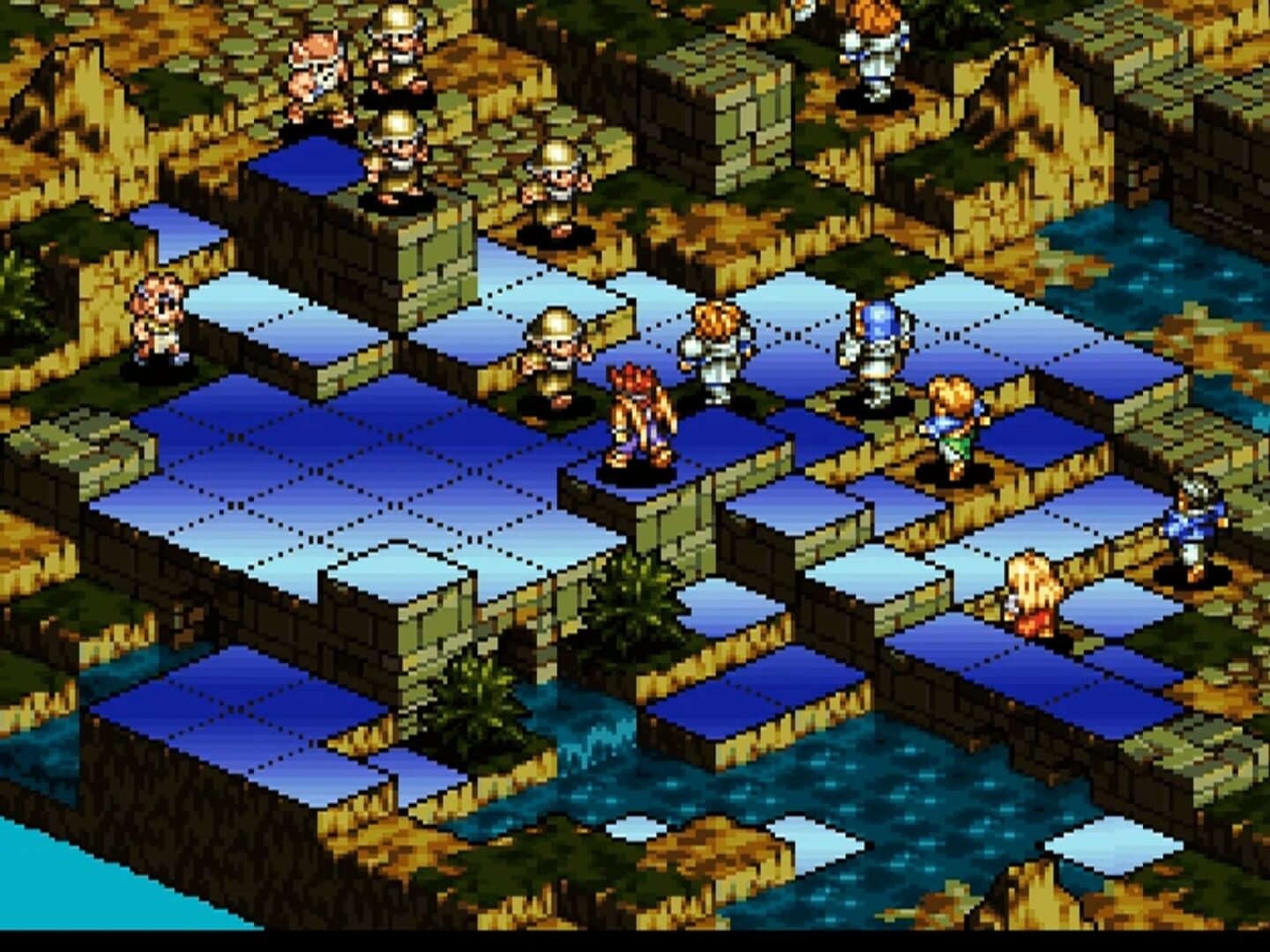
Tactics Ogre is a 3D isometric tactical role-playing game. The player starts out with a band of troops, builds a small army and fights many battles with choices to make in between, that will determine which one of the eight possible endings will be reached in a non-linear storyline. The player has the option to recruit characters, control individual equipment of each character, with over six male character classes, six female character classes, three demi-human classes, and more. It is also possible to train at safe locations to prepare the army before the next battle or storyline advancement.
- Released
- 6 October 1995
- Platforms
- PlayStationSNESSatellaviewSega SaturnWii
- Genres
- AdventureRole-playingStrategyTacticalTactical role-playingTurn-based strategyTurn-based tactics
- Developers
- Quest
- Publishers
- RiverhillsoftArtdink
- Series
- Ogre Battle
- Modes
- Single-player
- Perspective
- Bird view / Isometric
- Themes
- FantasyHistoricalSandboxWarfareRomance
- Country
- Japan
- Age ratings
- ESRB TACB PGCERO CPEGI 12USK 12GRAC 12+
- Languages
- English, Japanese
- Time to beat
- 30hmain story50hwith extras100hcompletionist
- Directors
- Yasumi Matsuno
- Composers
- Hitoshi Sakimoto
About
Tactics Ogre: Let Us Cling Together is a 1995 tactical role-playing game developed and published by Quest Corporation for the Super Famicom. It was later ported to the Sega Saturn (1996) and the PlayStation (1997), the latter released in North America in 1998 by Atlus USA. The second entry in the Ogre Battle series, the story takes place in the war-torn kingdom of Valeria, where protagonist Denim Powell works in a local resistance force against occupying powers, ending up caught in the ethnic conflicts driving the war. Battles are turn-based, taking place on grid-based maps from an overhead perspective with a focus on positioning and using character class abilities.
Production lasted two and a half years, with Ogre Battle creator Yasumi Matsuno acting as director, writer and lead designer. The storyline was inspired by conflicts in Europe and Asia, based heavily in personal and political drama over the fantasy-themed narrative of Ogre Battle: The March of the Black Queen. The gameplay, inspired by the video game Solstice, uses a chess-inspired combat system in contrast with the real-time battles of its predecessor. Hiroshi Minagawa was art director, while the characters were designed by Akihiko Yoshida. The music, composed by Hitoshi Sakimoto and Masaharu Iwata, used the narrative as inspiration and remains fondly remembered by the composers.
›Story
For eighty years, Valeria has been in constant strife, and its three leading ethnic groups all claim leadership. King Rodrick, aided by the forbidden powers of the "Palace of the Dead," is able to dominate the people of Valeria until Dorgalua of Bakram successfully leads his army to defeat Rodrick. Dorgalua then claimed the throne as his own, and was able to end the struggle between the ethnic groups. Under King Dorgalua, the rights of the people were preserved, and all internal struggles in Valeria came to a temporary halt.
All is right until the entire royal family is lost due to a string of accidents. Because the late King Dorgalua had no living heirs, the ethnic groups once again struggled for leadership: Abuna Brantyn of the royal court, Heirophant Balbatos of the Galgastani, and Duke Ronwey of the Walister all fought for control, but in the end, Balbatos and Brantyn stalemated. In order to preserve their power, the two men took separate measures: Heirophant Balbatos sought an "ethnic cleansing" policy and slaughtered thousands of innocent Walister and Galgastani, while Brantyn received aid from foreigners, the Dark Knights Loslorien of the Holy Lodis Empire.
Denam Pavel is the primary protagonist in Tactics Ogre. He is the son of Abuna Prancet, and after Prancet was taken away by the Dark Knights and his home town was massacred, Denam, his sister Catiua, and his friend Vyce plan a vendetta against the Dark Knights. He must lead the "Liberation Army" to bring freedom to the oppressed nation of Valeria.
Keywords
- anime
- medieval
- crafting
- religion
- war
- multiple endings
- class-based
- grid-based movement
- turn-based combat
- tactical rpg ( trpg )
- power glove
- single-player only
Media
The articlegameplay, story, development, reception
Gameplay
Tactics Ogre: Let Us Cling Together is a tactical role-playing game in which players take on the role of Denim Powell (renamable by the player), a soldier caught in the middle of a war in the nation of Valeria. The player moves between nodes on a worldmap, triggering story events followed by either a single battle or sequences of battles. Beginning the game, the player is asked to input the lead character's name, birthday, and answer a series of questions determining their alignment and statistics. Each movement on the world map equates to a single in-game day, which alters weather conditions.
Prior to battles, the player can equip their preferred units with chosen weapons, armor, items and accessories. Also included is a training mode, where the player controls both sides of a battle and can raise unit strength. This mode allows for two-person multiplayer in the Super Famicom release.
Story
Tactics Ogre takes place in Valeria, an archipelago united as a single kingdom under King Dolgare and worshipping a pantheon of six elemental gods, together with the Light Goddess Ishtar and the Chaos God Asmodeus. After Dolgare's apparent death with no direct heirs, the three primary ethnic groups of Valeria end up in a brief civil war, dividing into dedicated territories of varying sizes. The factions are Bacrum-Valeria, backed by the foreign nation of Lodis and ruled by its regent, Bishop Branta Mown; the Galgastan Kingdom led by Cardinal Barbatos; and the Walsta People led by Duke Ronway. After Galgastan gains the upper hand and declares itself ruler of Valeria, the neighbouring Walista are subjected to persecution and restricted to a small island.
The story opens with a small Walsta resistance group−Denim Powell, his sister Kachua, and his childhood friend Vice Bozek−attack a group of roaming Zenobian mercenaries, falsely believing their leader Lans Hamilton is the Black Knight Lans Tartare, a Lodis soldier who imprisoned Denim and Kachua's father Plancy in their childhood. The sympathetic Hamilton joins the group, bringing the old sage Warren, and Kachua vainly attempts to dissuade Denim from fighting. Denim's loyalty to the resistance is tested when Ronway orders the massacre of a town that refuses to join them, framing Galgastan for the crime. Whether Denim agrees or refuses the order, Vice disagrees and opposes him.
Development
The production of Tactics Ogre began at series developer and publisher Quest Corporation following the unexpected commercial success of Ogre Battle: The March of the Black Queen upon its 1993 release. The concept for Tactics Ogre was in place by 1992, though Matsuno's team had begun work on an untitled 3D action title which was abandoned when Quest Corporation requested a sequel to Ogre Battle. Matsuno created a multi-page detailed proposal for the game, with it taking a few months to get the project started at Quest. During this period, frustration with Quest's corporate structure had convinced Matsuno to eventually leave, but he decided to complete Tactics Ogre.
Matsuno acted as the game's director, designer and writer. Production, including later delays, lasted two and a half years, involving a team of 15 to 16 people.
Reception
The Super Famicom release has sold over 500,000 copies in Japan. The Saturn version had sold over 70,000 units by February 1997, making it one of the console's best sellers at the time. During its release month, Western PlayStation release ranked ninth in EB Games PlayStation sales charts. Japanese gaming magazine Famitsu gave the game a Gold Award as part of its review. Review aggregate website GameRankings gave the PlayStation release a score of just over 81%, based on six reviews.
Famitsu praised the implementation of the narrative into the gameplay. Electronic Gaming Monthly praised the narrative as easy to follow compared to Final Fantasy Tactics and noted its multiple endings, while a retrospective review from Nintendo Life's Gonçalo Lopes praised the story as "anything but [cliche]". Bryan Boulette of RPGamer gave extensive praise to the narrative, citing it as one of the best stories within the medium. Jeremy Tan of RPGFan was also fairly positive about the narrative due to its tone and variation, and magazine PlayStation Extreme lauded it as better than that of Tactics.
Legacy
Matsuno left Quest in 1995 once Tactics Ogre was completed, eventually joining Square (later Square Enix). Together with a number of Tactics Ogre staff members who followed him, he developed Final Fantasy Tactics (1997) for the PlayStation. Final Fantasy Tactics proved a success, and Matsuno went on to create multiple titles set within its fictional universe of Ivalice including Vagrant Story (2000) and Final Fantasy XII (2007). The latter would be his final project for Square Enix, as he departed the company in 2005 citing ill health, though he would return in later years to collaborate with Square Enix on a freelance basis. Banri Oda, a lead scenario writer for Final Fantasy XIV, cited Tactics Ogre as a direct influence on his storytelling for the expansion Shadowbringers.
While he left Quest after completing Tactics Ogre, Matsuno had been planning a third Ogre Battle title which would blend gameplay elements from the first Ogre Battle and Tactics Ogre into a mainstream experience. Quest continued production of the Ogre Battle series until 2003, when they were absorbed by Square following the completion and release of Tactics Ogre: The Knight of Lodis, a spin-off prequel to Tactics Ogre, going on to develop titles in the Final Fantasy Tactics subseries. Minagawa would reassemble most of the original staff, including Matsuno, for a PlayStation Portable remake of Tactics Ogre, released in 2010 in Japan and 2011 in the West. Released under its original title in the West and with the subtitle Wheel of Fortune in Japan, it received an expanded narrative, redesigned gameplay, artistic changes, graphical upgrades, and a new localization.
Releases by platformdates and regions as published
Title IDsone per regional release, with its latest update
Box artone per regional release we hold art for
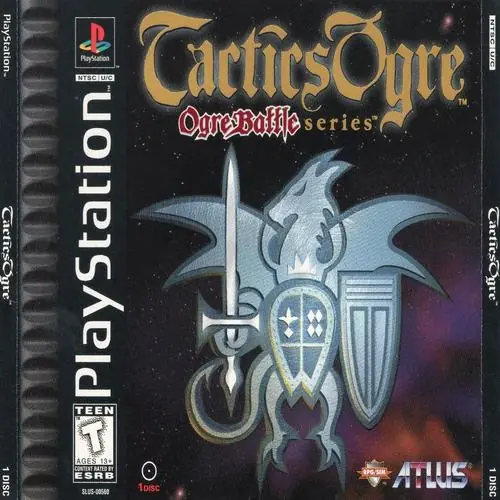
North America
PlayStation
Editions and related releases
- Derivative works
- Tactics Ogre: Wheel of Fortune
- Remade as
- Tactics Ogre: Let Us Cling Together
- Basis for
- Tactics Ogre: Reborn
- Built on it
- Tactics Ogre: RebornTactics Ogre: Let Us Cling Together
In the same series
 Timed Nintendo67
Ogre Battle: The March of the Black Queen
1993 · Legacy Mobile Device, PlayStation +4
Quest
 Nintendo exclusive92
Ogre Battle 64: Person of Lordly Caliber
1999 · 64DD, Nintendo 64 +3
Quest
 SNK exclusive
Ogre Battle Gaiden: Prince of Zenobia
2000 · Neo Geo Pocket, Neo Geo Pocket Color
Quest
 Nintendo exclusive80
Tactics Ogre: The Knight of Lodis
2001 · Game Boy Advance
Quest
 PlayStation exclusive82
Tactics Ogre: Reborn
2010 · Remake · PlayStation Portable
Square Enix
Games like this
 PlayStation exclusive89
Final Fantasy Tactics: The War of the Lions
2007 · Expanded · Android, PlayStation Portable +1
Adventure · Role-playing
 76
Brigandine: Abyss
2020 · Nintendo Switch, Nintendo Switch 2 +2
Role-playing · Strategy
 Nintendo exclusive89
Fire Emblem: Three Houses
2019 · Nintendo Switch
Adventure · Role-playing
 70
The Age of Decadence
2015 · Linux, Windows +1
Role-playing · Strategy
 85
Unicorn Overlord
2024 · Nintendo Switch, PlayStation 4 +2
Role-playing · Strategy
 Timed PlayStation82
Valkyria Chronicles 4
2018 · Nintendo Switch, PlayStation 4 +3
Role-playing · Strategy
 Timed PlayStation73
Utawarerumono: Itsuwari no Kamen
2015 · Nintendo Switch, PlayStation 3 +3
Role-playing · Strategy
 Timed PlayStation84
Utawarerumono: Mask of Truth
2016 · Nintendo Switch, PlayStation 3 +3
Role-playing · Strategy
Collections1 collection
Genres
- Turn-based tactics gamesList of released games
Description adapted from its source, CC BY-SA 4.0.