The articlegameplay, story, development, reception
Gameplay
The main objective of Taiko no Tatsujin games is to hit a special taiko drum controller, or a virtual equivalent, in rhythm with a selected piece of music. Players must strike the drum in time with the notes that scroll from right to left on the screen.
A song is cleared when the spirit gauge is filled beyond the target by achieving sufficient accuracy by the end of the song.
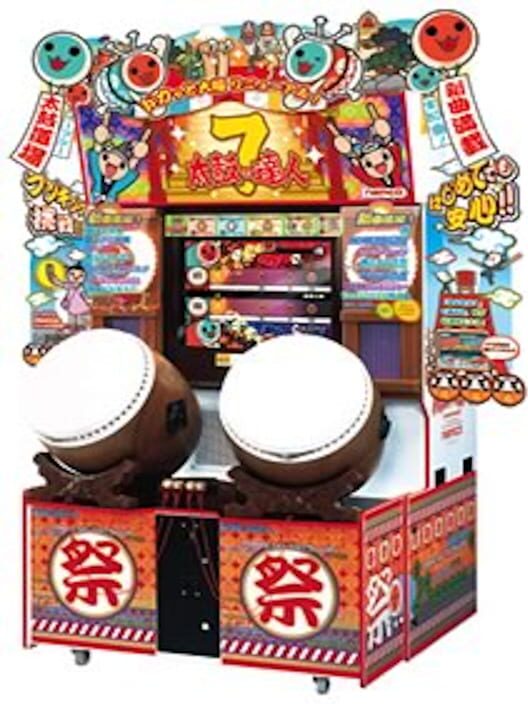
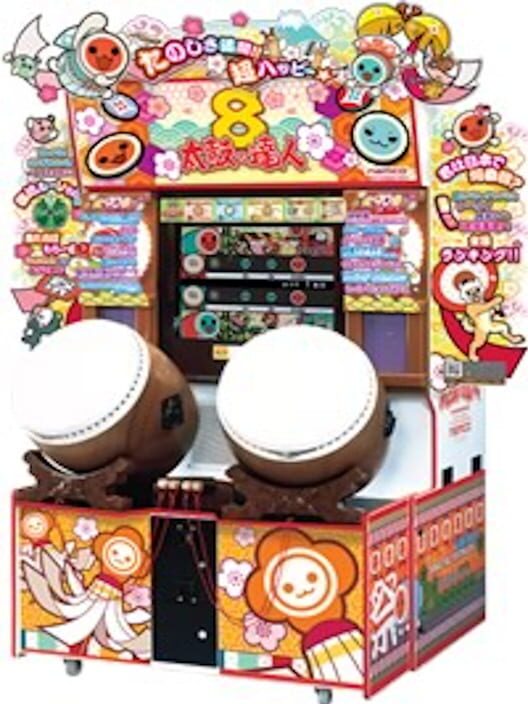
Arcade versions of Taiko no Tatsujin are equipped with simulated taiko drums that register hits when struck with drumsticks (bachi).
Console versions primarily use buttons for gameplay, although certain devices support additional input methods:
A virtual taiko drum is available on devices with touchscreens (such as the DS, 3DS, Wii U, iPod Touch, smartphones, and Nintendo Switch), which can be played using either a stylus or fingers.
Dedicated drum peripherals simulating real taiko drums can be purchased separately for the PS2, Wii, Wii U, PS4, and Nintendo Switch versions. This peripheral is included with the physical North American release for the PlayStation 2 and the European release for the Nintendo Switch.
The variety of notes in the game primarily consists of red and blue markers. The red don (ドン) note requires the player to strike the face of the drum, while the blue ka (カッ) note requires striking the rim.
Additional note types require rapid, consecutive hits on the drum. These include the yellow bar, the balloon note (referred to as a "burst note" in Taiko: Drum Master), and the Kusudama ball (represented as a yam in older releases starting from the PlayStation 2 Godaime version, or as a Mallet note in Drum Session! and Drum 'n' Fun!).
Unlike other rhythm games such as Guitar Hero, the drumming in Taiko no Tatsujin serves as an accompaniment rather than replacing an instrument in the music. Missing a note does not result in off-key sounds or interruptions to the background track, and players are free to strike the drum at any time, provided it does not interfere with nearby notes that could trigger a penalty.
Most games in the Taiko no Tatsujin series offer four main difficulty levels: Easy, Normal, Hard, and "Oni", known as "Extreme" in the English versions of Drum 'n' Fun, Drum Session, and the arcade releases. Oni represents the highest standard difficulty level. In addition, since the console game "Oni" certain songs may have a 5th difficulty level called "Ura Oni", however it is still called "Oni" in the in-game difficulty menu.
The sequence of notes in each level is referred to as a notechart.
==== Inner notecharts ====
First appearing in Taiko no Tatsujin Wii: Dodon! to Nidaime, some songs feature additional inner notecharts, often referred to by fans as "Ura Oni." These serve as alternative versions of the standard notecharts and are typically more challenging. Although originally available across multiple difficulty levels, inner notecharts later became exclusive to the Oni/Extreme level.
In some cases, inner notecharts alter the arrangement or version of a song, and in arcade releases, they may even switch to an entirely different track. Beginning with the third-generation arcade release in 2011, these inner versions became categorized as separate songs.
==== Notechart branching ====
Certain songs include notechart branching within specific difficulty levels. Depending on the player's performance, the game dynamically switches between the Normal notechart, Professional notechart, or Master notechart. In some songs, such as "Hyakka Ryoran," a drumroll appears at the beginning, allowing the player to choose among the three notechart paths.
Various aspects of gameplay in Taiko no Tatsujin can be customized according to the player's preference:
Players can select alternative instruments or sound effects to replace the traditional taiko drum sounds.
Gameplay modifiers can be applied to adjust elements such as note speed, reversed notecharts (with red and blue notes swapped), or randomized note arrangements.
In console versions, players can enable the "Auto" mode to have the notechart played automatically and perfectly; however, scores are not recorded in this mode. Additional options include "Perfect", which ends the song immediately after the first missed note, and "Spartan", which restarts the entire song upon a missed note.
Development
Following the successes of Beatmania (1997) and Dance Dance Revolution (1998), both released by Konami, Namco had originally planned to develop a guitar-based rhythm game for arcades. ; and Million Hits). As a result, in 2000, director Ken Nakadate and visual art director Takehito Sasaoka would propose a taiko-based game instead, with the latter demonstrating the basic concept by attaching tape to the bottom of a plastic bucket and striking it with sticks in time with music. Managing Director Yukio Ishikawa would commission a prototype to be used as part of a location test in Yokohama in the summer of 2000: although the sales department had predicted that Namco would only be able to sell 100 units to arcades, the test proved to be extremely popular.
The advanced age of CEO Masaya Nakamura, who was 75 at the time of development and would retire in 2002, had previously led to rumours within the company that he was losing interest in video games as a whole. Despite this, he would continue to playtest the company's new games. When it came to test the prototype, he would begin to play it before the team had finished explaining the project; afterwards, he turned to them, smiled, and simply said "this is good." Nakamura would then name the game Taiko no Tatsujin.
The main character of the game was originally intended to be a realistic young man wearing only a fundoshi, a traditional Japanese undergarment: although he was intended to fit in with the theme of a Japanese festival, this was rejected for being too surreal. Don-chan, Ka-chan, and the other characters were then created by a designer unrelated to the project, Yukiko Yokō, who had joined Namco in 1994: after she sketched a "taiko alien" due to the game having been demonstrated throughout the company building, she was brought onto the game and would continue to work on the franchise until 2007.
Reception
Taiko no Tatsujin games have generally received favourable reviews from critics. Most console and handheld releases received Famitsu scores of over 30 out of 40. Taiko: Drum Master received a 77-point Metacritic score based on 35 reviews.
As of 2019, the series has sold over 10 million copies on consoles.