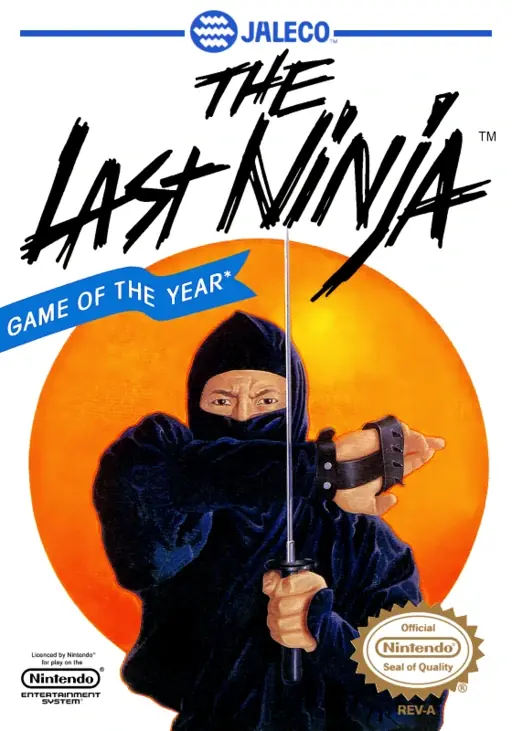

The articlegameplay, story, development, reception
Gameplay
The Last Ninja contains a blend of exploration, puzzle solving, and combat. The object of the game is to guide the ninja protagonist Armakuni on his journey to the palace of the evil shogun Kunitoki to assassinate him, avenge his clan, and retrieve the sacred scrolls. As the player progresses, Kunitoki's henchmen become more challenging as they learn the ways of the ninja.
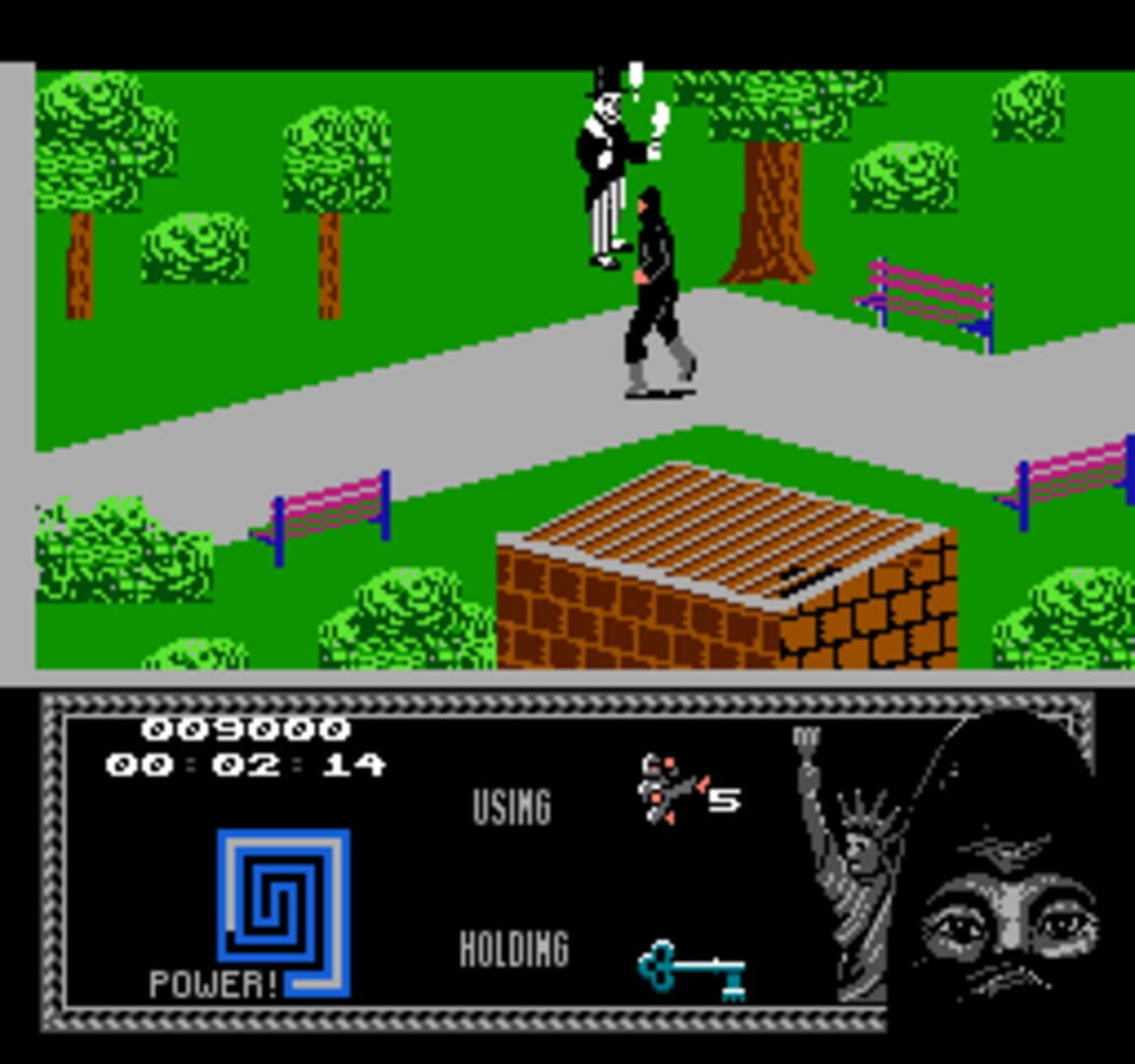
The interface consists of the opponents' energy and collected inventory (on the right) and player's health (on the bottom). The world is viewed in an isometric perspective allowing the player to move in eight directions. Movements are relative to the direction Armakuni is facing but restricted to predefined paths upon inaccessible scenery. Precision must be used when navigating and jumping around obstacles, traps, and fatal features of the terrain.
Story
For centuries, the clan of the Fujiwara reigned Japan; they trained themselves in the ways of the Ninjutsu to be the best warriors.
The evil Shogun Kunitoki had long been envious of the ways of the Ninjutsu and yearned to discover the secrets of their magic powers, as documented in the sacred Koga Scrolls. Once in every decade the Ninjutsu met on the island of Lin-Fen, where they paid their last respects to the shrine of the "White Ninja", to get further fine-tuning.
Development
The program was originally developed for System 3 in Hungary for almost a year by a team called SoftView (an internal development team of Novotrade Software) but the financial advance for the work was refunded and the Hungarian team was uncredited for its work. SoftView developed it in its proprietary Forth-like language as a foundation for portability. A lot of time was spent developing the programming language and game engine. The team had some of the levels done, but missed all the deadlines, so the code was returned to London by Cale, and the engine rewritten for the Commodore 64 by John Twiddy.
Cale said: "Basically, the whole idea – the whole concept – was mine. The vision of The Last Ninja as an isometric adventure was something I was very passionate about. Obviously, the machines back then weren't powerful enough to create fully 3D games, so an isometric viewpoint seemed to be the right solution to move away from the standard side-scrolling platform games. We wanted to do something a bit different, something that would really capture the imagination.
Reception
Computer Gaming World stated that "there is no exaggerating the graphic excellence of" The Last Ninja. It was very successful as an original Commodore 64 game. In Europe, its sales alone were in excess of 750,000 units and international multi-format sales exceeded 2,000,000 units. According to System 3's Mark Cale, about 4 million copies of the game were sold in all. It was the best-selling C64 game at the time.
The game won many awards and was universally critically acclaimed as original and ground-breaking. It was a runner up for Game of the Year at the Golden Joystick Awards '88. According to UGO: "For a 20+ year old game, The Last Ninja is surprisingly advanced, sporting a combat system which allows specific body parts to be targeted, environmental obstacles, multiple weapons and hidden items galore".