
- 84/100
- Critics1 review
1995 · Bethesda Softworks · First-person shooter · Shooter
The Terminator: Future Shock
The Terminator: Future Shock is a first-person shooter computer game released by Bethesda Softworks in 1995.
- Released
- 1995
- Platforms
- MS-DOS
- Genres
- First-person shooterShooter
- Developers
- Bethesda Softworks
- Publishers
- Bethesda Softworks
- Series
- Terminator
- Modes
- Single-player
- Perspective
- First person
- Themes
- ActionScience fiction
- Engine
- XnGine
- Country
- United States
- Age ratings
- USK 18ACB PGESRB T
About
The Terminator: Future Shock is a first-person shooter video game for MS-DOS developed by Bethesda Softworks and released in 1995. It is based on the Terminator franchise. The game received generally positive reviews, and a sequel, Skynet, was released in 1996.
Keywords
- post-apocalyptic
- robots
- futuristic
- licensed game
- resistance
- useable vehicles
- tie-in
Media
The articlegameplay, story, development, reception
Gameplay
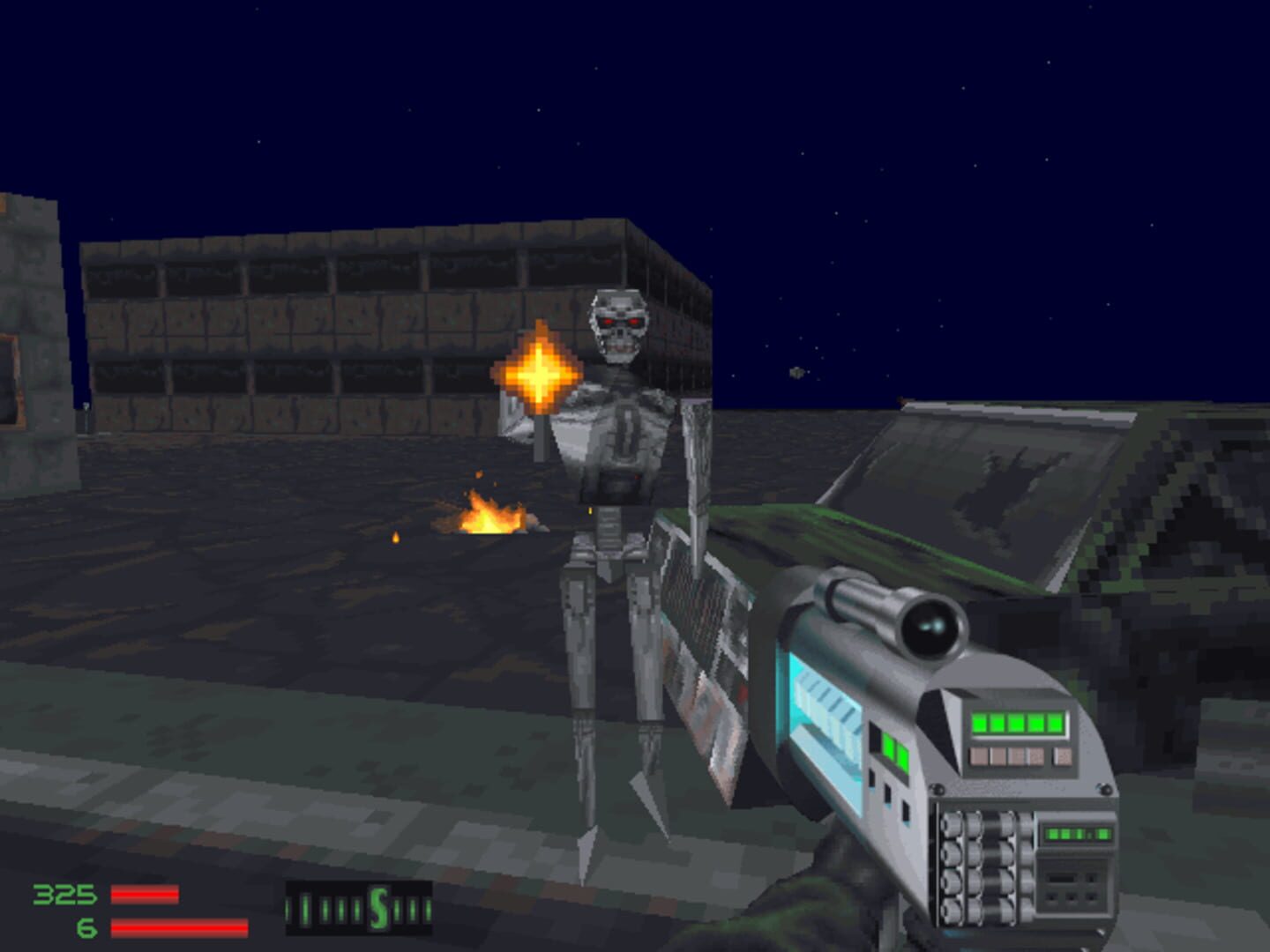
Future Shock is a first-person shooter in which the player navigates 3D levels in a post-apocalyptic world while fighting enemy robots with a wide variety of guns and grenades. Each level requires the player to accomplish a number of objectives before progressing. Levels include harsh terrain, as many areas contain radiation that is lethal to the player character. The terrain is navigated in three ways: on foot, in a jeep with a mounted cannon, or in an aerial combat robot, referred to as an HK fighter.
Future Shock is single-player only. A multiplayer deathmatch mode was added to the sequel, Skynet.
Story
Set in a post-apocalyptic future, The Terminator: Future Shock begins in 2015 with the player character escaping from an extermination camp with the help of the Human Resistance. After escaping, the character is introduced to John Connor, the leader of the Human Resistance, as well as a young Kyle Reese and begins aiding the resistance effort with missions. After several missions, T-800 model Terminators infiltrate the Human Resistance headquarters, causing its leadership to establish a new headquarters elsewhere. The player character later witnesses enemies appearing out of nowhere, eventually learning that Skynet has perfected time displacement.
As a result of the successful resistance missions, Skynet from the future begins manipulating time by strategically placing its forces to thwart successful resistance maneuvers. The Human Resistance learns that Skynet is using time displacement to transmit information to itself in 1995 in an attempt to increase the speed at which it will become sentient. The player character is sent on a mission to stop Skynet as the resistance HQ is besieged and Kyle Reese and Connor himself are seriously wounded.
Development
Bethesda Softworks developed the game using its XnGine 3D graphics engine, which the company had invested over $3 million into developing. Todd Howard produced the title. The XnGine engine incorporated technology advances to portray more realism in games, such as quicker action, unrestricted viewing angles, and freedom of movement. Its proprietary technology integrates 360-degree rotation with fully textured polygons, SVGA/VGA graphics and specialized video effects.
XnGine can generate weather effects, such as snow, sleet and fog; realistic shading; and textured, contoured terrain. Howard described the engine as a true 3D engine capable of real-time phong shading, which helps simulate area lighting effects from sources of light in the environment. Future Shock was developed by a team of 8–10 people. It was one of the first games in the first-person shooter genre to feature fully texture-mapped 3D environments and enemies, as well as one of the first to use mouse-look control.
Reception
The Terminator: Future Shock received generally favorable reviews from gaming publications. In the United Kingdom, the game ranked 5th in the best-sellers CD-ROMs for PCs during the week of February 25, 1996 according to the European Leisure Software Publishers Association.
Tal Blevins of GameSpot praised several aspects of the game. He described the game environment as "well thought-out", the control system as "smooth", and the audio-visuals as "superb", noting the familiar movie soundtrack. Phil Bedard of Computer Games Magazine compared the game to Doom, "but with some things thrown in that make it different". Bedard praised the music and stereo sound effects but wished that the game supported a higher resolution. He criticized the character controls, calling them difficult, as well as the occasional gameplay lag caused by a large number of game objects and the lack of network play.
Releases by platformdates and regions as published
In the same series

The Terminator (DOS)
1990 · MS-DOS, Windows
Bethesda Softworks
 64
Terminator 2
1991 · Amstrad CPC, Atari ST +5
 Nintendo exclusive
Terminator 2 (Game Boy video game)
1991 · Port · Game Boy
- 64
Terminator 2: The Arcade Game
1991 · Arcade, SNES +1
Midway Games
- 64
Terminator 2 (8-bit video game)
1992 · Game Gear, Master System +3
Software Creations
 Sega exclusive59
The Terminator (Sega video game)
1992 · Game Gear, Master System +2
Acclaim Studios London

The Terminator 2029
1992 · MS-DOS
 87
RoboCop Versus The Terminator
1993 · Game Boy, Game Gear +5
Virgin Interactive
- 64
Terminator 2 (16-bit video game)
1993 · SNES, Sega Genesis
 Sega exclusive
The Terminator (Sega CD video game)
1993 · Remake · Sega CD
Virgin Interactive

The Terminator: Rampage
1993 · MS-DOS
Bethesda Softworks

SkyNET
1996 · MS-DOS
Bethesda Softworks

Terminator: Dawn of Fate
2002 · PlayStation 2, Xbox
Paradigm Entertainment
 42
Terminator 3: Rise of the Machines
2003 · Game Boy Advance, GameCube +3
Black Ops Entertainment

Terminator 3: War of the Machines
2003 · Windows
 72
Terminator 3: The Redemption
2004 · GameCube, PlayStation 2 +1
Paradigm Entertainment
 40
Terminator Salvation
2009 · PlayStation 3, Windows +3
Grin

Terminator Genisys: Future War
2017 · Android, iOS
Plarium
 61
Terminator: Resistance Enhanced
2019 · PlayStation 4, PlayStation 5 +2
Games like this
 70
Strife
1996 · Linux, MS-DOS +2
First-person shooter · Shooter
The Terminator: Dawn of Fate
2002 · PlayStation 2, Xbox
Shooter · Post-apocalyptic
- 70
Strife: Quest for the Sigil
1996 · Linux, Windows +2
First-person shooter · Shooter
 58
Alpha Prime
2007 · Windows
First-person shooter · Shooter

Take No Prisoners
1997 · Windows
Shooter · Post-apocalyptic
 PlayStation exclusive70
Project Eden
2001 · PlayStation 2, Windows
First-person shooter · Shooter
 55
Chrome
2003 · Windows
First-person shooter · Shooter
 78
Gunman Chronicles
2000 · Windows
First-person shooter · Shooter
Collections1 collection
Genres
Description adapted from its source, CC BY-SA 4.0.