
The articlegameplay, story, development, reception
Gameplay
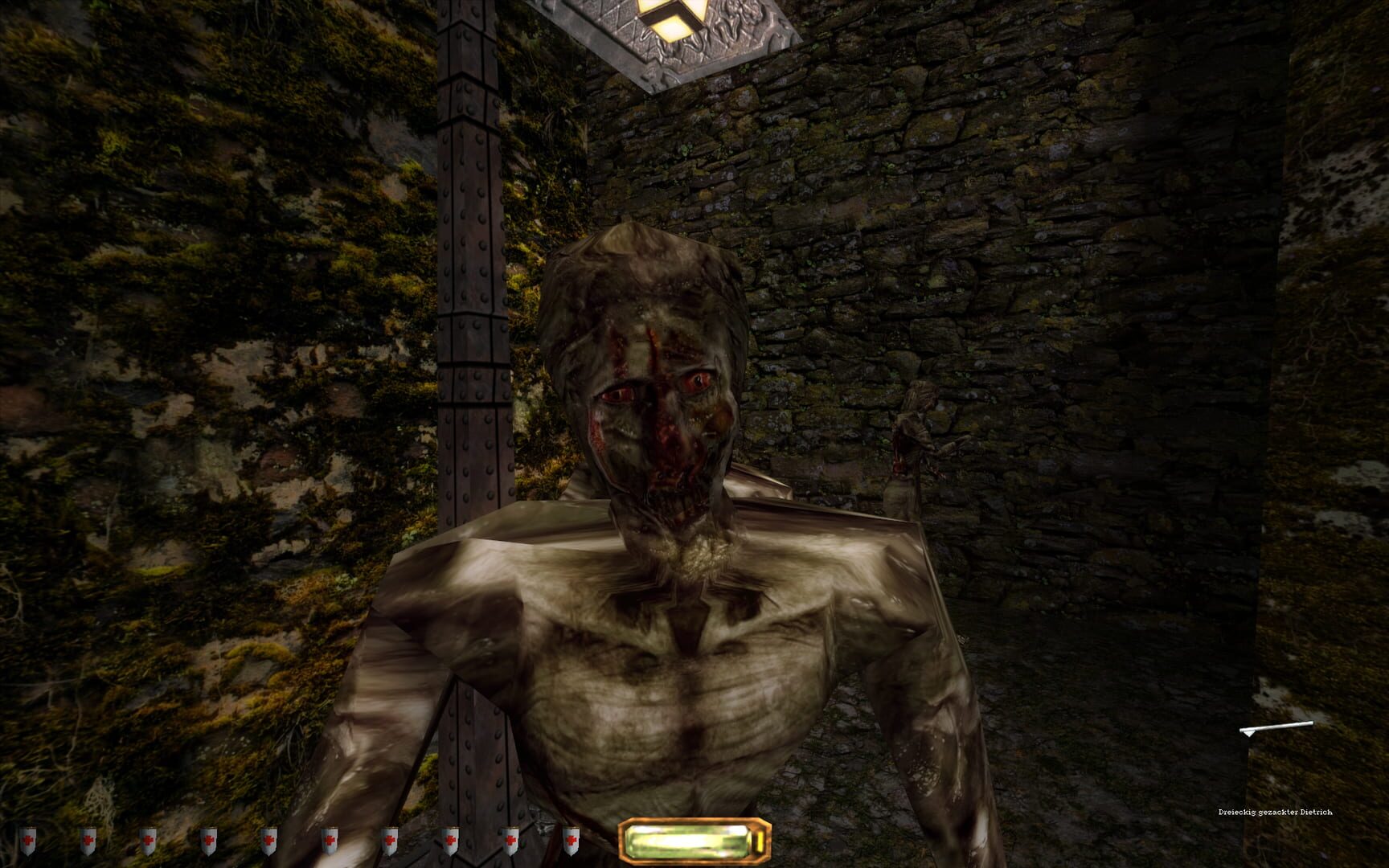
Thief takes place from a first-person perspective in a 3D environment, with the game's story taking place over a series of missions, in which the player character is able to perform various actions such as leaning, crouching, swimming, climbing, running and fighting, amongst other abilities. Levels are largely unscripted and maze-like, and allow for emergent gameplay; while non-player characters (NPCs) may either remain stationary or walk about on a patrol route, players have the freedom to choose how to get around them and the obstacles in a level's environments in order to complete specific tasks, such as getting through a locked door. In each level, the player is given a set of objectives to complete, such as stealing a specific object, which they must complete in order to progress to the next level. The player can choose to play on one of three difficulty settings before starting a level, which they can change between missions, with higher difficulties adding additional objectives such as not killing human NPCs or stealing a certain amount of loot from the amount available in a level, changing the amount of health the player character has, and changing how sensitive an NPC is to their environment. In some missions, players may find objectives being changed or new ones being added, due to certain circumstances they encounter, while failing a key objective or dying will fail a level, forcing a player to either replay it or load up a previous save.
As the game's emphasis is on stealth, players are encouraged to focus on concealment, evasion, distraction, misdirection, and subtle takedowns, rather than on outright confrontation; the player's character can engage in sword-based combat when the need arises, and can perform three different attacks as well as parrying, but has limited proficiency and damage resistance in such circumstances. To do so, players must remain aware of their surroundings. To assist them in remaining hidden, a special meter on the heads-up display (HUD), in the form of a gem, helps to indicate the player's visibility to NPCs; the brighter it is, the more easily they can be visually detected, thus sticking to dark, shady spots where the gem dims ensures the player is hidden, though NPCs can still find them if they get too close in front of them. To remain quiet, players must be careful of how much noise they produce, as well as what surfaces they are moving over; walking on soft surfaces like carpets and grass is preferable as footsteps remain quiet, compared to walking over metal floors and ceramic tiles, which produce a lot of noise.
Story
Thief takes place in a metropolis called "the City", which has been noted to contain elements of the Middle Ages-like dark fantasy and the Industrial Revolution. Project director Greg LoPiccolo said in an early preview: "In essence [... it's] this undefined medieval age, sort of medieval [Europe] meets Brazil meets City of Lost Children. There's some electricity, some magic, and some 19th century machinery kind of stuff."
The setting has been described as steampunk, a fantastical setting where steam engine technology is prominently used. It has also been argued that Thief is one of the earliest examples of the New Weird genre. During levels, the player may learn about the setting by finding notes and overhearing conversations; it has been noted that the player participates in the revelation of Thief's setting.
Development
Thief began development in April 1996. For the game's original designer and writer Ken Levine, credited by The Telegraph as "a key figure in the creation" of Thief, inspirations came from two of his favourite games, Castle Wolfenstein and Diablo. The initial concept was to make an action role-playing game and Levine was given the job of designing the game's world and story. Levine said the initial ideas and projects that have later morphed into Dark Camelot, before eventually evolving into The Dark Project, included School of Wizards, Dark Elves Must Die and Better Red Than Undead, the latter of which was "a campy story" about communist zombies.
The game was supposed to be a first-person sword fighting simulator, but "the marketing [department] killed the idea," to his disappointment. According to programmer Marc LeBlanc, "The first proposal was Better Red Than Undead, a '50s Cold War game where the Soviet Union is overrun with zombies and you have to go hack them to pieces as the loner from the CIA because bullets don't work on the undead." Doug Church said the game's design was built around the idea "of having factions who you could ally with or oppose yourself with or do things for or not."
Reception
com. Lance A. Larka of Computer Gaming World wrote: "If you're tired of Doom clones and hungry for challenge, give this fresh perspective game a try. I was pleasantly surprised."
Emil Pagliarulo of The Adrenaline Vault wrote: "I will tell you, without reservation, [...] that this has become my favorite game of all time." Paul Presley of PC Zone called it "a bloody good game".
Legacy
Thief was one of the first 3D stealth games for a personal computer, and its stealth gameplay innovations influenced later games in the genre. The game has been cited as the first to use light and shadow as a stealth mechanic, and the first to use audio cues, such as the ability to eavesdrop on conversations and alert guards with loud footsteps. The game's use of sound wave propagation, which allowed sounds to travel around corners and through rooms, became widely considered by game developers. Thief's influence has been recognized in other stealth games, such as Assassin's Creed, Hitman, Splinter Cell, and Tenchu.
Marc Laidlaw, writer and designer on Half-Life, said that "Thief is the single most terrifying, immersive, and rewarding game I have played and the one single-player game I continue to replay. [...] There are countless books I wish I had written; Thief is one of the few games I wish I had worked on." Laidlaw called Thief his favorite game, an opinion shared by Fallout 3 lead designer Emil Pagliarulo, and Michel Sabbagh of Bethesda Softworks.


