
The articlegameplay, story, development, reception
Gameplay
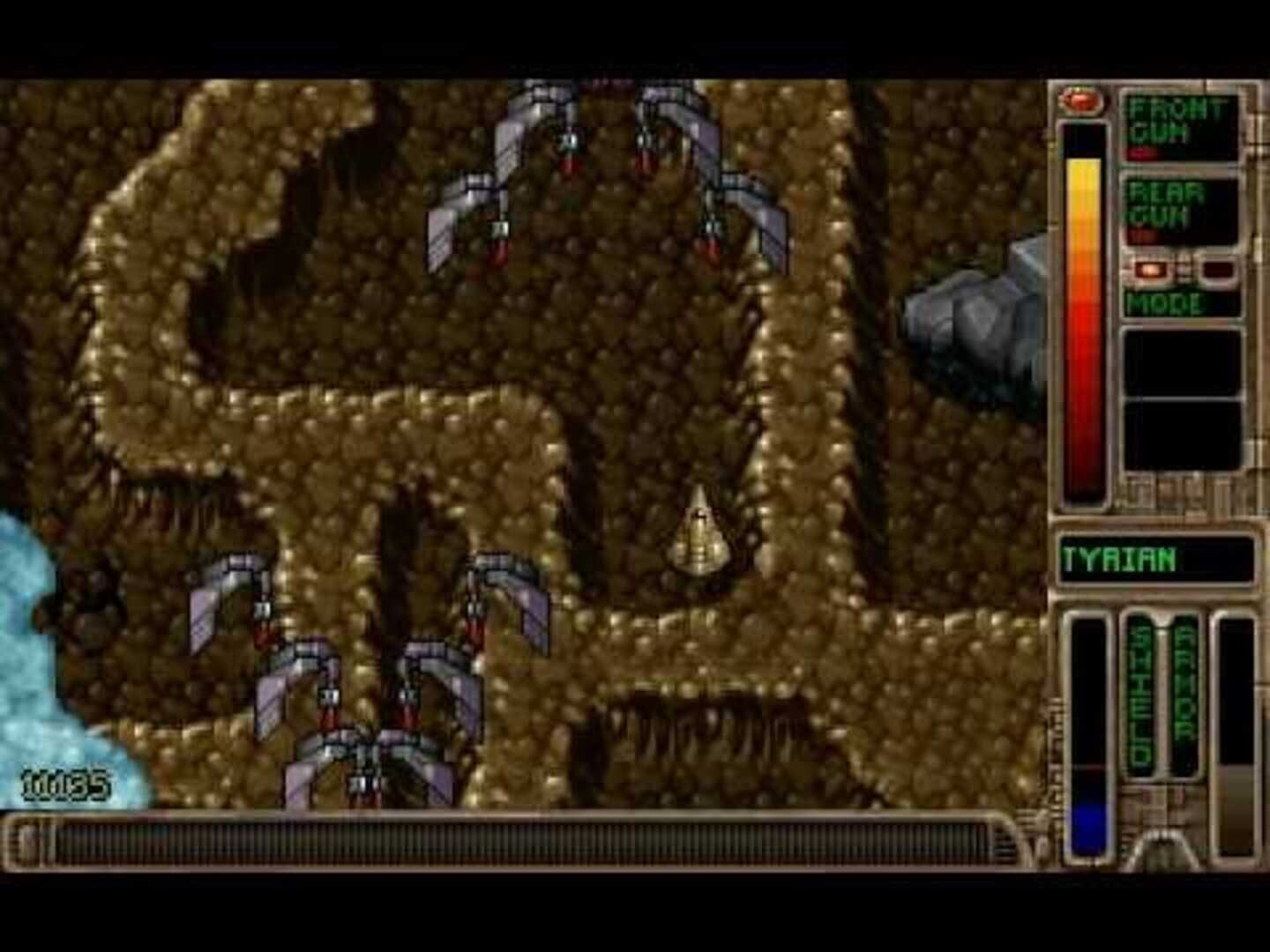
Tyrian follows the conventions of vertically scrolling shooters with forced forward movement. It was developed chiefly as a homage to the works of Compile, particularly their Zanac series.
The player controls a space ship fitted with different weapons (front and back, linked to the same button, and up to two external pods with their own buttons) and other equipment. The game presents a variety of enemies (some flying, some fixed, some on rails) and bosses, with many occurrences of fixed and/or indestructible obstacles. Before the player's starship is destroyed it must take enough damage to exhaust several points of shields (which regenerate over time) and armor.
Story
The game is set in the year 20,031. The player takes on the role of Trent Hawkins, a skilled spaceship pilot. While on the planet Tyrian, a hostile drone shoots his best friend, Buce Quesillac. Before dying Buce warns Trent that the drone belonged to the militaristic MicroSol megacorporation.
MicroSol has discovered Gravitium (the game's brand of Unobtainium) on Tyrian and seeks to keep it a secret. Now on MicroSol's hit list, Trent manages to secure a small, armed spacecraft and set out to the free world of Savara.
Development
Tyrian was developed by a credited total of 11 people, with "three main drivers": Alexander Brandon (composer and writer), Jason Emery (programmer and level designer), and Daniel Cook (artist and interface designer). For the aforementioned developers, Tyrian was their first commercial video game.
The origins of Tyrian began as an experiment in 1991, with a young Jason Emery showing his friend Alexander Brandon the preliminary workings of a scrolling background. The two continued developing, and eventually decided the work could be shown to a game company. Brandon wrote a proposal document and sent it to the two leading shareware game publishers of the time, Epic MegaGames and Apogee. However, the game lacked any sound or music, and the graphics were "definitely not professional". As such, "neither got overly excited", but both showed interest.
Reception
The game mostly received positive reviews. Tyrian scored 87% in PC Gamer (one percent below their Editor's Choice award). A reviewer for Next Generation complimented the use of a shop system for acquiring powerups, the ability to save games at any time, and the inclusion of a storyline to provide a reason behind "killing everything you see." He scored the game four out of five stars.
Computer Gaming World nominated Tyrian as "Action Game of the Year". The original developers Jason Emery and Alexander Brandon considered Tyrian's reception "far more" than their expectations.
Legacy
In February 2007 the Pascal and x86 assembly source code for Tyrian was delegated to a small group of developers to re-write in C, in a project named OpenTyrian, licensed under the GNU GPL-2.0-or-later. Jason Emery released Tyrian in 2007, along with some Game Boy and Game Boy Advance versions. Following that announcement, in April 2007 Daniel Cook announced the free availability of his Tyrian artwork (not including the later work for the Game Boy Color edition and for Tyrian 2000) under generic liberal terms of the open content Creative Commons Attribution 3.0 License.
In 2026, a fan-made remake based on the OpenTyrian code, OpenTyrian2000 Enhanced Edition, was released as free software for Windows, macOS and Linux, adding optional high-definition graphics, local co-op and mod support.


