
The articlegameplay, story, development, reception
Story
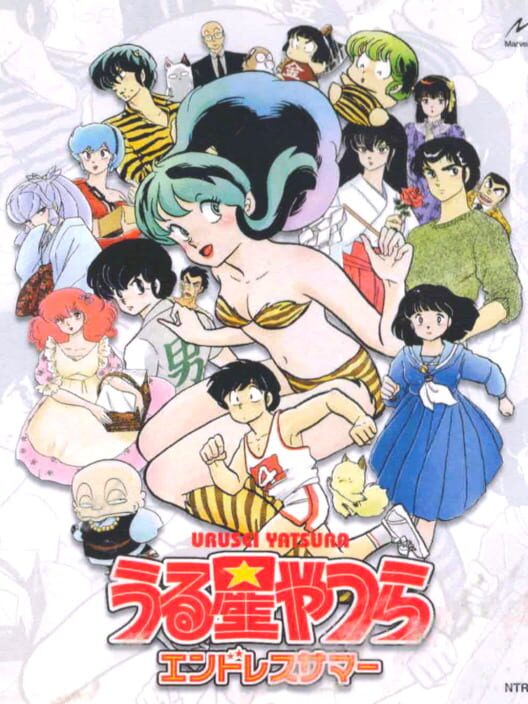
An alien race known as the Oni arrive on Earth to invade it. Instead of taking over the planet by force, the Oni give humans a chance to fight for the rights to the planet by taking part in a competition. The competition is a variant of the game of tag (known as "the game of the Oni" in Japanese), in which the human player must touch the horns on the head of the Oni player within one week. The computer-selected human player is Ataru Moroboshi, a lecherous, unlucky and academically unsuccessful high school student from the fictional Tomobiki Town (友引町, Tomobiki-chō) in Nerima, Japan, and the Oni player is Lum, daughter of the leader of the alien invaders.
Despite his initial reluctance to take part in the competition, Ataru becomes interested in the game when he meets Lum. When the competition begins, Lum surprises everyone by flying away and Ataru finds himself unable to catch her. Before the last day of the competition, Ataru's girlfriend Shinobu Miyake encourages Ataru by pledging to marry him if he wins. On the final day of the competition, Ataru wins the game by stealing Lum's bikini top, which prevents her from protecting her horns in favor of protecting her modesty.
In celebrating his victory, Ataru expresses his joy at being able to get married; however, Lum misinterprets this as a proposal from Ataru and accepts on the competition's worldwide live television broadcast. Despite the misunderstanding, Lum falls in love with Ataru and moves into his house.
Despite Ataru's lack of interest in Lum and attempts to rekindle his relationship with Shinobu, Lum frequently interferes and Shinobu loses interest in Ataru. Still, Ataru's flirtatious nature persists despite Lum's attention. Lum attempts to stop him from flirting, which results in Ataru receiving powerful electric shock attacks from Lum as punishment. Two characteristics of Ataru are particularly strong: his pervertedness and his bad luck that draws to him all bizarre residents of the planet, the spirit world and even the galaxy.
Later Lum begins attending the same school as Ataru despite his objections. Lum develops a fan base of admirers among the boys of the school, including Shutaro Mendo, the rich and handsome heir to a large corporation that all the girls from Tomobiki have a crush on. Despite their romantic interest, none of Lum's admirers will risk upsetting Lum by trying to force her and Ataru apart, although this does not stop them from trying to get Ataru punished due to his bad behavior, and interfering every time the two get close.
Development
In 1977, Rumiko Takahashi created the short story "Those Selfish Aliens", which was nominated for Shogakukan's Best New Comic Artist award. This served as the basis for creating Urusei Yatsura, which was first published a year later when Takahashi was 20 years old. The series was her first major work, having previously only published short stories, and is a combination of romantic comedy, science fiction, suburban life, and Japanese folktales. The title of the series is an untranslatable pun on the word urusai (うるさい), meaning "noisy" or "obnoxious", but written with the kanji for "planet"; the title can be translated roughly into English as "Those Obnoxious Aliens".
The series first appeared in Shogakukan's Weekly Shonen Sunday in September 1978. At the start of the series it was only scheduled to run for five chapters. Ataru was the central character and each chapter would feature a different strange character. The character of Lum was only going to appear in the first chapter and was not in the second chapter; however, Takahashi decided to re-include her in the third chapter.
The series was not an instant success and chapters were initially published sporadically due to Takahashi still being in university at the time. Between May and September 1978 she simultaneously worked on a series called Dust Spot; however, the increasing popularity of Urusei Yatsura caused her to focus on Urusei and the series became a regular serialization from the middle of 1979.
Takahashi said that she had been dreaming about the overall universe of Urusei Yatsura since she was very young. She said that the series "really includes everything I ever wanted to do. I love science fiction because sci-fi has tremendous flexibility. I adopted the science fiction–style for the series because then I could write any way I wanted to".
She wanted the reader to be completely surprised by the next panel and used slapstick comedy to create a reaction in the reader. When Takahashi ran out of ideas she would create new characters. Takahashi shared a small 150-square-foot (14 m2) apartment with her assistants, and slept in a closet due to a lack of space. While writing Urusei Yatsura she also began work on Maison Ikkoku and used this experience as well as her university experience as the basis for the setting of that series.
Character names often carry extra meanings used to describe a characters personality or other traits. For example, the name Ataru Moroboshi refers to being hit by a star, a reference to the aliens and other people who gather around him. The name Shinobu suggests a patient character; however, this in contrast to the character's actual personality. In a similar way, the setting for the series is "Tomobiki", which means "friend taking".
Tomobiki is also the name of a superstitious day in the old Japanese calendar system considered to have "no winners or losers" and occurred on every sixth day. Funerals rarely took place on this day as it was believed more deaths would soon follow. Lum was named after Agnes Lum, a bikini model during the 1970s. Lum's use of the English word "Darling" in reference to Ataru was to emphasize her status as a foreigner, as well as a play on the name Darrin, the husband figure from Bewitched.
The characters of Megane, Perm, Kakugari and Chibi are recurring characters throughout the first anime adaptation; however, in the manga they are nameless fans of Lum who appear less after Mendo is introduced. In contrast the character Kosuke Shirai plays a large role in the manga, but does not appear in the first anime series. His role is often performed by Perm. The second half of the first anime adaptation is closer to the manga than the first half.
In 2022, Takahashi said that Urusei Yatsura ended because she saw that Shinobu was happy after the character Inaba had been introduced. Takahashi has stated that she will not produce any more content for the series.
Reception
By November 2020, Urusei Yatsura had over 35 million copies in circulation. In 1985, the franchise generated ¥10 billion ($63.16 million) in merchandise sales. The manga won the 26th Shogakukan Manga Award in the shōnen category in 1980. It was awarded the "Best Comic" category at the 18th Seiun Award in 1987. On TV Asahi's Manga Sōsenkyo 2021 poll, in which 150,000 people voted for their top 100 manga series, Urusei Yatsura ranked 61st.
In Manga: The Complete Guide, Jason Thompson referred to Urusei Yatsura as "A slapstick combination of sci-fi, fairy-tale and ghost-story elements with plenty of cute girls." He also noted that Lum is "the original otaku dream girl." He awarded the series four stars out of four. Graham Higgins of The Independent praised the series.
He further wrote that the experience of reading Urusei Yatsura is "a bit like channel-hopping between The Outer Limits, Neighbours, and Star Trek." org, Fred Schodt expressed surprise at the popularity of the original English release of the manga as he believed the cultural differences would be a problem. Reviewing the 2019 English release of the manga, Arpad Lep of Comics Beat called Urusei Yatsura an impressive, essential debut by a living legend of comics, where "many themes and archetypes integral to her whole body of writing emerge already very well-developed." He compared its story to those by Shigeru Mizuki and its art, which he had strong praise for and noted gets better in just the first two volumes alone, to that of Go Nagai.
Lep said Takahashi nails the many gags and physical comedy, with the series' stability from the never-changing sitcom elements of "Disappointed parents. Put-upon girlfriend. Insatiable yokai. Weird uncle.
And our hero, a total loser" being fun and always staying fresh.
RightStuf wrote that Takahashi excels at creating characters who play off of each other perfectly and Urusei Yatsura's normally "calm [and] innocent", but hot-tempered, Lum serves as a wonderful foil to the "idiotic, lecherous, and lazy" Ataru. Nick Benefield of Operation Rainfall enjoyed that each chapter stands on its own and can largely be read in any order, as well as the manga's "heavy-handed usage" of puns, visual gags, and parodies of other works. He took issue with some of Viz's English translation decisions, not enjoying the amount of American slang used and feeling that terms such as "Oni" and "Karasutengu" should have been left untranslated, but acknowledged its improvement over their original 1990s translation. In a critical review of the first volume, Elias Rosner of Multiversity Comics praised her clear artwork, facial expressions and comedic timing for slapstick comedy, and stated "In spite of Takahashi's always lively artwork and sharp eye for slapstick, Urusei Yatsura is not for everyone.
Volume 1 does a brilliant job of introducing the absurdity of the world and the endearing obnoxiousness of its characters. Considering this work debuted over 40 years ago, the ways in which it has remained strong should be commended and fans of Takahashi's works will enjoy seeing her journey as a storyteller, which has only begun in here".
Legacy
The series has been credited by Jonathan Clements in Schoolgirl Milky Crisis: Adventures in the Anime and Manga Trade as influencing multiple other "geek gets girl" works including Tenchi Muyo! and Love Hina. Tokyo Movie Shinsha produced the series Galaxy High School for CBS as an attempt to create a similar series for the American market. The school scenario is reversed to be based around humans attending a high school for aliens.
In 1993, a band from Glasgow formed under the name "Urusei Yatsura" as a tribute. A life-size bronze statue of Lum was erected at Ōizumi-gakuen Station in 2015.