The articlegameplay, story, development, reception
Gameplay
In Yakuza: Like a Dragon, a major departure from previous Yakuza games is the battle system. Instead of the real-time action beat 'em up mechanics of previous games, Yakuza: Like a Dragon features a real-time turn-based role-playing combat system, with up to four party members. During combat, characters may use nearby surrounding items such as bicycles to attack enemies, or may kick certain environmental objects to their target if there is one on the way to the enemy, a mechanic returning from the previous Yakuza games. Players can also call on various party assists to strengthen the party or defeat enemies, with additional assists unlocked through story progress or through the completion of various sidequests.
The game world can still be explored after completing the game. A new game plus mode with additional difficulty settings exclusive to this mode was released as paid downloadable content for the Japanese version of the game, but is included at no additional cost in the Western release.
Party members can be customized with Jobs, a form of character classes similar to other RPGs. Different jobs have unique abilities, equipment, and statistics, and each party member has at least one exclusive job. Two jobs can only be obtained via paid downloadable content.
Similar to previous games in the Yakuza series, side-quests (known as sub-stories in-game) can be taken up by the player to gain additional rewards and players are also able to enjoy the various side activities around the map such as karaoke. A new side-activity introduced in this game is Dragon Kart, which is similar to other kart racing games in terms of its gameplay.
Story
Yakuza: Like a Dragon is set in 2019, three years after the events of Yakuza 6: The Song of Life. For the first time in the Yakuza series, the focus shifts away from Tokyo and the game's fictional recreation of Kabukichō, called Kamurochō. Instead, most of the gameplay takes place in the Yokohama district of Isezaki Ijincho, which is based on Yokohama's real-life Isezakichō district. However, Kamurochō and the Osaka district Sotenbori (another area from previous Yakuza games, based on the real-life Dōtonbori district) are featured in the game. Yokohama's criminal underworld consists of three interconnected factions known as the Ijin Three: the Chinese-Japanese gang Yokohama Liumang, the Korean-Japanese Geomijul mafia, an offshoot of the Jingweon Mafia, and the local yakuza organization, the Seiryu Clan.
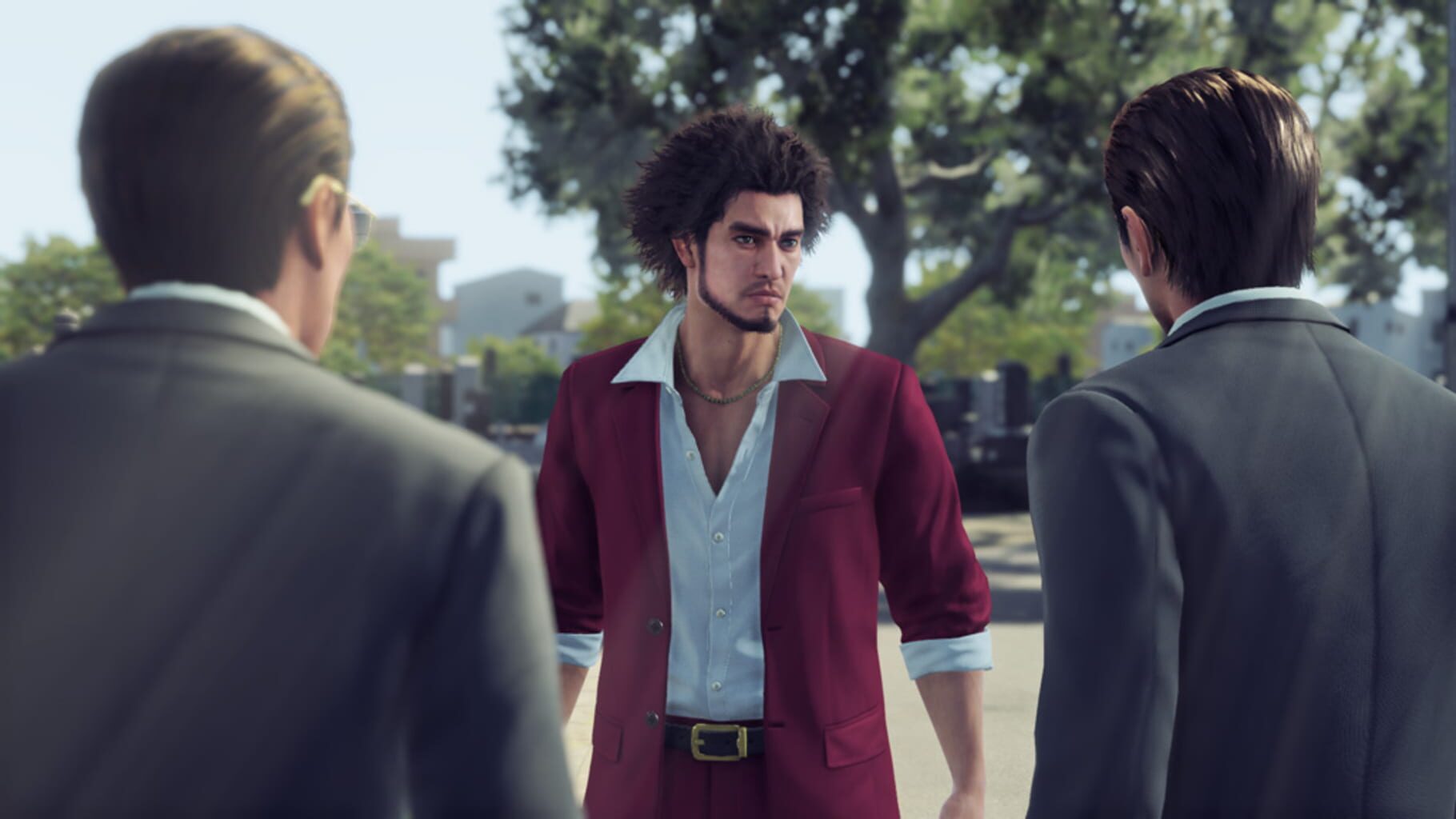
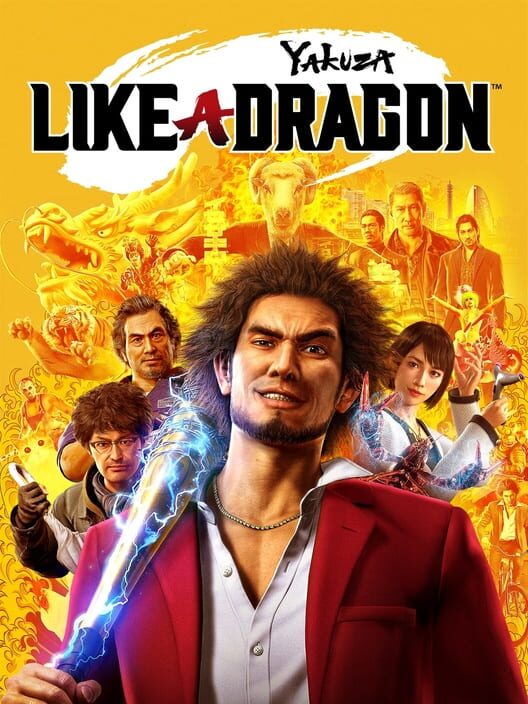
Yakuza: Like a Dragon is also the first main series game not to have Kazuma Kiryu (Takaya Kuroda/Darryl Kurylo) as its protagonist, though he appears in a supporting capacity. Its lead character is Ichiban Kasuga (Kazuhiro Nakaya/Kaiji Tang), a low-ranking member of the Arakawa Family, a subsidiary of the Kanto-based Tojo Clan. Mandatory playable characters who join Kasuga's party include Yu Nanba (Ken Yasuda/Greg Chun), a homeless ex-nurse; Koichi Adachi (Akio Otsuka/Andrew Morgado), a former police officer; Saeko Mukoda (Sumire Uesaka/Elizabeth Maxwell), a hostess bar manager; Joongi Han (Yuichi Nakamura/Keong Sim), a Geomijul operative and the body double of the Jingweon Mafia leader of the same name from Yakuza 6; and Tianyou Zhao (Nobuhiko Okamoto/Robbie Daymond), leader of the Liumang. A fictionalized version of Japanese actress Eri Kamataki appears as a character of the same name (voiced in Japanese by herself and in English by Eden Riegel), as the chief executive officer of Ichiban Confections who recruits Kasuga to help turn her company around as part of the business management minigame. She may be recruited as an optional party member once the player reaches the first milestone objective within the minigame.
Important non-player characters include Masumi Arakawa (Kiichi Nakai/George Takei), the patriarch of the Arakawa Family; Masato Arakawa (Kohsuke Toriumi/Will Yun Lee), Arakawa's son who falsified his identity to become Ryo Aoki, the upstart Governor of Tokyo; Jo Sawashiro (Shinichi Tsutsumi/Brian Bloom), Arakawa's long serving right-hand man and the captain of the Arakawa Family; Sota Kume (Daisuke Hirakawa/Zach Aguilar), a fanatical member of Bleach Japan, a political movement that seeks to cleanse Japan of its 'grey zones' (e.g. prostitution, illegal immigration, organized crime etc.) and protégé of Aoki; Seonhee (Hana Takeda/Fiona Rene), the head of the Geomijul; Ryuhei Hoshino (Tetsuo Kanao/JB Blanc), chairman of the Seiryu Clan; Akira Mabuchi (Masanori Takeda/Ed Bosco), the second-in-command of the Liumang; Reiji Ishioda (Show Hayami/Rino Romano), a lieutenant of the Osaka-based Omi Alliance; and Yosuke Tendo (Miou Tanaka/John Eric Bentley), an opportunistic Omi Alliance member and disgraced former professional boxer. Other characters include: Mitsuo Yasumura (Satoshi Tsuruoka/SungWon Cho), Kasuga's oath brother in the Arakawa Family; Nick Ogata (Kazumasa Nakamura/Ray Chase), a wealthy businessman who befriends Kasuga and occasionally provides him financial support; Isao Nonomiya (Yōhei Tadano/William Salyers), the owner of a soapland in Ijincho who hires Kasuga and his party to investigate a conspiracy involving his employee; and Mamoru Takabe (Daichi Endo/Darin De Paul), captain of the Seiryu Clan.
In addition to Kiryu, several characters from previous Yakuza titles also return in supporting roles: Osamu Kashiwagi (Shunsuke Sakuya/David Hayter), a former senior Tojo Clan member who survived the events of Yakuza 3 and became proprietor of the Survive bar in Ijincho; Daigo Dojima (Satoshi Tokushige/Roger Craig Smith), sixth chairman of the Tojo Clan; Goro Majima (Hidenari Ugaki/Matthew Mercer) and Taiga Saejima (Rikiya Koyama/Ron Yuan), senior Tojo Clan members who accompany Daigo; Masaru Watase (Rintarō Nishi/James C. Burns), captain of the Omi Alliance; and Makoto Date (Kazuhiro Yamaji/Bill Farmer), a Kamurochō police detective and long-time friend of Adachi.
In 2001, Masumi Arakawa persuades Ichiban Kasuga to confess to a murder that his captain, Jo Sawashiro, allegedly committed, to protect the latter's reputation. Kasuga, feeling indebted to Arakawa, agrees to shoulder the blame for the crime. Arakawa promises to greet Kasuga upon his release. 18 years later, after serving his sentencing, Kasuga is released from jail, but Arakawa is nowhere to be seen.
He is picked up by police officer Koichi Adachi, who reveals that the Tojo Clan has perished, and in its place, Kamurocho has become the territory of its rival, the Omi Alliance. Adachi also informs Kasuga that Arakawa was responsible as he betrayed the clan to join the Omi, while Arakawa's son Masato, whom Kasuga once chauffeured, has died due to his deteriorating health. Seeking to expose the truth together, they crash an Omi Alliance meeting held by Arakawa. Adachi is arrested for trespassing whilst Arakawa shoots Kasuga.
Three days later, a homeless man named Yu Nanba heals Kasuga's wounds after discovering his body in Isezaki Ijincho. Nanba sees a counterfeit bill in Kasuga's pocket and tells him that he is safe from the Omi Alliance because Ijincho is hostile territory. Kasuga and Nanba meet Adachi, where they agree to work for soapland owner Isao Nonomiya to make extra money. After uncovering a conspiracy plot at the city's retirement home, the gang discovers that Nonomiya is murdered, which alerts Saeko Mukoda, one of his employees.
Determined to find Nonomiya's murderer, Saeko joins Kasuga's team. The party discovers that his killer is Akira Mabuchi, a lieutenant of the Yokohama Liumang. They also uncover the Liumang's collaboration with the Geomijul Mafia and Seiryu Clan in running a money counterfeiting s
Development
The game was initially announced on August 26, 2017, alongside Fist of the North Star: Lost Paradise and Yakuza Online. During development, the project was code-named Shin Ryu ga Gotoku, meaning "New Like a Dragon" or "Like a New Dragon," or "Shin-Yakuza" in English. Sega announced that the game's story was completed at the end of May 2019. Sega received permission from Square Enix's Dragon Quest series creator Yuji Horii to mention Dragon Quest in the game, which was Kasuga's favorite video game.
Series creator Toshihiro Nagoshi said that the new style of logo was done to reflect Kasuga's differing personality compared to Kazuma Kiryu. Sega staff explained in a 2019 interview that they wanted to try a different style of gameplay, but that if it is badly received, they intend to return to real-time combat for future games. The game's main theme, "Ichibanka" (一番歌, Number One Song), was performed by Shonan no Kaze, who previously performed the main themes of Yakuza 0 and Kurohyō 2: Ryū ga Gotoku Ashura hen, and Yasutaka Nakata.
The game is the first mainline Yakuza title to receive an English dub since the original Yakuza in 2005. Alongside the English dub, as in Judgment, it also features dual English subtitle sets: one with the Japanese audio with English subtitles matching the Japanese translation, and the other matching the English dub. Localizations in French, German, Italian, and Spanish focus on the Japanese audio, regardless of the selected voice language. The International release in Japan and Asia, as well as the Western release via an update, has dual audio and eleven subtitle and text languages (including three new languages), Portuguese, Russian, Japanese, Simplified Chinese, Traditional Chinese, and Korean to the previous five languages (French, German, Italian, Spanish, Portuguese and Russian are only available in the Western release on PS5; all other versions have all languages present regardless of region).
For the first time in the series, karaoke songs in the English dub are sung in English by the English voice cast, with the English versions displaying the English lyrics (on all languages) and the Japanese versions displaying the Japanese romaji lyrics (only when the language set to English, French, German, Italian, Spanish, Portuguese or Russian; Japanese kanji lyrics when set to Japanese; Traditional Chinese lyrics when set to Traditional Chinese and Simplified Chinese; Korean lyrics when set to Korean), unlike the Yakuza Remastered Collection, in which lyrics between the Japanese kanji and romaji and English translation can be toggled. Darryl Kurylo and Bill Farmer reprise their roles from the original Yakuza as Kazuma Kiryu and Makoto Date, respectively. Matthew Mercer replaces Mark Hamill as Goro Majima, David Hayter replaces John DiMaggio as Osamu Kashiwagi (credited as "The Bartender"), and Isaac C. Singleton Jr.
replaces Gary Anthony Williams as Gary Buster Holmes.
Reception
Yakuza: Like a Dragon received "generally favorable reviews", according to the review aggregation website Metacritic. Fellow review aggregator OpenCritic assessed that the game received "mighty" approval, being recommended by 91% of critics. Critics praised the game's new take on the Yakuza series alongside the characters, but criticized the turn-based battles as being repetitive towards the end of the game.
In a positive review for Game Informer, Jeff Cork praised the new protagonist, writing, "Without the weight of half a dozen or so games and their associated histories on his shoulders, Kasuga is a blank slate for this new Yokohama adventure. Kasuga certainly has goals and motivations... but the fact that he's such a small figure in this world creates an exhilarating feeling of freedom". Cork also enjoyed the game's job system saying that it "holds a satisfying amount of depth" and allows for unique party combinations.
Jordan Devore of Destructoid disliked the long animations in combat, "Early on, I had a fun enough time watching these chaotic and slightly out-of-control scenes unfold. They didn't drag on. But at a certain point, I got so sick of waiting for Ichiban and co. to run up and actually perform their attacks". Additionally, Devore wrote that, "Put another way, Like a Dragon's turn-based combat is fine, but fine can only go so far when hours-long brick walls force you to stop and grind for XP so you can stand a reasonable chance against beefy boss encounters."
Yahtzee Croshaw of The Escapist called Yakuza: Like a Dragon the third best game of 2020, praising it for turning around the Yakuza franchise "with its fun characters and greater lean into the inherent silliness of the franchise." In his review of the game he commended it for how "a likeable protagonist and a bit more of a lean into the usual wackiness it has successfully charmed the nurses into keeping the life support machine plugged in. Every Yakuza game is basically a loose box of disconnected toys, but for the record, this is a particularly nice box with some choice toys. Like, Legos and Masters of the Universe."
Yakuza: Like a Dragon was the best selling print game during its first 4 days on sale in Japan, with 300,000 copies sold. By March 2020, a total of 450,000 digital and physical copies had been sold in Japan and Asia.
By December 2023, Yakuza: Like a Dragon had sold 1.8 million units worldwide, with 400,000 of those units being sold in Japan.
By June 2025, it would be revealed that Yakuza: Like a Dragon had sold 2.8 million units.
Yakuza: Like a Dragon was awarded a Japan Game Awards Award for Excellence in the Future Division at the Tokyo Game Show 2019.
Yakuza: Like a Dragon received nominations for "Best RPG" at The Game Awards 2020, and "Role-Playing Game of the Year" at the 24th Annual D.I.C.E. Awards, but lost both to Final Fantasy VII Remake. The game also received a nomination for Ultimate Game of the Year at the Golden Joystick Awards.
Yakuza: Like a Dragon was also awarded with a PlayStation Partner Awards Partner Award for achieving "particularly noteworthy results". Other awards included Hilarious Humor at the Dreamies, and OUTSTANDING Game, Franchise Role Playing at the 2020 NAVGTR Awards where it was also nominated in seven other categories.