
1987 · Port · Taito · Arcade · Shoot 'em up
Darius
Timed NEC exclusivePort
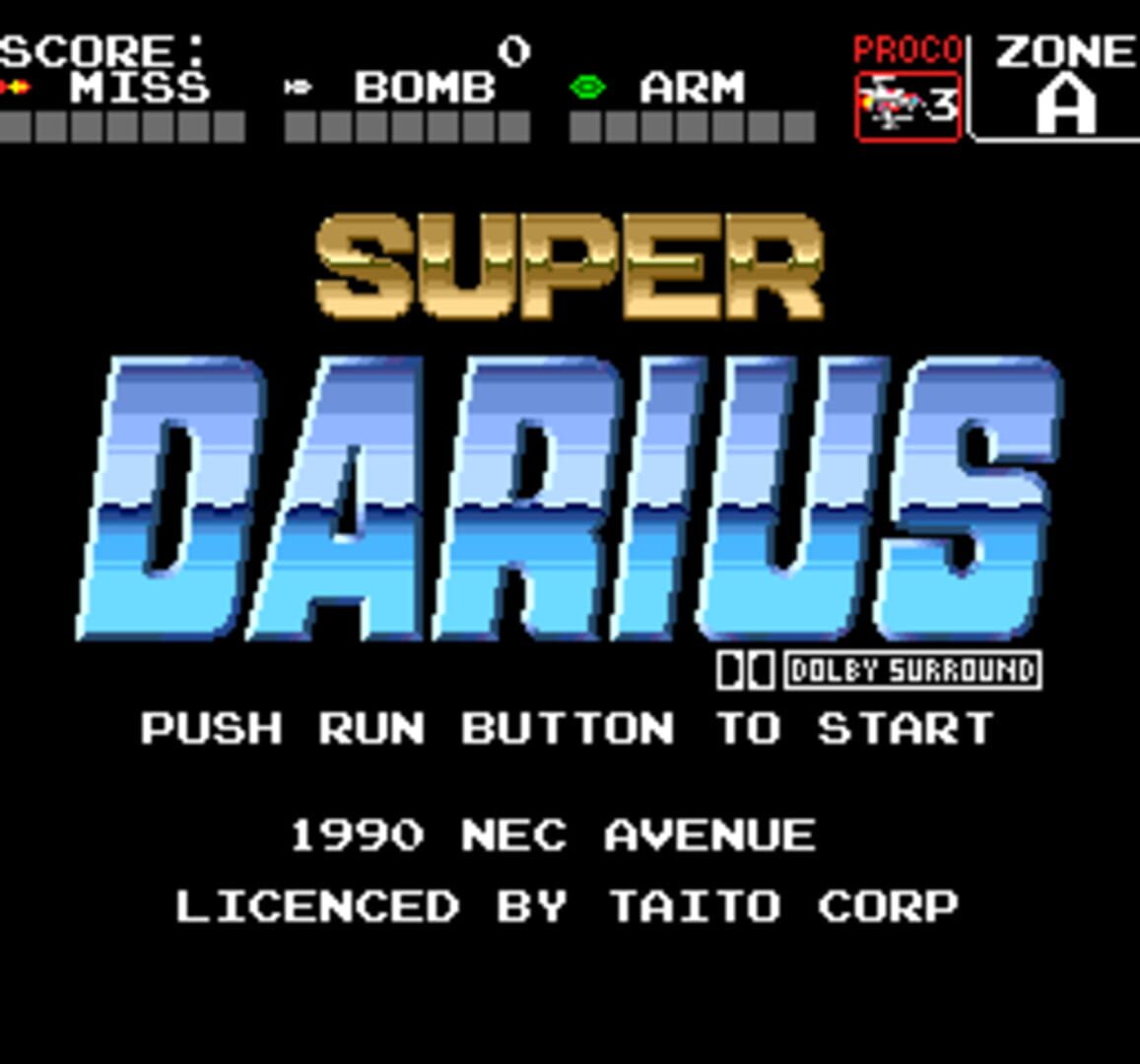
Super Darius is a 1990 port of Darius for the PC Engine CD-ROM, and the only attempt at an accurate port of the game for many years; it even uses recordings of music and sound effects straight from the PCB! Its other claim to fame is the introduction of all 26 bosses from the original draft for Darius, some of which were earlier seen on promotional material and some of which were used in Darius II instead.
- Released
- 1987
- Platforms
- Atari STGame BoyGame Boy AdvanceNintendo SwitchTurboGrafx-16Turbografx-16/PC Engine CDWiiZX SpectrumArcade
- Genres
- ArcadeShoot 'em upShooter
- Developers
- Taito
- Publishers
- Taito
- Series
- Darius
- Modes
- Co-opMultiplayerSingle-player
- Perspective
- Side view
- Themes
- ActionScience fiction
- Country
- Japan
- Age ratings
- CERO A
- Composers
- Hisayoshi Ogura
About
Darius is a 1987 horizontally scrolling shooter video game developed and published by Taito for arcades. Players control a starship named the Silver Hawk in its mission to destroy the Belser empire before they wipe out the planet Darius. Its gameplay involves traversing through a series of scrolling levels while destroying enemies and collecting power-up icons. It is notable for its unique three-screen panoramic display.
The game was designed by a small team of others led by Junji Yarita. In contrast to other similar games, which feature mechanical or insect-like enemies, Darius uses aquatic creatures like fish and crabs for its enemies and screen-filling bosses. Its large arcade cabinet, based on Taito's earlier panoramic display game Laser Grand Prix (1983), was designed to provide a cinematic atmosphere and stand out from other games at the time. The soundtrack was created by Taito's "house band" Zuntata, the majority being composed through a combination of FM synthesis and sampling.
›Story
Darius, Year 201. Invasion!
The vicious Belsar have attacked the peaceful Darius system, which now faces absolute devastation at their abominable hands! Darius' defense fighters proved no match for the overwhelming firepower of the alien forces, which wiped out their entire fleet in one fell swoop!
With nothing left to protect them, the people could only sit and wait for the icy embrace of death as the satellite bombardments continued unopposed. The scent of despair hung thickly in the air, all hope of survival having been quashed.
But then, from out of the darkness of the mourning clouds came a single bright light in the sky.
"Silverhawk........."
Like a phoenix brought forth from the embers of a burning world, the bird shaped visage became a beacon of the planet's last fight for survival! Perhaps the end is not as nigh as it first appeared.
Keywords
- shoot 'em up
- shmup
- side-scrolling
- wii virtual console
Media
The articlegameplay, story, development, reception
Gameplay
Darius is a two-dimensional horizontally scrolling shoot 'em up set in a fictional future. Uniquely among shoot 'em ups, the game's screen is three times wider than conventional size, and the arcade cabinet uses an arrangement of three screens to accommodate it. The player controls an ornate fighter spacecraft, named the Silver Hawk, and must navigate through scrolling terrain while battling a variety of fighter craft, ground vehicles, turrets, and other obstacles throughout the game's stages (referred to as zones in the game). The ship's arsenal consists of forward-firing missiles, aerial bombs and a protective force field, all of which can be upgraded by power-ups (in the form of large, colored orbs) that are dropped by specially-colored enemies throughout the game's zones.
When the player reaches the end of a zone, a boss appears, which must be defeated to proceed. Once the boss of a zone is destroyed, the player is given a choice of which zone to play next via a branching path. While there are 28 zones in total, only seven can be played in a single run.
Story
After years of pollution and the depletion of natural resources on Earth, humans decided to search beyond the Solar System for habitable planets to live on. A space program dedicated to this premise eventually found a solar system similar to the Earthling's and the space colonists selected a habitable planet they named Darius.
After settling on Darius, the inhabitants learned to start a new life and thrive in both society and technology. However, their peace was disturbed by an armada of malevolent maritime shaped space craft controlled by the Belser Army, a race of humanoid space colony based warrior people who have selected the Darius colonists as their next combatants. The Darius inhabitants' only line of defense were the Silver Hawk series: single-piloted fighter craft designed for long space travel with the ability to wield different weapons at the same time. Two of the fleet's top pilots were selected to defend Darius: Proco and Tiat. Together, the two assigned in thwarting Belser's attack on Darius.
Development
Darius was designed by Junji Yarita, with assistance by planner Akira Fujita and programmer Toru Sugawara. Fujita was interested in creating a shoot'em up game where the player fought a huge battleship at the end of each stage — as a way to "spice things up" and make it stand out among other similar games, Fujita made the bosses themed around fish and other aquatic creatures. Yarita designed these battleships and created a total of 26 different designs, but time constraints only allowed the development team to use 11 of them in the final game. A single boss took roughly ten days to create. Some of the unused designs made it onto the game's promotional material, which was attributed to the art being outsourced to a different company.
The arcade cabinet, designed by Natsuki Hirosawa, uses three individual monitors made to appear seamless via mirror effects. The idea was previously used in Taito's earlier games Wyvern F-O and Super Dead Heat, and was added to give the game a more cinematic presentation and to make it feel more unique compared to other shooting games on the market. A headphone jack and volume dials are also present, as is a speaker system installed beneath the player's seat, which is referred to by Taito as a "body sonic" system. This concept was originally meant to be used for the 1983 game Laser Grand Prix, but it proved too costly and was scrapped.
Reception
In April 1987, Game Machine listed Darius as being the most popular upright arcade unit in Japan at the time. It went on to be the third highest-grossing large arcade game of 1987 in Japan.
Releases by platformdates and regions as published
Title IDsone per regional release, with its latest update
Editions and related releases
- Included in
- TurboGrafx-16 MiniPC Engine MiniDarius Cozmic CollectionDarius Cozmic Collection: Special EditionDarius Cozmic Collection Arcade
- Expanded editions
- Darius: Extra Version
- Part of
- Darius
- Ported as
- Darius RDarius+Darius PlusArcade Archives: Darius
- Built on it
- Darius+Darius PlusDarius R
In the same series


Games like this
 Nintendo exclusive68
Super R-Type
1991 · SNES, Wii
Arcade · Shoot 'em up
 70
Image Fight
1990 · Arcade, FM Towns +7
Arcade · Shoot 'em up
 Timed PlayStation65
Söldner-X 2: Final Prototype
2007 · Nintendo Switch, PlayStation 3 +2
Arcade · Shoot 'em up
 Nintendo exclusive
Nemesis 3: The Eve of Destruction
1987 · MSX, Wii
Arcade · Shoot 'em up
 76
R-Type 2
1989 · Amiga, Android +3
Arcade · Shoot 'em up
 PlayStation exclusive72
R-Type Final 3 Evolved
2023 · PlayStation 5
Arcade · Shooter
 Atari exclusive70
Astro Fighter
1979 · Arcade, Atari 7800
Arcade · Shoot 'em up
 Timed Sega68
Gynoug
1991 · Nintendo Switch, Sega Genesis +1
Arcade · Shoot 'em up
Collections6 collections
Platform libraries
- Atari ST gamesCommercial games
- ZX Spectrum games
- Game Boy Advance gamesGames › List of games
- TurboGrafx-16 gamesList of games
- TurboGrafx-16 gamesList of games
- TurboGrafx-16 gamesList of games
- Nintendo Switch games (An–Az)List
Publishers
- Virtual Console games for WiiTitles › TurboGrafx-16 / PC Engine
- Virtual Console games for WiiTitles › TurboGrafx-16 / PC Engine
Description adapted from its source, CC BY-SA 4.0.