
The articlegameplay, story, development, reception
Gameplay
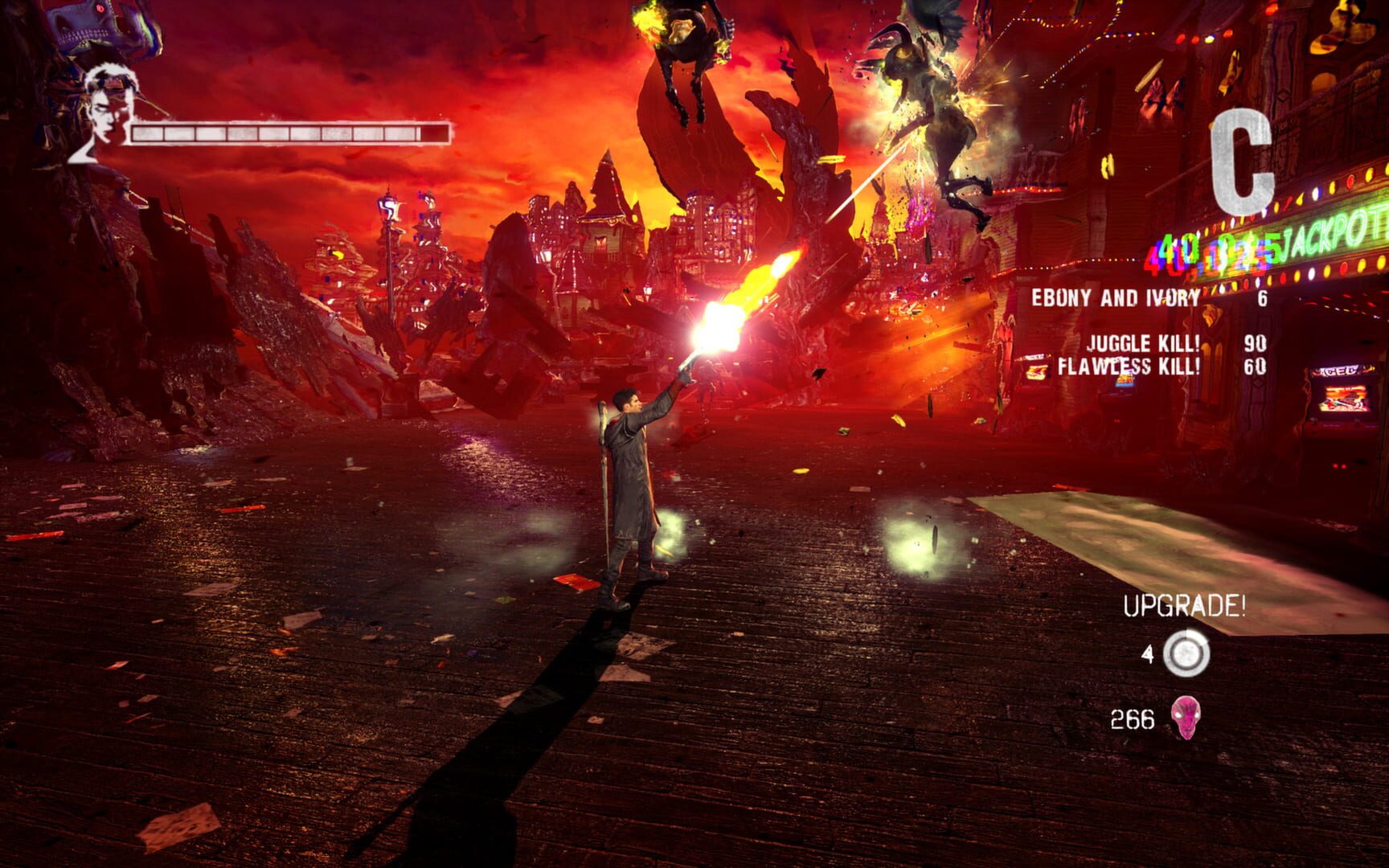
DmC: Devil May Cry is a hack and slash action-adventure video game played from a third-person perspective. In the game, the player assumes control of Dante, who must use his powers and weaponry to fight against enemies and navigate treacherous Limbo City. Dante's primary weapon of choice is his sword named Rebellion, and his dual pistols named Ebony and Ivory. As a hack-and-slash game, DmC allows players to string together consecutive attacks to form combos or perform special moves.
Dante can also launch enemies into the air with his sword, parry incoming attacks, and quickly dodge. Occasionally, players will be able to activate the "Devil Trigger" mode, which makes Dante faster and more powerful, regenerates his health, and launches weaker enemies into the air. Unlike previous games in the series, DmC forgoes a manual lock-on system and instead tracks enemies automatically with its game camera. A player's performance is scored and rated according to different ranks.
Story
The game is set in a parallel universe of the series. The game's story takes place in Limbo City, a modern-day city secretly controlled by all-powerful demons, manipulating humanity through bestowing on humanity the comforts of life, with the demons themselves residing in a parallel plane called "Limbo". Living on the fringes of society is Dante, a young man aware of the existence of demons, devoting himself to fighting them in secret, but otherwise wasting his life by indulging in junk food and sex.
One day, Dante is warned by a young woman named Kat that he is in danger, just as a Hunter demon drags him into Limbo. Dante grabs his weapons and slays the Hunter with Kat's help, as she can see into Limbo with her psychic powers. Dante returns to the human world and accepts Kat's offer to meet with her boss, Vergil. Along the way, Kat explains that Vergil leads "The Order", an organization intent on exposing the demons and releasing the world from their control.
Development
Under the leadership of Global Head of Production Keiji Inafune, publisher Capcom greenlit several projects to westernize its portfolio of video games. Capcom Japan approached its division in America to find a new direction for the Devil May Cry franchise in an attempt to boost sales and introduce the game to a broader audience. UK-based studio Ninja Theory was chosen to develop a new project, as Capcom was impressed by their work on Heavenly Sword and felt that they were capable of creating games with a good story and immersive atmosphere. They were also impressed by Ninja Theory's technology, and their fast pace of game development.
Pre-production of the game started when Enslaved: Odyssey to the West was approaching release. The development team included over ninety members with nearly ten of them being from Capcom. Capcom producer Motohide Eshiro remarked that the collaboration was a stimulating experience for the team, though he added that development was challenged by the language differences between the two studios. Capcom also had to tone down the game's overall violence level, removing gameplay mechanics such as dismemberment to avoid having the game rated Z (Ages 18 and up only) by CERO.
Reception
DmC: Devil May Cry received "generally favorable" reviews, according to review aggregator website Metacritic. It was nominated for "Action Game of the Year" at the 17th Annual D.I.C.E. Awards, and "British Game" at the 10th British Academy Games Awards, losing to BioShock Infinite and Grand Theft Auto V, respectively.
Nathan Brown from PC Gamer felt that the combat was stylish, applauding the game for combining the various fighting styles of Devil May Cry 3. Mark Walton from GameSpot enjoyed the fluidity of the combat system and described it as "rewarding". He also liked the varied enemies, which encourage players to adapt on the fly and fight tactically. The game's sense of progression was praised by reviewers, with Brown applauding the game patiently communicating its gameplay systems.


