
The articlegameplay, story, development, reception
Gameplay
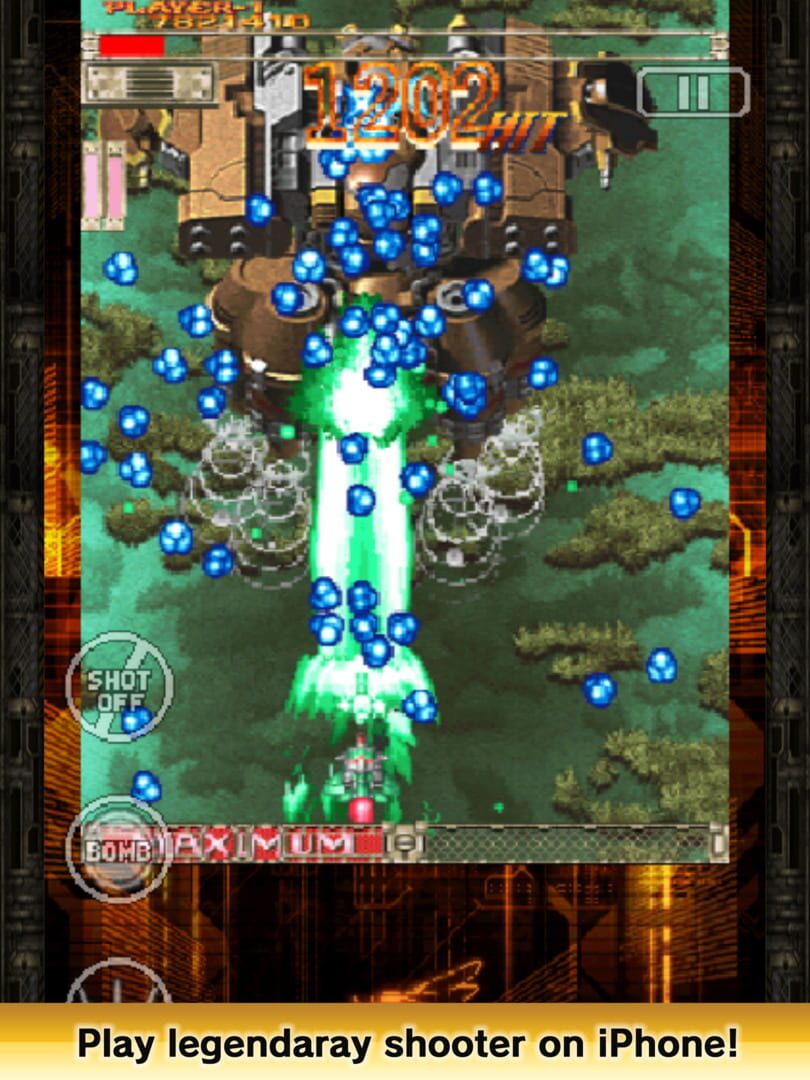
DaiOuJou follows the conventions of the previous game with only a few changes. The chaining system is intact and works in much the same way. Causing an enemy to explode fills a meter, and every enemy destroyed before the meter depletes adds to the current chain and again refills the meter. Holding the laser weapon over a large enemy will hold the meter steady and slowly accumulate hits. In this way it is possible to create a single chain out of any of the 5 stages.
The controls in DaiOuJou are identical to the previous games in the series, and the same shot-laser dynamic as seen in Donpachi and Dodonpachi are also present, with spread bombs and laser bombs also making a return. However, there are only 2 ships, a narrow shot ship (Type-A) and a wide shot ship (Type-B). In addition, the game introduces Element Dolls, which will power up the player's weapons. The element dolls are:
Shotia: Powers up standard shots and has a less powerful laser. Can carry 3 bombs at the start, and holds a maximum of 6.
Leinyan: Powers up laser shots and has a weaker shot attack. Can carry 2 bombs at the start, and holds a maximum of 4.
EXY: Powers up both shot and laser weapons, giving them intense power. Can carry 1 bomb at the start, and holds a maximum of 2.
Piper: Exclusive to the Xbox 360 in X-mode, Piper will fire hyper versions of the shot and laser, rapidly increasing the combo gauge. The player can still gain and activate hypers, but they make the shots green and give the player the ability to cancel bullets with their shots. To compensate, the player cannot use bombs (although the MAXIMUM bonus for obtaining bomb items is still intact).
Introduced in this game and carried on in later entries is the Hyper system. By gaining large combos, attacking enemies at close range, and collecting bee medals while a large combo is active (Bee medals now give score based on how large of a combo is racked up), you build up a hyper meter at the top of the screen. When the meter fills up, a hyper powerup drops from the bottom of the screen. Activating the hyper will cancel all bullets currently onscreen and increases the firepower of your shot and laser.
Hypers also increase the rate of which combos are built up, as small enemies will give more hits on the combo gauge, larger enemies will add to the current combo chain much faster, and combos on bosses build up at a much faster rate. In addition, if a hyper meter is filled during a boss fight, all bullets on screen are cancelled and turned into score bonuses.
Story
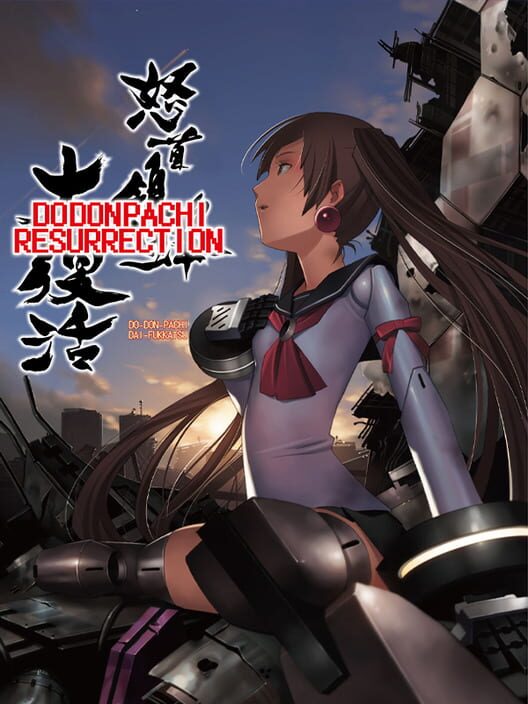
After the events of Dodonpachi, in which the pilot stops Colonel Schwarlitz Longhener's plan to annihilate humanity, the remains of the Donpachi Corps are sealed away in the moon, never to be heard from again. 1000 years later, the robotic army, led by Hibachi, have reawakened and are slowly rebuilding itself in order to wipe out humanity again, taking the defenseless moon colony of Lunapolis. The world quickly resurrects the Donpachi Corps, and aided by Element Dolls, sentient androids meant to increase a ship's power, are deployed on the moon to destroy Hibachi's army.
Depending on the element doll the player chose at the beginning of the game, the ending will differ upon defeating Hibachi;
Shotia: In a last resort attack, Hibachi's program turns into a virus and invades Shotia's system, slowly deleting her memories bit by bit. Shotia's last memories are those with her pilot, and she dies with a smile.
Leinyan: After defeating Hibachi, Leinyan has developed feelings for her pilot. Upon returning to Earth, Leinyan is taken away to be experimented on, but escaped and reunites with her pilot.
EXY: EXY shuts down Hibachi's computer network, but was driven insane due to the overflow of data. EXY kills her pilot and does not return to Earth. The events of this game will eventually lead to Dodonpachi Daifukkatsu.
Development
This variant was a limited edition release. The arcade board includes the original and Black Label games, which can be selected during boot time. The Black Label game can be identified by the black title screen. After the release of the Black label, the original version is called White Label, particularly for clarification.
A prototype export/overseas version of the Black Label edition named DoDonPachi III was discovered in 2016.
The music tracks are puns of shooting game companies. Mukei is named after NMK, Toua is named after Toaplan, Takimi is named after Takumi Corporation, Torejya is named after Treasure, Saikyou is named after Psikyo, Seibu is named after Seibu Kaihatsu, Sakusetsu is named after Success Corporation, Taitou is named after Taito, Raijin is named after 8ing/Raizing, and Awaremu is named after Irem.
As often pointed out by fans, Manabu Namiki confirmed that the tracks from the game are the shooting game companies stated above he wanted to show respect for.
With Junya Inoue still a graphical designer, the serene steampunk world of Progear has been replaced with hard sci-fi. The graphic style, especially the ships were drawn so as to resemble the original Dodonpachi. Bullets are drawn in blue and pink, and many of the backgrounds are deliberately flat so as not to distract from the on-screen action.
Reception
In Japan, Game Machine listed DoDonPachi DaiOuJou on their June 1, 2002 issue as being the third most-popular arcade game during the previous two weeks. DaiOuJou was met with positive reception from critics since its release in arcades and other platforms. According to review aggregator site Metacritic, the iOS version received "generally favorable" reviews. Famitsu reported that the PlayStation 2 and Xbox 360 versions sold over 19,593 and 10,526 copies in their first week on the market respectively. Both the PlayStation 2 and Xbox 360 versions sold approximately 53,881 copies combined during their lifetime in Japan.