
The articlegameplay, story, development, reception
Gameplay
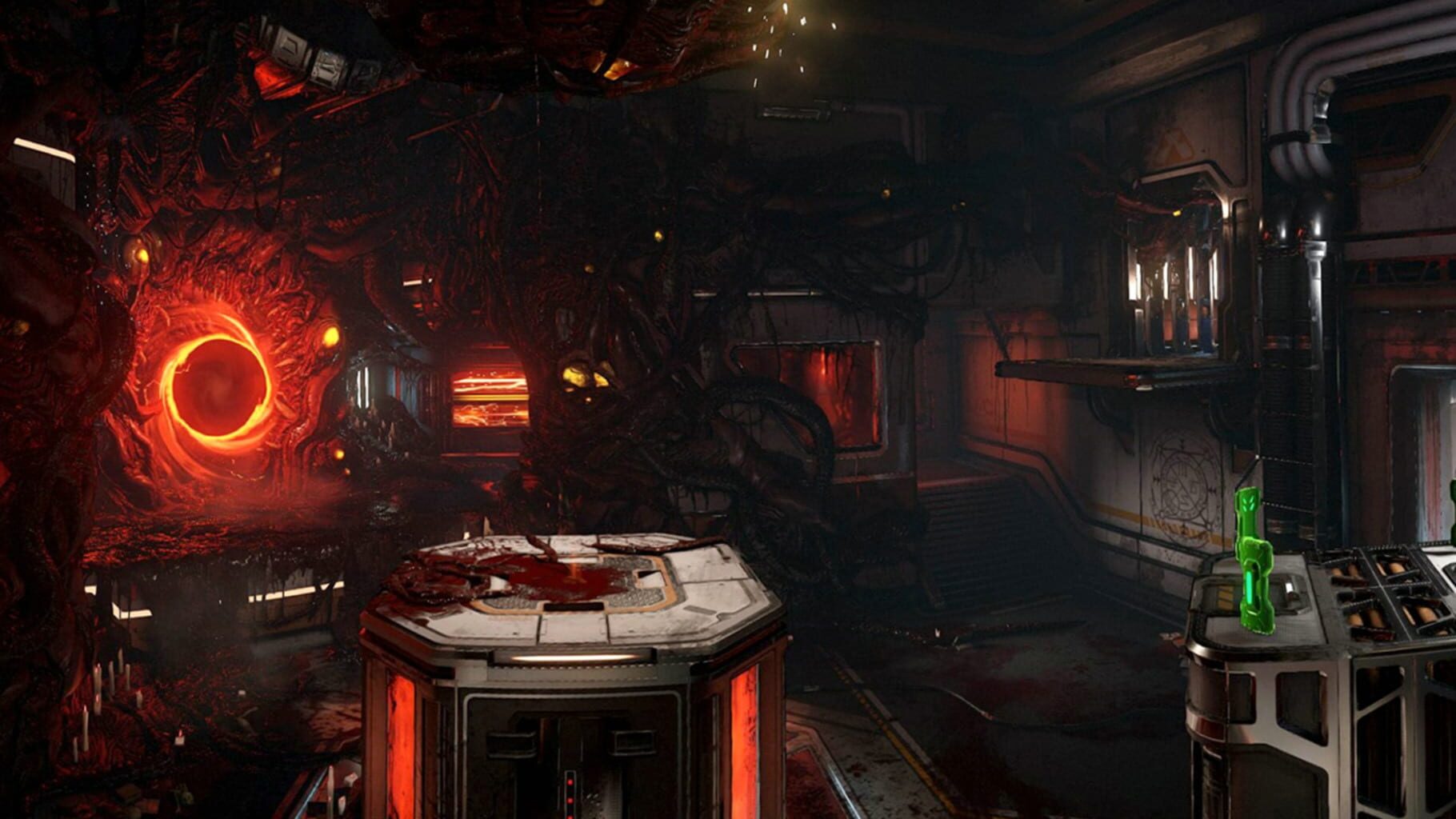
Doom is a first-person shooter. Gameplay consists of fast movement and frenetic combat against aggressive and mobile opponents, as well as exploration of the game's environments via double-jumps and ledge climbing. To progress through the game, the player wields an arsenal of weapons influenced by those of Doom and Doom II, such as a chainsaw and the BFG 9000, against demonic opponents also influenced by the original Doom games. Weapons do not need to be reloaded and can be augmented with various mods obtained during the campaign.
To replenish their resources, the player must pick up items or kill enemies. Players may recover health by using the "Glory Kill" mechanic, in which sufficiently damaged enemies enter a stunned state and may be killed by the player in a short melee animation. Ammunition can be replenished by using the chainsaw on an enemy, which instantly kills them if there is enough fuel in the chainsaw.
Story
Doom takes place on Mars in 2149, where the Union Aerospace Corporation (UAC) operates a facility to exploit an energy seeping from Hell, an alternate dimension populated by hostile lifeforms known as demons. To solve an energy crisis on Earth, the UAC constructed the Argent Tower to extract and refine raw Hell energy into Argent energy, which deteriorates the physical and mental health of the facility's staff, and allowed transit to and from Hell. After discovering that Argent energy had properties that defied their understanding of physics, the UAC began occult research into Argent energy and Hell, and the demons, who its staff began to worship and cybernetically modify.
The facility is run by Samuel Hayden, a UAC scientist who transferred his consciousness to an android body after being afflicted with terminal brain cancer during the construction of the Argent Tower. In addition to directing the energy extraction and refining process, Hayden organizes expeditions into Hell to retrieve captive demons and artifacts for study. Among them is a sarcophagus containing the player character, a being they call the Doom Slayer and fear immensely, along with his armor, the Praetor Suit. Assisting Hayden is VEGA, a self-aware artificial intelligence that controls and monitors the facility. Leading the UAC's research into biomechanics is Olivia Pierce, a protege of Hayden's who developed crippling scoliosis while working on Mars and makes a pact with the demons to open a portal between Mars and Hell and allow the demons to conquer humanity.
Development
After releasing Doom 3 in 2004, id Software began working on a new intellectual property, Rage, and unsuccessfully sought to license the Doom franchise to another developer as it had with Wolfenstein. In 2007, however, id began development of Doom 4. The studio, which had 19 employees at the time of Doom 3's release, struggled to simultaneously develop Rage and Doom 4. Development of Doom was first revealed via job listings on id's website on May 7, 2008, for a project titled Doom 4.
On June 23, 2009, ZeniMax Media, parent company of Bethesda Softworks, acquired id and announced that Bethesda would publish its future games. According to id creative director Tim Willits, the partnership allowed the company to have two teams, each having a project in parallel development. Asked in April 2009 about whether Doom 4 would be a sequel to Doom 3 or a reboot, id CEO Todd Hollenshead stated that it was neither.
Reception
Upon release, Doom was positively received, with scores of 85/100 for PC and PlayStation 4, 87/100 for the Xbox One, and 79/100 on Nintendo Switch on Metacritic. The final PC version of the game received very positive reviews from users on Steam. The Nintendo Switch port was also praised in a review by Nintendo Life.
The game's single-player elements received critical acclaim and were favorably compared to contemporary shooter games. Mike Henriquez of GameRevolution described the visual and artistic design as "top-notch". Sam White in The Daily Telegraph lauded Doom for its performance on all platforms, weapon design, and score. Peter Brown of GameSpot praised single-player because he thought that the reboot captured the spirits of the older games, while refining them with modern elements.


