
The articlegameplay, story, development, reception
Gameplay
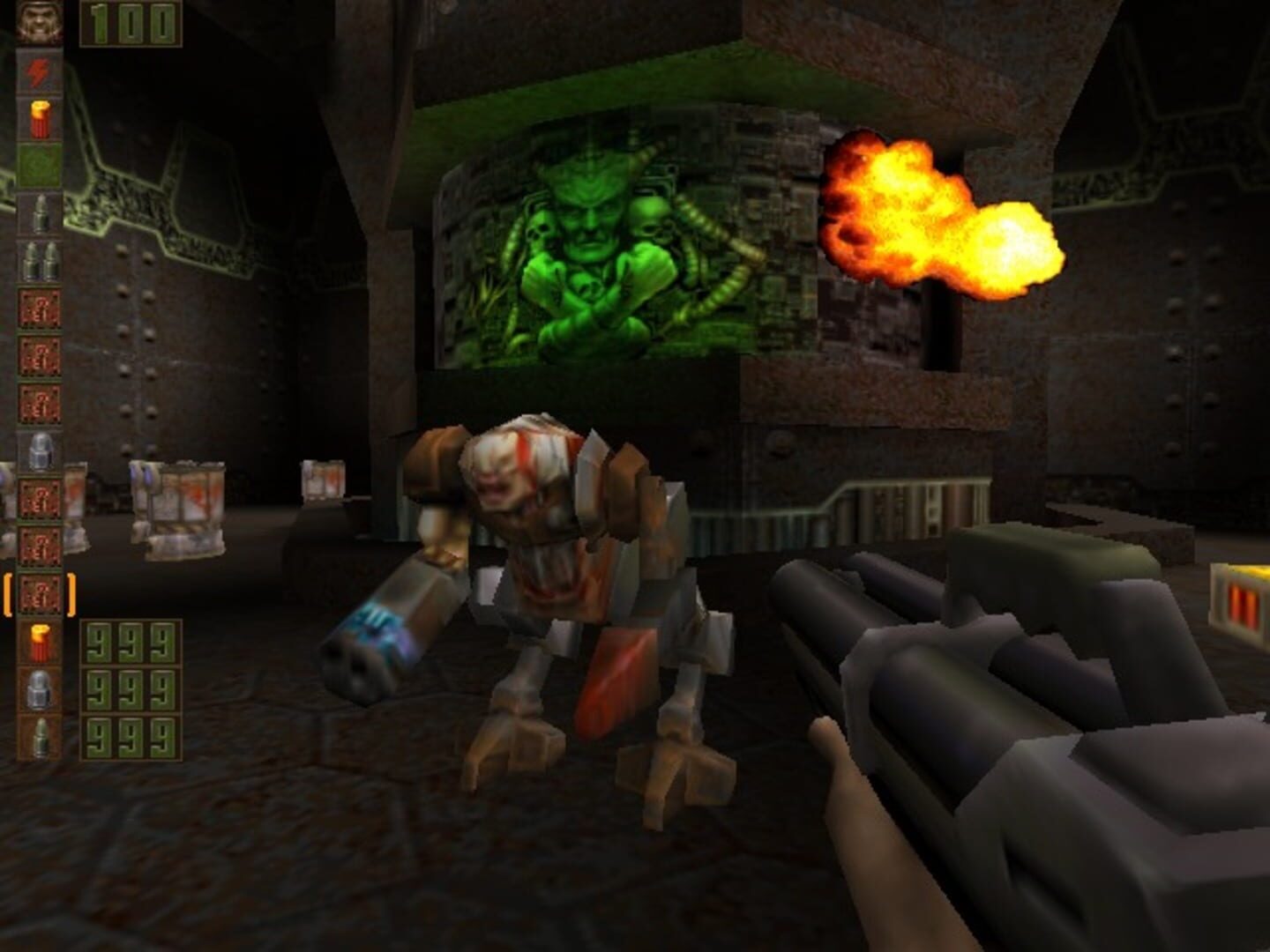
Quake II is a first-person shooter, in which the player shoots enemies from the perspective of the main character. The gameplay is very similar to that featured in Quake, in terms of movement and controls, although the player's movement speed has been slowed down, and the player now has the ability to crouch. The game retains four of the eight weapons from Quake (the Shotgun, Super Shotgun, Grenade Launcher, and Rocket Launcher), although they have been redesigned visually and made to function in slightly different ways. The remainder of Quake's eight weapons (the Axe, Nailgun, Super Nailgun, and Thunderbolt) are not present in Quake II.
The six new weapons are the Blaster, Machine Gun, Chain Gun, Hyperblaster, Railgun, and BFG10K. The Quad Damage power up from Quake is present in Quake II, and new power-ups include the Ammo Pack, Invulnerability, Bandolier, Enviro-Suit, Rebreather, and Silencer.
The single-player game features a number of changes from Quake. First, the player is given mission-based objectives that correspond to the storyline, including stealing a Tank Commander's head to open a door and calling down an air-strike on a bunker. CGI cutscenes are used to illustrate the player's progress through the main objectives, although they are all essentially the same short piece of video, showing a computerized image of the player character as he moves through game's levels. Another addition is the inclusion of a non-hostile character type: the player character's captured comrades.
It is not possible to interact with these characters, however, as they have all been driven insane by their Strogg captors. The game features much larger levels than Quake, with many more wide open areas. A hub system allows the player to travel back and forth between levels, which is necessary to complete certain objectives. Some of the textures and symbols that appear in the game are similar to some of those found in Quake.
Enemies demonstrate visible wounds after they have taken damage.
The multiplayer portion is similar to that of Quake. It can be played as a free-for-all deathmatch game mode, a cooperative version of the single-player game, or as a 1 vs 1 match that is used in official tournaments, like the Cyberathlete Professional League. It can also be played in Capture the Flag mode (CTF). The deathmatch game benefited from the release of eight specifically designed levels that id Software added after the game's initial release.
They were introduced to the game via one of the early patches, that were released free of charge. Prior to the release of these maps, players were limited to playing multiplayer games on the single-player levels, which, while functional as multiplayer levels, were not designed with deathmatch gameplay specifically in mind.
As in Quake, it is possible to customize the way in which the player appears to other people in multiplayer games. However, whereas in Quake, the only option was to change the color of the player's uniform unless third party modifications were used, now the game comes with a selection of three different player models: a male marine, a female marine, and a male cyborg; choice of player model also affects the speech effects the player's character will make, such as exhaling in effort while jumping or groaning when injured. Each model can be customized from in the in-game menu via the selection of pre-drawn skins, which differ in many ways; for example, skin color, camouflage style, and application of facepaint.
Story
Quake II takes place in a science fiction environment set against the backdrop of a war between humanity and an alien race known as the Strogg, who capture and convert organic creatures into horrific cyborgs for their war machine. In the single-player game, the player assumes the role of a Marine named Bitterman taking part in "Operation Alien Overlord", a desperate attempt to end the war by launching a counter-offensive on the alien home planet of Stroggos. Most of the other soldiers are captured or killed as soon as they approach the planned landing zone. Bitterman survives because another Marine's personal capsule collided with his upon launch, causing him to crash far short of the landing zone. Bitterman fights his way through the highly industrial Strogg city, destroying strategic objectives along the way, and finally kills the Strogg leader, the Makron, in his orbital asteroid base.
Development
Originally, Quake II was supposed to be a new game and intellectual property; titles like "Strogg", "Lock and Load", and just "Load" were toyed with in the early days of development. But after numerous failed attempts, the team at id decided to stick with Quake II and forgo the Gothic Lovecraftian horror theme from the original in favor of a more sci-fi aesthetic.
It was a conscious decision [to change Quake II's direction] and controversial inside the company. We weren't happy with the [original] Quake story. [John] Romero was gone, so there was no one left to defend it. Kevin Cloud headed up Quake II and he wanted to make it story-driven.
In the 2023 documentary FPS: First Person Shooter, both designer Tim Willits and artist/co-owner Adrian Carmack agreed that looking back, the game should have had a different name. One of the names that almost got approved was "Wor." However, due to legal concerns, the development team ultimately decided to use the Quake name despite the sequel having no narrative connection to the original game. Willits also noted that the game's premise drew inspiration from the 1961 World War II film The Guns of Navarone, particularly its depiction of a mission to destroy an apparently impregnable fortress housing a massive weapon.
The game was developed with a 13-person team. Activision obtained the worldwide distribution rights to the game in May 1997. Adrian had said that Quake II is his favorite game in the series because "it was different and a cohesive project". This is the last id Software game to feature American McGee as he was fired shortly after its release.
Unlike Quake, where hardware-accelerated graphics controllers were supported only with later patches, Quake II came with OpenGL support out of the box. Later downloads from id Software added support for AMD's 3DNow! instruction set for improved performance on their K6-2 processors, and Rendition released a native renderer for their V1000 graphics chip. 21.
This update includes numerous bug fixes and new levels designed for multiplayer deathmatch. 20 and is simply a slight modification to make compiling for Linux easier.
Quake II uses an improved client–server model introduced in Quake. The game code of Quake II, which defines all the functionality for weapons, entities, and game mechanics, can be changed in any way because id Software published the source code of their own implementation that shipped with the game. Quake II uses the shared library functionality of the operating system to load the game library at run-time—this is how mod authors are able to alter the game and provide different gameplay mechanics, new weapons, and much more. 0-or-later on December 22, 2001.
21 followed later. An LCC-friendly version was released on January 1, 2002, by a modder going by the name of Major Bitch.
Quake II's game engine was a popular license and formed the basis for several commercial and free games, such as CodeRED: Alien Arena, War§ow, SiN, Anachronox, Heretic II, Daikatana, Soldier of Fortune, Kingpin: Life of Crime, and UFO: Alien Invasion. Valve's 1998 video game Half-Life used the Quake II engine during early development stages. However, the final version runs on a heavily modified version of the Quake engine, GoldSrc, with a small amount of the Quake II code.
The soundtrack for Quake II was mainly provided by Sonic Mayhem, with some additional tracks by Bill Brown; the main theme was also composed by Bill Brown and Rob Zombie, and one track by Jer Sypult. The soundtrack for the Nintendo 64 version of the game was composed by Aubrey Hodges, credited as Ken "Razor" Richmond.
Since the release of the Quake II engine's source code, several updates from third-party projects to the game engine have been created; the most prominent of these are projects focused on graphical enhancements to the game such as most notable Yamagi Quake II, Quake2maX, EGL, Quake II Evolved, and KMQuake II. The source release also revealed numerous security flaws which can result in remote compromise of both the Quake II client and server. As id Software no longer maintains Quake II, most third-party engines include fixes for these bugs. The unofficial patch 3.24 that fixes bugs and provides minor balance tweaks is popular among Quake II purists, as it is an update to the original engine code, rather than a modernized fork. The most popular server-side engine modification for multiplayer, R1Q2, is generally recommended as a replacement for the 3.20 release for both clients and servers.
In July 2003, Vertigo Software released a source port of Quake II for the Microsoft .NET platform, using Managed C++, called Quake II .NET. It became a poster application for the language, showcasing the powerful interoperability between .NET and standard C++ code. It remains one of the top downloads on the Visual C++ website. In May 2004, Bytonic Software released a source port of Quake II (called Jake2) written in Java using JOGL. In 2010 Google ported Jake2 to HTML5, running in Safari and Chrome.
In December 2018, Polish programmer Krzysztof Kondrak released the original Quake II v3.21 source code with Vulkan support added. The port, called vkQuake2, is available under the GPLv2.
A new source port of the game, titled Quake II RTX, was announced by Nvidia in March 2019 and was released on June 6 for Windows and Linux on Steam. This source port requires either a Nvidia RTX or an AMD Radeon RX 6000 series GPU or higher to utilize these cards' hardware ray tracing functionality, but a software fallback is available for graphics cards that are fast enough.
The source port, provided free of charge, includes the three levels present in the original Quake II demo, but can be used to play the full game if its data f
Reception
Quake II received very positive reviews across all platforms. Next Generation reviewed the PC version of the game and stated that "all in all, id should be commended for the advancement of its technology and improvement in its single-player level design, but it's going to be up to mod designers to provide the necessary additions to the multiplayer game in order to make it stand out from Quake." GamePro said the game "lives up to its impossibly high hype." 0 out of 5 in all four categories (graphics, sound, control, and funfactor).
On aggregating review website GameRankings, the PC version held 87%, the Nintendo 64 version 81%, and the PlayStation version 80%. AllGame editor Michael L. House stated, "the beauty of Quake II is not in the single-player game, it's in the multi-player feature." GameSpot editor Vince Broady described Quake II as "the only first-person shooter to render the original Quake entirely obsolete."
Daniel Erickson reviewed the N64 version of the game for Next Generation, and stated that it was "a good first-person shooter with a great multiplayer mode; GoldenEye is no longer the only game in town."
At the Academy of Interactive Arts & Sciences' inaugural Interactive Achievement Awards, Quake II was awarded "PC Action Game of the Year"; it also received nominations for "Computer Entertainment Title of the Year" and "Interactive Title of the Year". Quake II won Macworld's 1999 "Best Shoot-'Em-Up" award, and the magazine's Christopher Breen wrote: "In either single-player or multiplayer mode, for careening-through-corridor-carnage satisfaction, Quake II is a must-have." It also won Computer Gaming World's 1997 "Action Game of the Year" award. The editors wrote that "for pure adrenaline-pumping, visceral, instantly gratifying action, Quake II is the hands-down winner.
No game gave us the rush that Quake II did". In 1998, PC Gamer declared it the 3rd-best computer game ever released, and the editors called it "id's gun-happy masterpiece is the most sensational and subtle shooter ever, and one of the best games of any type ever created." In 1999, Next Generation listed Quake II as number 5 on their "Top 50 Games of All Time", commenting that, "Quake 2 is the standard for multiplayer shooting, and we've yet to see a 'Quake killer' that can keep us from returning to multiplayer Quake for longer than a month or so."
Quake II entered PC Data's monthly computer game sales rankings at #2 for December 1997, behind Riven. The game's sales in the United States alone reached 240,913 copies by the end of 1997, after its release on December 9. According to PC Data, it was the country's 22nd-best-selling computer game of 1997. The following year, Quake II secured fifth place on PC Data's charts for January and February 1998, then dropped to #8 in March and #9 in April.
It remained in PC Data's top 20 for another two months, before exiting in July 1998. Quake II surpassed 850,000 units shipped to retailers by April 1998, and 900,000 by June. According to PC Data, Quake II was the United States' 14th-best-selling computer game during the January–November 1998 period. 6 million.
GameDaily reported in January 1999 that Quake II's sales in the United States had reached 550,000 units; this number rose to 610,000 units by December of that year. Worldwide, Quake II sold over 1 million copies by 2002.