
The articlegameplay, story, development, reception
Gameplay
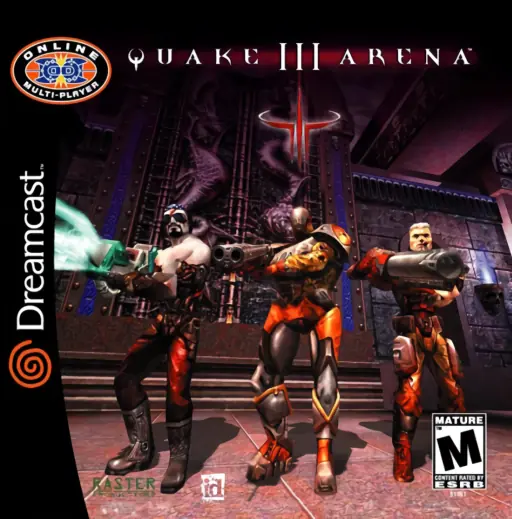
Unlike its predecessors, Quake III Arena does not have a single-player campaign. Instead, it replicates the multiplayer experience with computer-controlled players. The game's story is brief: "the greatest warriors of all time fight for the amusement of a race called the Vadrigar in the Arena Eternal." The introduction video shows the abduction of such a warrior, Sarge, while making a last stand.
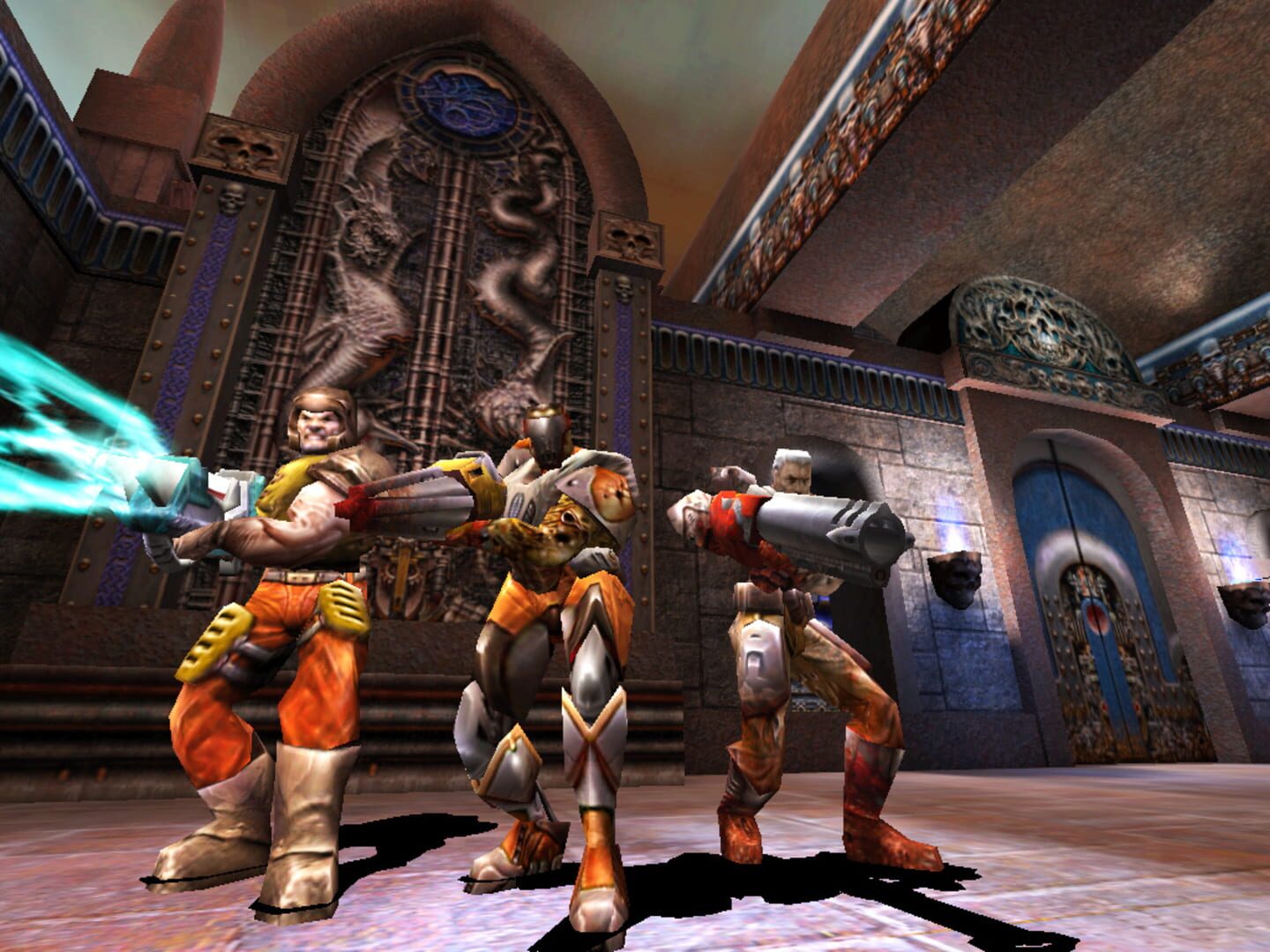
Continuity with prior games in the Quake series and even Doom is maintained by the inclusion of player models and biographical information. A familiar mixture of gothic and technological map architecture as well as specific equipment is included, such as the Quad Damage power-up, the rocket launcher, and the BFG.
In Quake III Arena, the player progresses through tiers of maps, combating different bot characters that increase in difficulty, from Crash (at Tier 0) to Xaero (at Tier 7). As the game progresses, the fights take place in more complex arenas and against tougher opponents. While deathmatch maps are designed for up to 16 players, tournament maps are designed for duels between 2 players and in the single-player game could be considered 'boss battles'.
The weapons are balanced by role, with each weapon having advantages in certain situations, such as the railgun at long-range and the lightning gun at close quarters. The BFG super-weapon is an exception to this; compared to other similarly named weapons in the Doom/Quake series, Quake III Arena's incarnation of this weapon is basically a fast-firing rocket launcher and it is found in hard-to-reach locations. Weapons appear as level items, spawning at regular intervals in set locations on the map. If a player dies, all of their weapons are lost and they receive the spawn weapons for the current map, usually the gauntlet and machine gun. Players also drop the weapon they were using when killed, which other players can then pick up.
Quake III Arena comes with several gameplay modes: Free for All (FFA), a classic deathmatch, where each player competes against the rest for the highest score, Team Deathmatch (TDM), where usually two teams of four compete for the highest team frag (kill) total, Tournament (1v1), a deathmatch between two players, usually ending after a set time and Capture the Flag, which is played on symmetrical maps where teams have to recover the enemy flag from the opponents' base while retaining their own.
Quake III Arena was specifically designed for multiplayer. The game allows players whose computers are connected by a network or to the internet to play against each other in real time, and incorporates a handicap system. It employs a client–server model, requiring all players' clients to connect to a server. Quake III Arena's focus on multiplayer gameplay spawned a lively community, similar to QuakeWorld, that is still active as of 2026.
Development
During early March 1999, ATI leaked the internal hardware vendor (IHV) copy of the game, which unveiled to the public in Macworld Conference & Expo at Moscone Center in January and Makuhari Messe in February by Steve Jobs (CEO of Apple Inc. at the time when it unveiled). This was a functional version of the engine with a textured level and working guns. The IHV contained most of the weapons (excepting the Gauntlet) that would make it into the final game although most were not fully modeled; a chainsaw and grappling hook were also in the IHV but did not make it into the final release.
Many of the sounds that would make it into the final release were also included. The game was developed by nine people in 18 months.
After the IHV leak, id Software released a beta of the game called Quake III Arena Test on April 24, 1999, initially only for Mac OS before expanding to Windows at a later date. The Q3Test started with version 1.05 and included three levels that would be included in the final release: dm7, dm17, and q3tourney2. Id Software continued to update Q3Test up until version 1.09.
id co-founder and former technical director John Carmack has stated that Quake III Arena is his favorite game he has worked on.
Quake III Arena was shipped to retailers on December 2, 1999; the official street date for the game was December 5, although id Software chief executive officer Todd Hollenshead expected the game to be available as early as December 3 from retailers like Babbage's and EB Games. The game supported the A3D 2.0 HRTF technology by Aureal Semiconductor out of the box.
The id Tech 3 engine is the name given to the engine that was developed for Quake III Arena. Unlike most other games released at the time, Quake III Arena requires an OpenGL-compliant graphics accelerator to run. The game does not include a software or Direct3D renderer.
The graphic technology of the game is based tightly around a "shader" system where the appearance of many surfaces can be defined in text files referred to as "shader scripts". Quake 3 also introduced spline-based curved surfaces in addition to planar volumes, which are responsible for many of the surfaces present within the game. Quake 3 also provided support for models animated using vertex animation with attachment tags (known as the .md3 format), allowing models to maintain separate torso and leg animations and hold weapons. Quake 3 is one of the first games where the third-person model is able to look up and down and around as the head, torso and legs are separate. Other visual features include volumetric fog, mirrors, portals, decals, and wave-form vertex distortion.
For networking, id Tech 3 uses a "snapshot" system to relay information about game "frames" to the client over UDP. The server attempts to omit as much information as possible about each frame, relaying only differences from the last frame the client confirmed as received (Delta encoding). id Tech 3 uses a virtual machine to control object behavior on the server, effects and prediction on the client and the user interface. This presents many advantages as mod authors do not need to worry about crashing the entire game with bad code, clients could show more advanced effects and game menus than was possible in Quake II and the user interface for mods was entirely customizable.
Unless operations which require a specific endianness are used, a QVM file will run the same on any platform supported by Quake III Arena. The engine also contains bytecode compilers for the x86 and PowerPC architectures, executing QVM instructions via an interpreter.
Quake III Arena features an advanced AI with five difficulty levels which can accommodate both a beginner and an advanced player, though they usually do not pose a challenge to high-tier or competitive players. Each bot has its own, often humorous, 'personality', expressed as scripted lines that are triggered to simulate real player chat. ". Each bot has a number of alternative lines to reduce the repetition of bot chatter.
The Gladiator bots from Quake II were ported to Quake III Arena and incorporated into the game by their creator - Jan Paul van Waveren, aka Mr. Elusive. Bot chat lines were written by R. A.
Salvatore, Seven Swords and Steve Winter. Xaero, the hardest opponent in the game, was based on the Gladiator bot Zero. The bot Hunter appears on magazine covers in the later id game Doom 3.
On August 19, 2005, id Software released the complete source code for Quake III Arena under the GNU General Public License v2.0 or later, as they have for most of their prior engines. As before, the engine, but not the content such as textures and models, was released, so that anyone who wishes to build the game from source will still need an original copy of the game to play it as intended.
Fast inverse square root, sometimes referred to as Fast InvSqrt() or by the hexadecimal constant 0x5F3759DF, is an algorithm that estimates
1
x
{\displaystyle {\frac {1}{\sqrt {x}}}}
, the reciprocal (or multiplicative inverse) of the square root of a 32-bit floating-point number
x
{\displaystyle x}
in IEEE 754 floating-point format. The algorithm is best known for its implementation in the source code of Quake III Arena.
At the time, it was generally computationally expensive to compute the reciprocal of a floating-point number, especially on a large scale. However, the fast inverse square root bypassed this step.
Around 2002, initial speculation pointed to John Carmack as the probable author of the code, but he demurred and suggested it was written by Terje Mathisen, an accomplished assembly programmer who had previously helped id Software with Qua
Reception
Metacritic, which assigns a normalised rating in the 0–100 range, calculated an average score of 93 out of 100 ("Universal acclaim/Must-Play") for the Dreamcast version, 84 out of 100 ("Generally favorable reviews") for the PlayStation 2 version's Revolution edition. while the Xbox Live Arcade version's Arena Arcade edition received a lowest score with the average score of 69 out of 100 ("Mixed or Average").
Reviews for the game were very positive, with many describing the game as fast and addictive. Curved surfaces were a welcome addition to the series. Most reviewers felt the game was best when played with others online. A Diehard GameFan review by Robert Howarth described the game as the best "pure deathmatch" experience around, but criticised the game's frame rate, which didn't run very well on low-end systems and required either a RIVA TNT2 or GeForce 256 GPU to run the game at an acceptable frame rate.
GameSpot reviewer Jeff Gerstmann described the game as outstanding. He noted the fun level designs, great-looking textures, impressive special effects and weapons sounds. Gerstmann however criticised the narrator's voice and thought that some levels could become too crowded when playing multiplayer. An IGN review felt the game lacked originality but enjoyed the detailed wall textures and outer space jump levels.
The high number of character skins and the artificial intelligence of opponent bots were praised but the weapons were said to be "bland and predictable". A Eurogamer review described the game as "polished" and "stunning" and thought that it "was extremely well balanced and plays very well". The reviewer was especially pleased with the customisable 3D engine and looked forward to new maps and mods.
Blake Fischer reviewed the PC version of the game for Next Generation, rating it five stars out of five, describing it as "the best deathmatch yet. Period. End of story. If you want single-player or a storyline, buy Half-Life. If you want great DM and near-infinite expandability, Quake III is the best in the business".
Frank O'Connor reviewed the Dreamcast version of the game for Next Generation, rating it four stars out of five, and stated that it was "a brilliant, if flawed, conversion of arguably the best online game ever made – it's sure a hell of a lot more interesting use of the Dreamcast modem than Chu Chu Rocket". The Dreamcast version won GameSpot's annual "Best Multiplayer Game" award among console games, and was a runner-up in the "Best Shooting Game" category, which went to Perfect Dark.
Garrett Kenyon reviewed the PlayStation 2 version of the game for Next Generation, rating it four stars out of five, and stated that "all in all, this is a fast and beautiful game – easily the best shooter available for PS2". Japanese gaming magazine Shūkan Famicom Tsūshin scored the PlayStation 2 version of the game a 25 out of 40 (63 out of 100 for online version), while a User Reviewer average scored at the MK2network website are scored 62 out of 100. The PlayStation 2 version was a nominee for The Electric Playground's 2001 Blister Awards for "Best Console Shooter Game", but lost to Halo: Combat Evolved for Xbox.
Quake III Arena won PC Gamer US's 1999 "Special Achievement in Graphics" award, and wrote that it "set a new high-water mark in 3D graphics this year". During the 3rd Annual Interactive Achievement Awards, the game was nominated for "Computer Action Game of the Year", which was ultimately awarded to Half-Life: Opposing Force.
In January 2016, Red Bull labeled Q3DM17 (The Longest Yard) one of the 10 greatest FPS multiplayer levels of all time.
Quake III's sales surpassed 50,000 copies during its first three days of release, by which time 1 million copies had been printed. It debuted at #5 on PC Data's weekly computer game sales chart for the December 5–11 period. The game rose to fourth place in the weekly top 10 the following week. Domestically, it sold 222,840 copies and earned revenues of $10.1 million (~$17.9 million in 2025) by early 2000.
In North America, Quake III sold 168,309 copies and earned $7.65 million (~$13.6 million in 2025) from January through October 2000, according to PC Data. Its overall sales in the region, including its launch in 1999, totaled 319,970 units by November 2000. Its sales for 2000 alone ultimately reached 190,950 units and $8.4 million (~$14.9 million in 2025) by the end of the year. The game later received a "Silver" sales award from the Entertainment and Leisure Software Publishers Association (ELSPA), indicating sales of at least 100,000 copies in the United Kingdom.
Quake III Arena's multiplayer-focused development led to it developing a large community of competitive players and like its predecessors it was used extensively in professional electronic sports tournaments. In competitive Quake III Arena there are two distinct gameplays, often referred to as 'rulesets', the out-of-the-box Quake III Arena game, also known as vanilla Quake 3 (VQ3), and the CPM ruleset of the Challenge Pro Mode Arena mod. On July 26, 2006, Challenge Pro Mode Arena with VQ3 gameplay was chosen by Cyberathlete Professional League as the mod of choice for their tournament, making it the standard competitive mod for Quake III Arena. Previously, Orange Smoothie Productions was the most widely used tournament mod.
The following competitions have held Quake III events:
Cyberathlete Amateur League
Cyberathlete Professional League
Electronic Sports World Cup
QuakeCon
World Cyber Games
Dreamhack
These competitions have now moved on to more recent games or have transitioned to its variant successor, Quake Live.