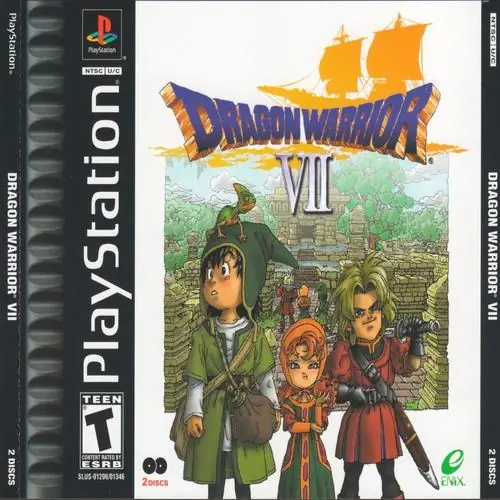
The articlegameplay, story, development, reception
Gameplay
Dragon Quest VII is best known for its huge size. Without completing the game's side quests, a single game of Dragon Quest VII can take a hundred hours or more. In terms of gameplay, not much has changed from previous installments; battles are still fought in a turn-based mode from a first person perspective. Although non-battle sequences are rendered in 3D, battles themselves are still portrayed two dimensionally.
The ability to talk with the party characters in and outside of battles was added to this game. They offer advice about battle strategies and plot points, or simply comment on how they feel at a given moment. There are four ways and means of locomotion: walking (striding), sailing a boat, flying a magic carpet, or using an object known as the skystone. Each of these can move across different terrain; however, some are more limited than others.
Story
The story begins when the father of the protagonist brings home a map fragment from a fishing trip; this map suggests to the protagonist and his friend that the world had, at some point in its past, had many continents, though now there is only the small island of Estard (エスタード, Esutādo). The two of them find a way to travel back to the past, when the continents still existed. The continents are facing serious problems that threaten their existence; the protagonist and his growing party work to resolve the problems, and when they do, the continents reappear in the present. When all the continents are finally restored, the party confronts the Demon King Orgodemir, who long ago defeated the Almighty (God in the Japanese script and the English PlayStation release) and is responsible for the continents' disappearance.
After his initial defeat, Orgodemir returns in the present and poses as the Almighty to trick humanity into worshiping him, then seals the continents away again. The party summons the Four Great Spirits to expose Orgodemir, then travels to the Demon King's fortress where they destroy him for good in a final showdown. Afterwards, the party celebrates their victory with the allies they made during their journey and return to their ordinary lives.
Development
Dragon Quest VII was designed by series creator Yuji Horii and directed by Manabu Yamana. Shintaro Majima signed on as art director, while series veterans Akira Toriyama and Koichi Sugiyama designed the characters and composed the music respectively. The game was officially announced in 1996 and originally expected to be released for the Nintendo 64DD. On January 15, 1997, it was announced that development had been moved to the PlayStation.
By the next day, both stock in Sony and Enix rose significantly in Japan. In turn, the move to the PlayStation was described as a "semi-crisis situation" for Nintendo, with Japanese stock analysts and industry observers losing faith in the long-term viability of the Nintendo 64 line. Enix cited the larger potential market and lower cost of manufacturing CDs as the reasons for the change of platform. By 2000, Dragon Quest VII was predicted to be so successful in Japan that it would "create a 50 billion yen effect on the Japanese economy", said research firm DIHS.
Reception
Dragon Warrior VII received both commercial and critical success in Japan. 57 million units were sold within 17 days of the game's release; the game established itself for having the largest annual shipment of any independently sold game for the original PlayStation. 9 million copies by November. Shipments of Dragon Quest VII reached four million copies on January 5, 2001, and the game became the sixth best-seller video game of all platforms in Japan at that time.
1 million units as of March 2003. engaging without depending on a high degree of realism..." well refined and artfully executed." The game also won four awards from the 5th Japan Entertainment Software Awards by the Computer Entertainment Supplier's Association (CESA), including Best Prize, Scenario Prize, Sales Prize, and Popularity Prize.