The articlegameplay, story, development, reception
Gameplay
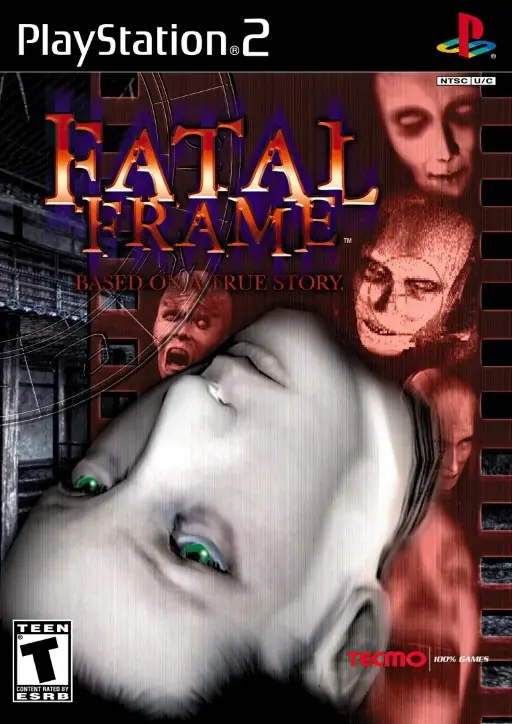
Fatal Frame is a survival horror video game set within an abandoned Japanese mansion, divided into a prologue tutorial and four chapters. The player controls Miku Hinasaki for the majority of the game, with the prologue featuring Miku's brother Mafuyu. Each part of the mansion includes a map of its layout, and each level is rendered in real-time instead of using pre-rendered backgrounds. During navigation, players guide the characters through multiple rooms, each with a semi-fixed camera perspective that changes depending on a character's position.
Environments are invariably dark, with exploration being possible through the use of a flashlight. During exploration, various items can be found scattered through environments: these include documents and cassette recordings expanding on elements of the story, health items, and other objects. In some areas, the main character must also solve puzzles to progress. Progress is saved at savepoints through the mansion, and at the end of each chapter.
Story
The story, set in the year 1986, focuses on orphaned siblings Miku and Mafuyu Hinasaki, who share the ability to sense and perceive supernatural events. When Mafuyu disappears in the haunted Himuro Mansion searching for his tutor Junsei Takamine and his assistants, Miku goes to Himuro Mansion. As she explores the mansion, Miku discovers signs that Takamine's party were killed by the mansion's ghosts, and finds rope burns appearing on her wrists and ankles, manifestations of a curse on anyone who enters Himuro Mansion. Further exploration through the mansion turns up information on a dark ritual that took place within Himuro Mansion: a chosen "Rope Shrine Maiden" was torn apart using ropes attached to her limbs and neck, then the ropes that killed her were soaked in her blood and used to seal the Hell Gate, a portal to the afterlife that keeps a dark force known as "the Malice" and the restless dead from escaping into the living world.
The last sacrifice, Kirie Himuro, fell in love with a visitor prior to her death; while the Himuro family head had the man killed in secret, Kirie remained attached to the mortal world through her love for him. This attachment meant that her sacrifice did not seal the Hell Gate, allowing Malice to infest Himuro Mansion, with its inhabitants either dying or being driven mad. Kirie's spirit haunts the mansion in a splintered form; a child version who helps Miku at various points, and an adult version corrupted by Malice responsible for the curse which kills visitors. Mafuyu was captured by Kirie as he resembles her dead lover.
Development
The concept for the game came to future director Makoto Shibata shortly after he finished work on Tecmo's Deception: Invitation to Darkness. The concept came to Shibata inspired by his own dreams and encounters with what he felt were supernatural occurrences. Development began when the PlayStation 2 hardware was first introduced to Tecmo, under the codename "Project Zero". One of the things they drew inspiration from was the positive reception of polygon characters in the Silent Hill series, using this to go a step further and create the sense of seeing things off-screen.
The ultimate goal was to create as frightening an atmosphere as possible. The staff included multiple developers from the Deception series. According to character designer and CGI director Hitoshi Hasegawa, the game's key colors are black and white: white represented hope, while black represented fear. During early development, a large amount of effort went into adjusting the lighting and shading, with the most obvious in-game representation of the key colors and desired effect being Miku's torch piercing the darkness inside the mansion.
Reception
During 2001, Fatal Frame sold just over 42,000 units in Japan, ranking among the top 300 best-selling games of that year. Upon its release in Europe, the PS2 version sold 12,000 copies. According to an interview with Kikuchi and Shibata, the game was an unexpected success in both North America and Europe. The two attributed this to the recent popularity of Japanese horror films like Ring.
The PS2 version met with "mixed or average" reviews according to review aggregation website Metacritic, earning a score of 74 out of 100 based on 22 critic reviews. Famitsu praised the use of the Camera Obscura in creating a sense of tension in combination with the sound and visual design. IGN's David Smith, while noting some difficulties with the controls, generally praised its atmosphere and gameplay, saying that "horror fans are advised to pick this one up at their leisure, and even the jaded might find something to renew their interest in the genre". Chris Baker of 1UP.com similarly praised the atmosphere and enjoyed the gameplay, particularly noting its ability to make him feel like a newcomer to gaming with its late-game difficulty spike.
Legacy
The success of Fatal Frame prompted Tecmo to turn the concept into a series. Since the original game's release, the gameplay has remained generally unchanged, becoming a defining part of the series' identity. A standalone sequel, Fatal Frame II: Crimson Butterfly, was released in 2003 in Japan and North America, and 2004 in Europe. A further sequel, Fatal Frame III: The Tormented, was released in 2005 in Japan and North America and 2006 in Europe. The first three Fatal Frame titles form a loosely-connected trilogy, with The Tormented continuing narrative elements from the first two titles.
Shortly after the game's release, a Hollywood film adaptation was announced in 2003. Based on the game's story and intended to be set in Japan as opposed to a Western country, Robert Fyvolent and Mark R. Brinker were to be the writers and John Rogers was the producer. Steven Spielberg has been brought in to polish the script.