Ludography
60/100
Players13 ratings
Jr. Pac-Man cover

1983 · Midway Games · Arcade · Maze

Jr. Pac-Man

Atari console exclusive

The gameplay of Jr. Pac-Man is similar to that of its predecessors: The player controls the titular Jr. Pac-Man and scores points by eating all of the dots in the maze. Four ghosts roam the maze and attempt to capture him.

Also known as
Jr Pacman
Released
13 August 1983
Platforms
ArcadeAtari 2600Atari 5200Commodore C64/128/MAXMS-DOSAtari 7800Commodore 64
Genres
ArcadeMazePuzzle
Developers
Midway Games
Publishers
Midway Games
Modes
Single-player
Perspective
Side view
Themes
Action
Country
United States

About

Jr. Pac-Man is an arcade video game developed by General Computer Corporation and released by Bally Midway in 1983. It has the same gameplay as prior entries in the Pac-Man series, but the maze scrolls horizontally and has no escape tunnels. Unlike previous Pac-Man games, the bonus item moves around the maze.

It changes dots into a form that slows Jr. Pac-Man as they are being eaten and can also destroy power pellets.

Keywords

  • ghosts
  • mascot
  • death
  • maze
  • side-scrolling
  • artificial intelligence
  • high score
  • anthropomorphism
  • cat
  • collectibles
  • non-humanoid protagonist
  • female antagonist

Media

The articlegameplay, story, development, reception

Gameplay

The core gameplay of Jr. Pac-Man is similar to its predecessors. The player controls the eponymous Jr. Pac-Man (who wears an animated propeller beanie), and scores points by eating all of the dots in the maze, while four ghosts (Blinky, Pinky, Inky, and Tim, who replaces Clyde) chase him around the maze and attempt to catch him.

Eating a power pellet turns the ghosts blue, briefly allowing the player to eat them for extra points. Once the maze is cleared, a new maze is presented and the gameplay continues.

Development

Tim Hoskins worked at General Computer Corporation (GCC) as Jr. Pac-Man's project lead. Hoskins recalled that GCC's founder Doug Macrae came up with the idea, referring to the game as Pac-Baby in his project notes. Macrae echoed this, adding that "Junior Arriving" had been an intermission scene in Ms.

Pac-Man. As Pac-Man and Ms. Pac-Man were what Macrae described as "huge successes", the company continued with the series. During this period in arcade development, they had the option to develop the game as a new arcade cabinet or implement a new hardware kit.
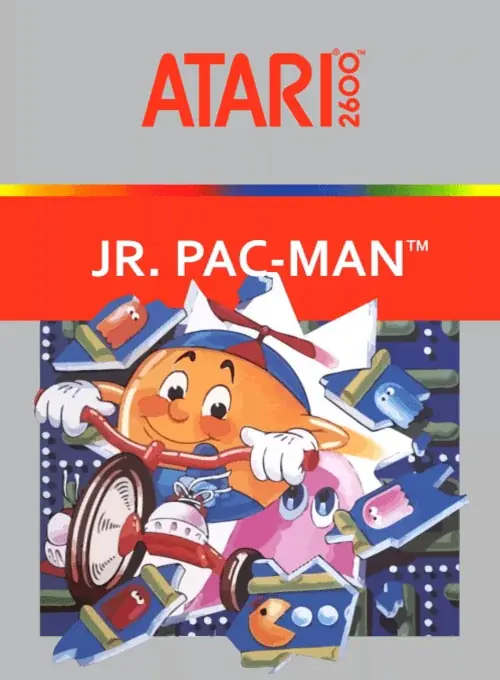
Releases by platformdates and regions as published

Releases by platform
PlatformReleasedRegions
Arcade13 October 1983North America
Atari 26001 October 1984North America
Atari 5200Cancelled31 December 1984Worldwide
Commodore C64/128/MAX31 December 1988Worldwide
MS-DOS31 December 1988North America

Box artone per regional release we hold art for

Games like this

Collections2 collections

Platform libraries

Description adapted from its source, CC BY-SA 4.0.