
The articlegameplay, story, development, reception
Gameplay
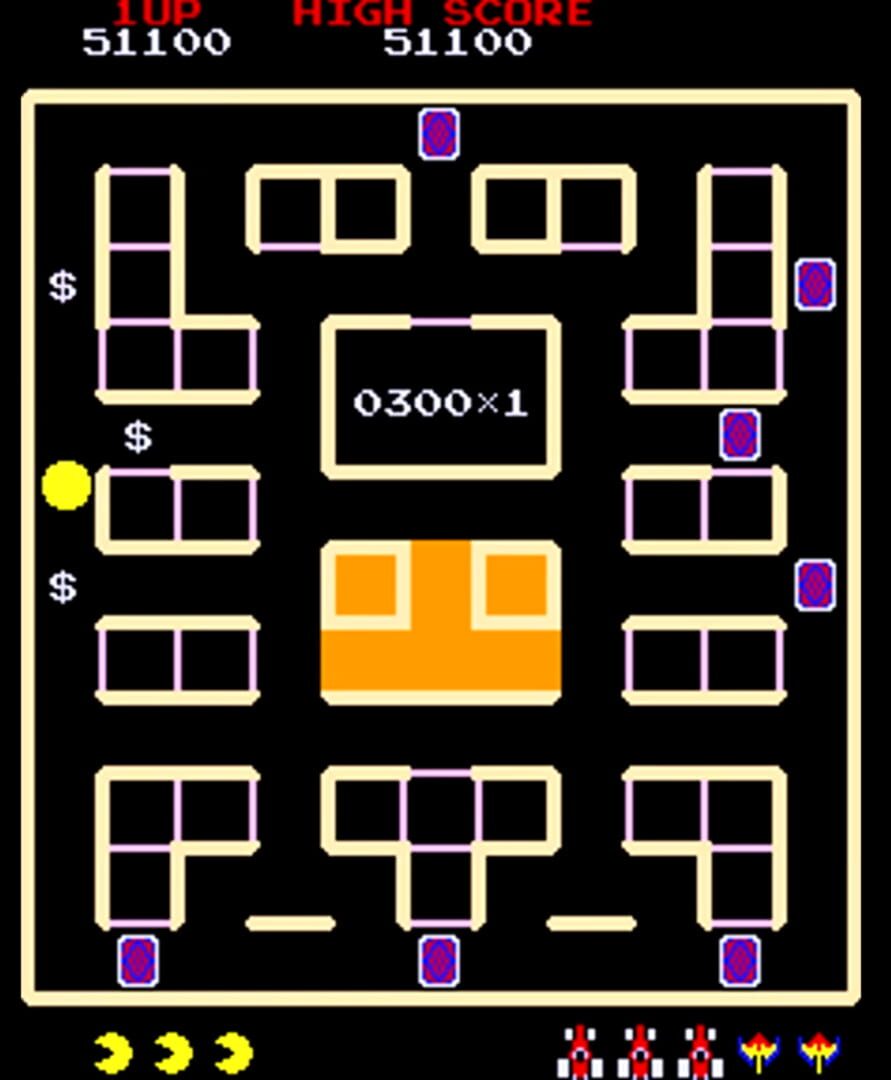
Controls consist of a four-position joystick and a button. Using the joystick, the player guides Pac-Man through an enclosed maze in which several items are locked behind doors. Several face-down cards are scattered throughout the maze; when Pac-Man runs over one of these, it flips over to reveal one of the items, which becomes unlocked so Pac-Man can eat it. Two items in each maze are power-ups, which correspond to "S" cards.
Upon eating one of these, Pac-Man temporarily turns blue and grows larger; the player can now press the button to fire a beam that briefly stuns the ghosts. Items include a flagship from Galaxian, a red car from Rally-X, a trumpet, a snowman, and a miniature Pac-Man. The items are simply different cosmetically, and all of them have the same effect.
Development
Pac & Pal was developed and published by Namco in July 1983 in Japan. It is the third game in the Pac-Man series that was made by Namco themselves, as Pac-Man's North American distributor Midway Games had produced many of their own sequels that Namco had little involvement with. Pac & Pal is largely based on Super Pac-Man, Namco's own sequel to the original, and retains a similar graphical style and many of its mechanics. With the Pac-Man brand increasing in popularity in Japan, Namco sought to produce a follow-up that matched its success.
Super Pac-Man was largely unsuccessful, so Pac & Pal was made to improve on its flaws and update its core features. Yuriko Keino, who is best known for her work on games such as Dig Dug and Xevious, composed the soundtrack. Namco and Midway had plans to release Pac & Pal in North America under the new name Pac-Man & Chomp Chomp, which replaced Miru with Pac-Man's spherical dog from the Hanna-Barbera cartoon series. Pac-Man & Chomp Chomp was never released in North America due to the market being over-saturated with Pac-Man games.
Reception
While Pac & Pal saw success in its first few months on the market, it was relatively a commercial failure and remained obscure for many years. The game's drastic differences compared to the original Pac-Man and Super Pac-Man and its limited production run have been attributed to its downfall. Retrospectively, Pac & Pal has gained attention for its many changes to the gameplay of its predecessors, and is seen among the stranger entries in the Pac-Man franchise.
In 1998, Anthony Baize of Allgame was largely critical of the game. He described its gameplay as "horrible", and criticized it for being too distant from the gameplay of the original Pac-Man. He wrote: "Overall, Pac & Pal is a travesty. In my mind, it holds the title as worst and weirdest Pac-Man sequel ever unleashed upon the world.


