
The articlegameplay, story, development, reception
Gameplay
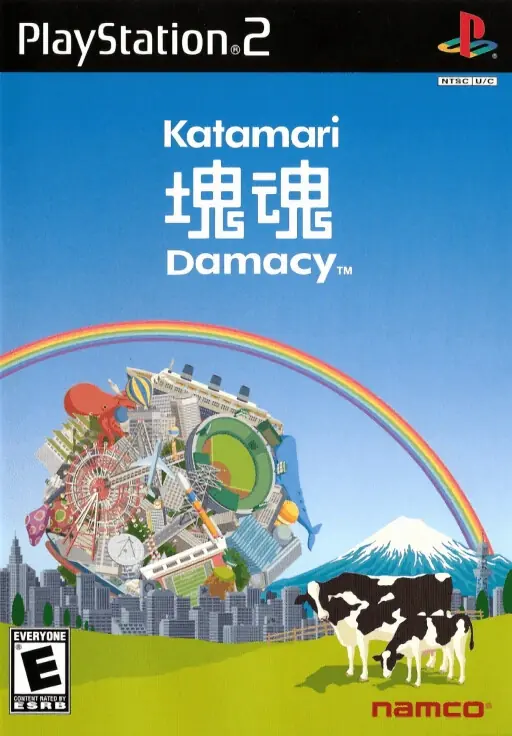
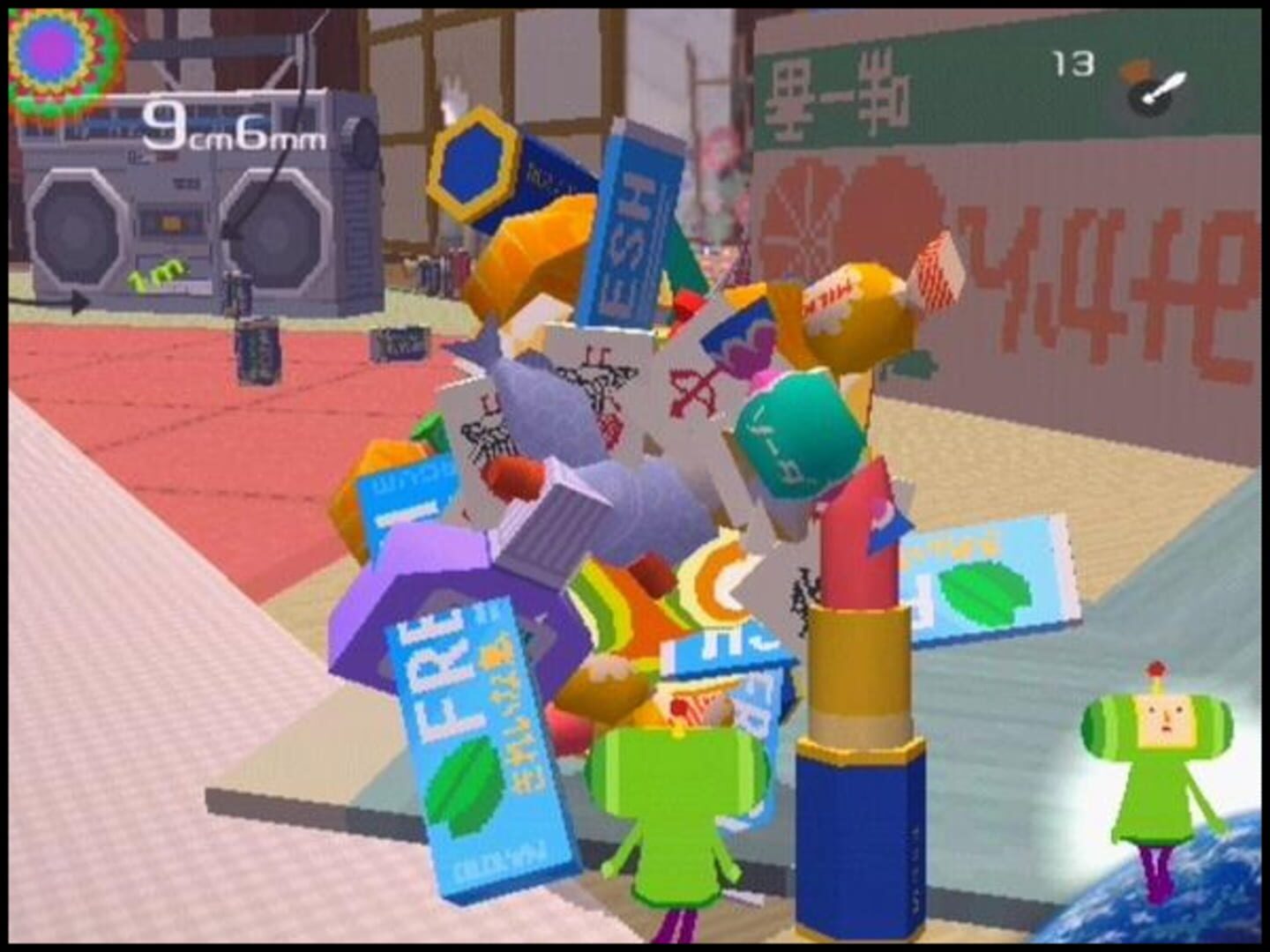
The player controls the Prince as he rolls the katamari around houses, gardens, and towns in order to meet certain parameters set by the King of All Cosmos. The player uses the two analog sticks on the DualShock controller in a manner similar to the classic arcade game Battlezone to control the direction the katamari rolls. Other controls can be triggered by the player to gain a quick burst of speed, flip the Prince to the other side of the katamari and more.
Objects that are smaller than the katamari will stick to it when the player comes into contact with them, while greater objects can be hurdles; colliding at high speed with any may cause objects to fall off the katamari, slowing the player's progress. The game uses size, weight, and surface area to determine if an object will stick to the katamari. This allows slender objects, such as pencils, that are longer than the katamari is wide, to be picked up, and these will alter how the katamari rolls until more objects are picked up. Animals such as cats will chase the katamari, knocking things from it, but once the katamari is great enough, it will scare the animals away, and they can be rolled up once they are chased down.
Story
In a drunken stupor, an eccentric, god-like entity called the King of All Cosmos destroys all the stars, Earth's Moon and other such celestial bodies in the universe, except for Earth itself. Despite acknowledging his mistake, the King charges his five-centimeter-tall son, the Prince, to go to Earth with a "Katamari"—a magical ball that allows anything smaller than it to stick to it and make it grow—and collect enough material for him to recreate the stars and the Moon. The Prince is successful, and the universe is returned to normal.
A side-story follows the Hoshino family as the Prince works at his tasks. The father, an astronaut, is unable to go to the Moon after it is wiped out by the King, and the daughter, whose name is Michiru, "senses" the Prince's work—she can feel when each constellation returns to the sky. Ultimately, the family, along with their house and town, are rolled up in the katamari that is used to remake the Moon.
Development
Keita Takahashi entered Musashino Art University to study sculpting in 1995. During his studies, he came to a philosophy that his art needed to combine practical elements along with a bit of whimsy and humor. After graduation, Takahashi no longer had the desire to pursue sculpting as a full-time career, and saw the potential to become involved in video games as a means to continue his art interest in a larger medium. Joining Namco as an artist around 1999, Takahashi worked on a number of smaller projects for the publisher.
One of these was called Action Drive, inspired by Crazy Taxi but with more spy-based elements atop the driving gameplay. During this, Takahashi came up with the ideas of the characters that would be central to Katamari Damacy: the King, the Queen, and the Prince of all Cosmos. His idea would have been that the queen had been kidnapped by agents on Earth, and the lazy King sends the Prince to rescue her. To do this, the player would use the diminutive Prince's head, shaped like a hammer, to stun humans, after which the Prince would then "drive" the humans around by putting a steering wheel on the back of the human's head.
Reception
Katamari Damacy enjoyed moderate success in Japan. The game was sold at about two-thirds of the price of a new game at the time. It was the top-selling game the week of its release with 32,000 units sold, and sold over 155,000 copies in Japan by the end of 2004. Namco, however, originally estimated that over 500,000 units would be sold in Japan.
The game was not released in PAL territories such as Europe and Australia since publishers thought it was too "quirky" for these markets; Electronic Arts picked up both sequels, We Love Katamari and Me & My Katamari, for release in Europe.
Legacy
Katamari Damacy has spawned numerous sequels on the PlayStation 2 and newer game consoles. The game's direct sequel on the PlayStation 2, We Love Katamari, was released internationally in 2005 and 2006. Its story is self-referential, following on the success of the first game, most of the levels are based on requests from newfound fans of the King and the Prince. Though sharing the same mechanics, We Love Katamari introduces new gameplay features, such as co-operative play, and new goals, such as collecting the most valuable objects, that would continue through its sequels.
On July 29, 2012, the game was included in an exhibit at the New York Museum of Modern Art, entitled "Century of the Child: Growing by Design". Here, the game was used to demonstrate the change in toys and "playthings" over the 20th century, specifically praising the game for its "quirky manipulations of scale" that makes it accessible for all ages. Vice president of marketing for Namco Bandai Games America, Inc. Carlson Choi described the inclusion of Katamari Damacy to the exhibit as "a testament to the creative designs embodied in Namco Bandai's games, in addition to being a validation of video games as a modern form of interactive art".