
The articlegameplay, story, development, reception
Gameplay
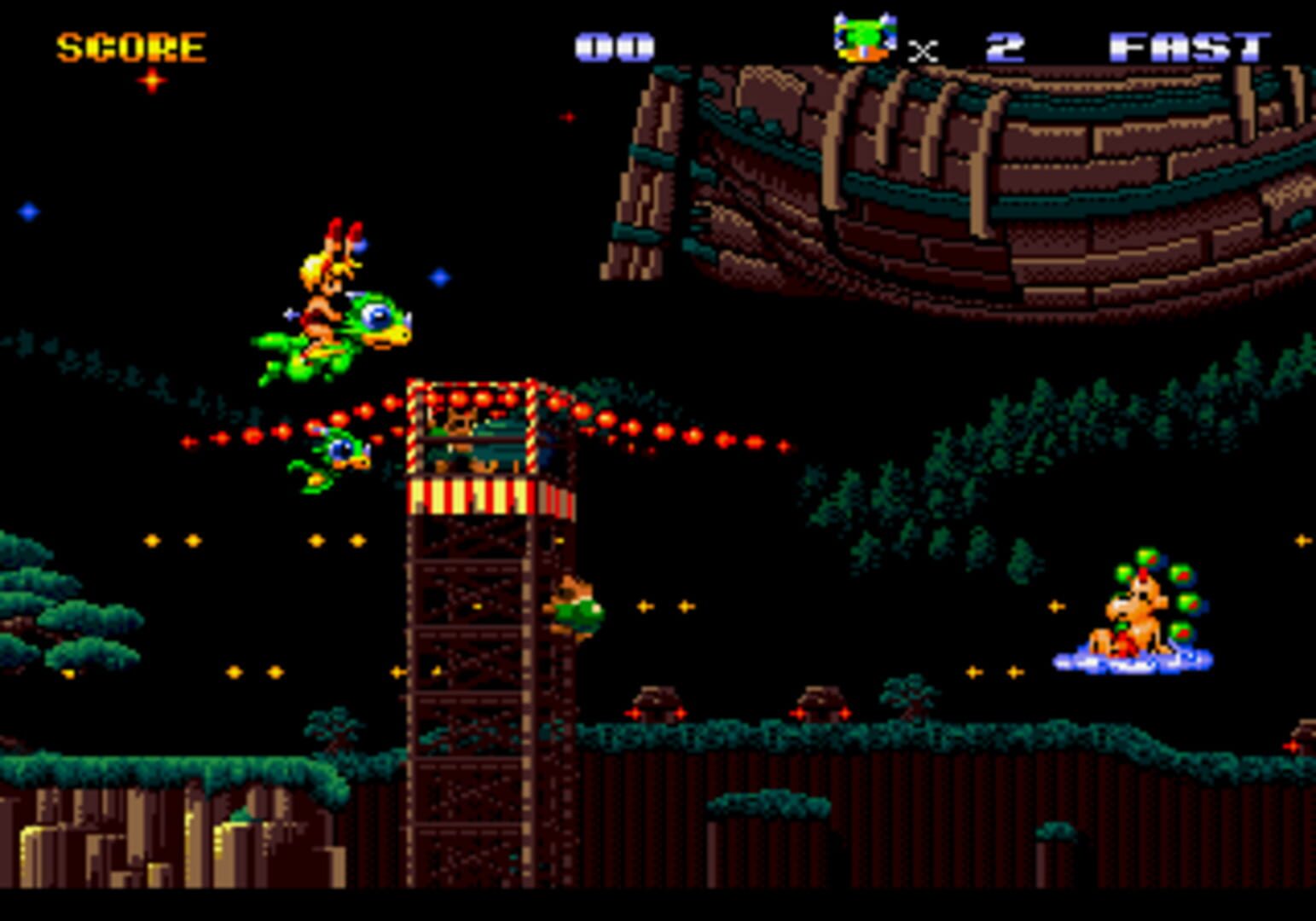
The game consists of Rami riding on top of Spot, who can shoot fireballs at enemies. By earning "Power-Up Items", the player increases the power of the flames to six different levels. The player can also pick up Sub-Weapons and use either the Ground Bombs, the Explosive Throwing Stars or Homing Spot Jrs. (companion fighters) depending on the type of Sub-Weapon Items available.
Normally, Spot Jrs. are for covering Spot; however by pressing the "C" Button, they become powerful bullets projected forward. If surrounded by the enemy, the player can use the Kamikaze Attack, sacrificing the Spot Jrs. to do larger damage, only for them to reappear when Spot ceases to shoot.
Story
The game is set in the Keiō era (1865–1868) of Japanese history, during the Tokugawa shogunate. Rami Nanahikari, a naughty girl in her prime, has been raised from a young age and brought up by her grandparents to be the next Guardian of the Key to the Secret Treasure, known as "Ark", and is really a descendant of aliens who came to Earth in ancient times. She does not know the importance of the Treasure, and her overbearing grandmother does not remember what secret the Key unlocks. The Key was stolen while Rami was at the local convenience store, and now she must get the Key back.
Wearing her bunny girl costume, Rami rides into battle on her trusty dragon, Spot, as she encounters various enemies such as tanuki, dogs, cats, monkeys, the Seven Lucky Gods, the U.S. military forces, the Russian Army, and a serpentine dragon, until she arrives at the ship of Dr. Pon Eho, a tanuki billed as the most intelligent creature on Earth with an IQ of 1400, his appearance being appropriate for the thief that he is.
Development
Keio Flying Squadron was made by a small team of developers; director Yasushi Endo, game designer Satoru Honda, programmer Teruhito Yamaki, and composer Tsukasa Tawada, with art and graphics by Hiroshi Ogawa and Hitoshi Kakumu, and character designs by Hiromasa Ota and Takeshi Honda. Since Victor Entertainment was originally a music company before its merge with Nihon AVC, they had been developing products that brought out the potential of CD-ROMs. Most of their previous video games were overseas ports of other games; following the release of the SNES version of Dungeon Master, the developers all came together to create their first original game.
According to Honda, the developers wanted a story inspired by Kachi-kachi Yama, a Japanese folktale about a rabbit and a villainous tanuki. However, he believed that just because a rabbit was the main character did not mean that it had to be an actual rabbit. He chose a bunny girl as the protagonist of the game, naming her Rami Nanahikari, and reducing her breast size in order to fit his vision. He additionally stated that the attire was chosen so that Rami could easily be seen onscreen during gameplay.
Reception
In Japan, Keio Flying Squadron sold slowly by word-of-mouth due to an ineffective advertising campaign, but its reputation spread and it gained a cult following after its release. The game was met with average critical sentiments. In 1996, the game was said to have become popular in Europe and North America.
Sega Pro's Jason Johnson and Mark Hill called the Japanese release of the game one of "many mediocre releases on CD", and stated that it "contains bland and unoriginal ideas that will disappoint most players". Mark Pilkington would review the English version two years later in 1995, stating, "It's creepy, it's kooky and a perfect introduction to shoot-'em-ups." Mean Machines Sega's Tom Cox stated that the game "look[ed] like a complete rip-off of Konami's Parodius", but praised the game for its "fresh ideas", such as the enemies and bosses and the soundtrack "being played on genuine oriental instruments". Sega Magazine's Tom Guise and Richard Leadbetter deemed it "an enjoyable, playable blaster that doesn't push the Mega-CD's capabilities, but adds a good game to its catalogue".


