
The articlegameplay, story, development, reception
Gameplay
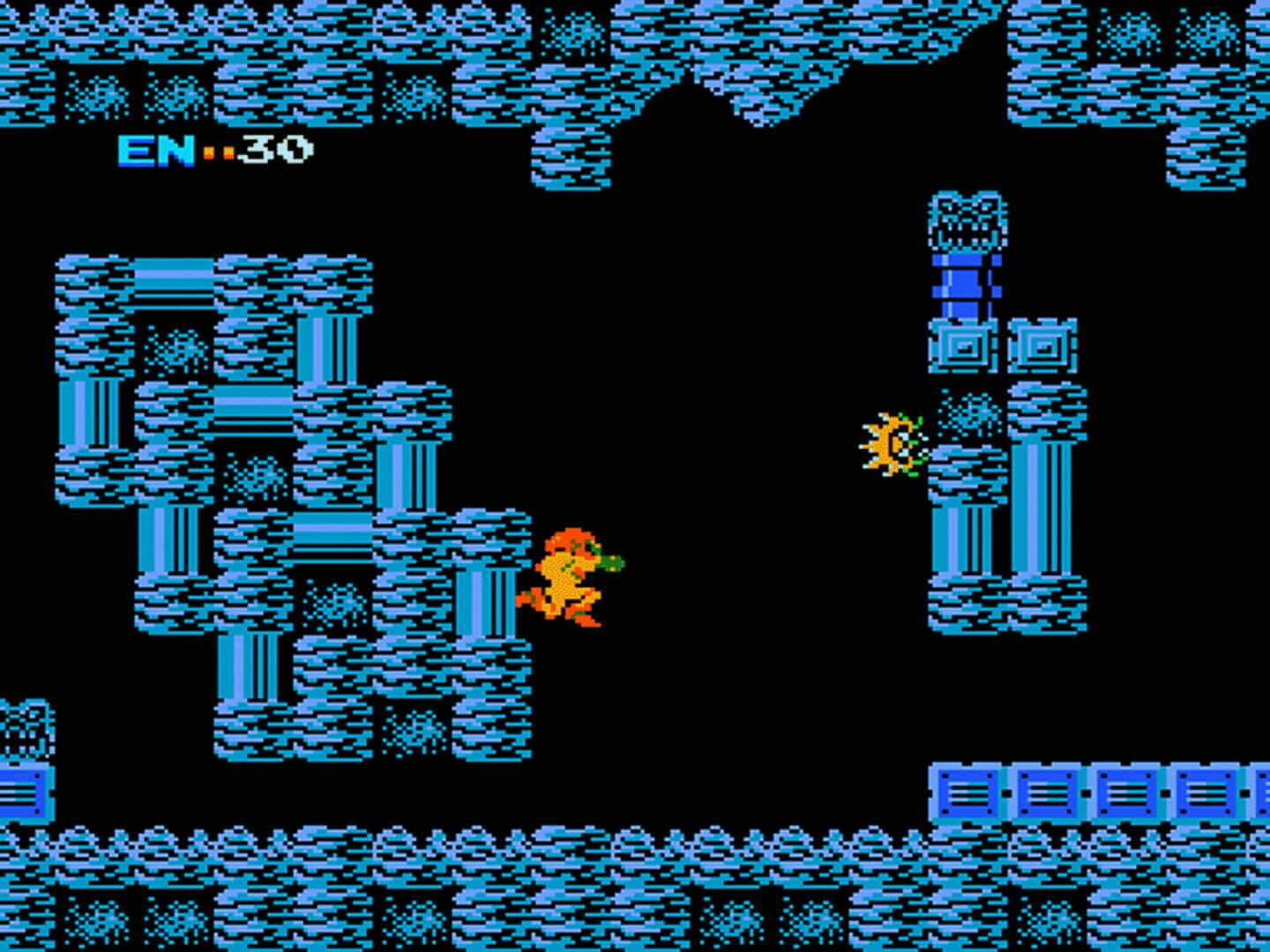
Metroid is an action-adventure game in which the player controls Samus Aran in sprite-rendered two-dimensional landscapes. The game takes place on the planet Zebes, a large, open-ended world with areas connected by doors and elevators. The player controls Samus as she travels through the planet's caverns and hunts Space Pirates. She begins with a weak power beam as her only weapon, and with only the ability to jump.
The player explores more areas and collects power-ups that grant Samus special abilities and enhance her armor and weaponry, allowing her to enter areas that were previously inaccessible. Among the power-ups that are included in the game are the Morph Ball, which allows Samus to curl into a ball to roll into tunnels; the Bomb, which can only be used while in ball form and can open hidden floor/wall paths; and the Screw Attack, a somersaulting move that destroys enemies in its path.
Story
In the year 20X5, the Space Pirates attack a Galactic Federation-owned space research vessel and seize samples of Metroid creatures—the predatory lifeforms discovered on the planet SR388. Dangerous floating organisms, the Metroids can latch on to any organism and drain its life energy to kill it. The Space Pirates plan to replicate Metroids by exposing them to beta rays and then using them as biological weapons to destroy all living beings that oppose them. While searching for the stolen Metroids, the Galactic Federation locates the Space Pirates' base of operations on the planet Zebes. The Federation assaults the planet, but the Pirates resist, forcing the Federation to retreat.
As a last resort, the Federation decides to send a lone bounty hunter to penetrate the Pirates' base and destroy Mother Brain, the biomechanical life-form that controls the Space Pirates' fortress and its defenses. Considered the greatest of all bounty hunters, Samus Aran is chosen for the mission. Samus lands her gunship on the surface of Zebes and explores the planet, traveling through the planet's caverns, finding upgrades such as missiles, bombs, energy tanks, the Morph Ball, Screw Attack, and Ice Beam, and uses these weapons to dispatch the alien creatures who get in her way. She comes across Kraid, an ally of the Space Pirates, and Ridley, the Space Pirates' commander, and defeats them both.
Development
After Nintendo's release of commercially successful platforming games in the 1980s, including Donkey Kong (1981), Ice Climber (1985), Super Mario Bros. (1985), and the critically acclaimed adventure game The Legend of Zelda (1986), the company began work on an action game. The word "Metroid" is a portmanteau of the words "metro" and "android". It was co-developed by Nintendo's Research and Development 1 division and Intelligent Systems, and produced by Gunpei Yokoi.
Metroid was directed by Satoru Okada and Masao Yamamoto (credited as "Yamamoto"), and featured music written by Hirokazu Tanaka (credited as "Hip Tanaka"). The scenario was created by Makoto Kano (credited with his last name), and character design was done by Hiroji Kiyotake (credited with his last name), Hirofumi Matsuoka (credited as "New Matsuoka"), and Yoshio Sakamoto (credited as "Shikamoto"). The character design for Samus Aran was created by Kiyotake.
Reception
Metroid was a commercial success, reported to be "famous" and "very popular" by 1989. As of 2004, 2.73 million units of Metroid have been sold worldwide.
A reviewer in the Japanese video game magazine Beep said they found themselves absorbed into the game, while finding it took time to use the game's controls and found the only negative to be the long loading time on the Famicom Disk System. All three reviewers in Famicom Hisshoubon complimented the gameplay, with one reviewer writing it did not have the disjointed feeling that similar personal computer games had and another saying the game grew better as Samus becomes stronger in the game. The third reviewer initially thought it would be similar to the game Mighty Bomb Jack, but was surprised at its originality. Two reviewers complimented the background music and graphics, with one saying that if Super Mario Bros. felt like being in a manga comic, Metroid made the player feel like they were in a special effects film.


