The articlegameplay, story, development, reception
Gameplay
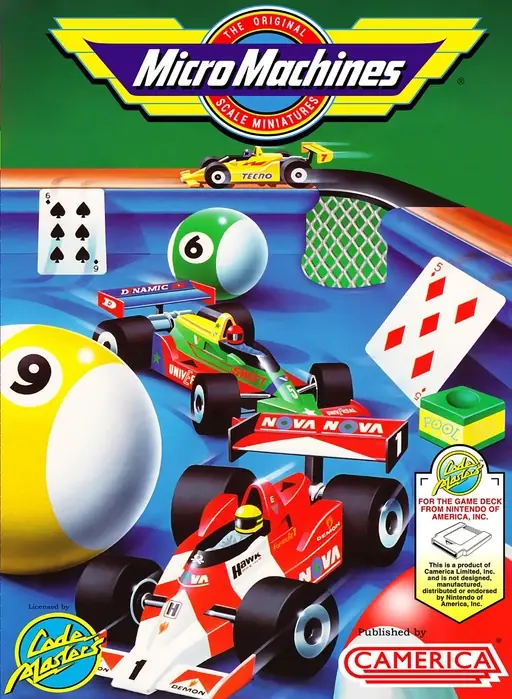
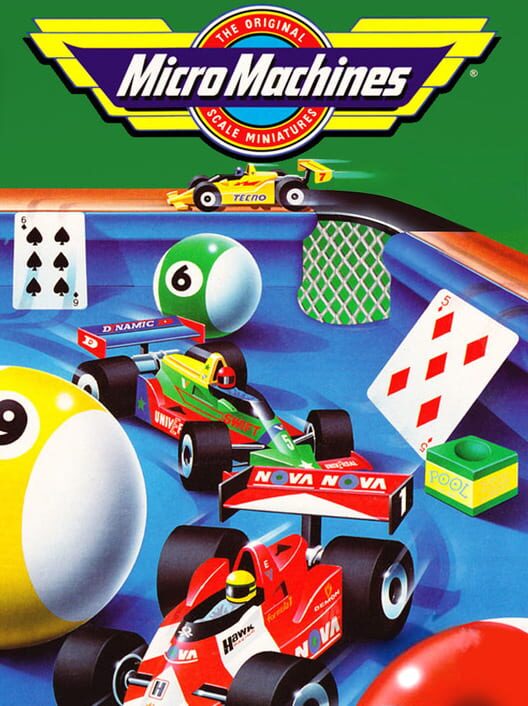
Micro Machines is a top-down racing game: players observe races from above. Players race in environments such as breakfast and pool tables, work desks, and treehouses, driving toy vehicles such as powerboats, helicopters, formula one cars, and tanks that can shoot other racers. Courses have a predefined path that racers must follow: if a player leaves the defined route for too long they are sent back to the track. Many have obstacles such as cereal boxes on breakfast tables, and pencil sharpeners on desks.
There are two game modes: the Micro Machines Challenge, and head-to-head. In both modes, players select a character. In Micro Machines Challenge, players race against three computer-controlled opponents, and must finish in first or second to qualify for the next round. Players are given three chances: if all three are lost the game is over.
Every three races, players compete in a time trial race to earn an extra chance. In head-to-head, players race against another vehicle. Players are colour-coded, and the goal is to get lights on the screen to show the player's colour by getting a screen ahead of the other player, so the trailing player is no longer visible. When this happens, one light turns to the colour of the leading player.
The game ends when all eight lights are one colour, or after three laps, in which case victory goes to the player with the most lights. If the game is tied, there is a "sudden death play-off", where the next player to win a light wins. The game starts with four lights of each colour. Head-to-head can be played in either single-player mode or with two players.
With two players, certain characters have a handicap to give the other player a better chance. The Game Gear version supports two players via link-up, or by players holding one end of the console each with one player using the buttons and the other the D-pad.
Development
In 1990, the founders of Codemasters, David and Richard Darling, were at the Consumer Electronics Show in Las Vegas, and were impressed with the popularity of the Nintendo Entertainment System in the US. They wanted to develop games for the system, but did not have a licence from Nintendo. In October 1989, programmer Andrew Graham developed a prototype, California Buggy Boys, a racing game with a top-down view on a scrolling dune-based race track. Its two player mode, based on the 1983 Adventure International game Rally Speedway, does not employ split screen, a technique that is hard to achieve on NES hardware.
Instead, two players race on a single screen, hugging the screen edges as the distance between them grows. Once the distance is large enough, the winning player gains a point – a difference from Rally Speedway, in which the losing player gains a time penalty instead.
The prototype was showcased with multiple consoles networked. It featured buggies similar to those in Power Drift, targeting the United States market. Codemasters then obtained a licensing deal with Galoob, wanting a game based on its Micro Machines toys. California Buggy Boys was used as a base, and Galoob sent a good selection of toys to Codemasters.
The development team did not have access to official Nintendo documents, and their knowledge of the NES's hardware came from reverse engineering. They chose recognisable household environments such as tables, although the NES's limited graphics capabilities necessitates repetition. Artist Paul Perrot converted the California Buggy Boys graphics using Deluxe Paint and a cross compiler. According to Graham, the team tried to keep the tracks short, as they were considered more enjoyable.
Graham stated that the artificial intelligence (AI) is basic by modern standards, and that it was difficult to replicate the multiplayer experience in single-player mode. The AI consisted of invisible arrows, which directed computer-controlled vehicles. Graham stated that split screen was not viable on the NES, and that the single-screen system was something that he was eager to try. He further stated that he was "very happy" with the multiplayer mode, saying it is the best part of the game and made the single player mode "boring" in comparison.
He was very pleased when Richard Darling stated that Micro Machines is the best game they had ever made. Another multiplayer mode was shown at the Consumer Electronics Show, but was discontinued due to requiring a network.
Micro Machines was completed in September 1990. It was not submitted to quality assurance, so a major bug that caused the game to crash was discovered near completion. The bug occurred when the player tried to reverse on the first race, but none of the testers thought to do so as they thought it was so easy. It was determined that just one binary bit was wrong, but many buggy ROM chips had already been manufactured, so a device akin to a miniature Game Genie was installed in the cartridges to correct it.
Reception
Micro Machines received critical acclaim. The multiplayer mode in particular was well received, and some reviewers complimented the graphics and addictiveness. Reviewing the Mega Drive version, Computer and Video Games's Steve Keen lauded the vehicle movement and sound effects, and Paul Rand praised the multiplayer mode. Both described Micro Machines as one of the better racing games on the Mega Drive.
In 1994, Micro Machines was listed as their best Mega Drive driving game. The reviewer from Mega magazine eulogised the playability, but criticised the lack of a save function. Nevertheless, he thought the game was "destined to become a classic". In a later review, the game was described as "utterly wonderful", and the addictiveness of the head-to-head mode was praised.
The game was listed at number eight of their top 100 list. GamesMaster's Jim Douglas lauded the graphics, "brilliant" controls, and the two-player mode, and James Leach described the Mega Drive version as "even better" than the NES version, and eulogised the addictiveness. A reviewer from Mean Machines Sega agreed with GamesMaster by complimenting the addictiveness of two-player mode, but believed the single-player mode is too easy. Sega Force's reviewer praised the visuals and "colourful" graphics and the two-player mode, but described the sounds as "average".
The game was described as having an "undeniable charm" by a reviewer from French magazine Supersonic.
The Game Gear and Master System versions were noted for the ability to link two units together, and the graphics, respectively. Reviewing the Game Gear version, Mean Machines Sega's reviewer believed the method of two players on one console was "revolutionary", but criticised the sprite flicker. Nevertheless, the game was described as "probably the most playable game around". A reviewer from GamePro described the graphics as colourful, but criticised the difficulty of distinguishing vehicles despite the colour-coding.
The sounds were described as "standard for the Game Gear", but the two-player via console sharing was lauded, but also described as "clumsy". Computer and Video Games's Deniz Ahmet had a similar opinion to GamePro's reviewer by describing the graphics as "well designed", and also had an opinion similar to that of Mean Machines Sega, with regards to the two-players sharing function. The conversion was described as "extremely accurate". Sega Master Force's reviewer liked the originality and addictiveness, and described the Game Gear version as "fantastic".
The Master System version was complimented by Mean Machines Sega for its two-player mode, describing it as "timeless", "great fun", and an "absolutely essential purchase"—but with "flat" graphics. French magazine Player One eulogised the Master System version's two-player mode and echoed Mean Machines Sega's opinion by describing the game as "A must", and in their Game Gear review, a similar compliment was made, calling it original and "well done". The Game Gear and Master System versions were reviewed together by a reviewer from German magazine Mega Fun, who complimented their humour. The animation of the Game Gear version was described by Joypad as "breathtaking", and that of the Master System version was described as "excellent".
Their sprites were criticised, saying the Master System version deletes sprites when there is an excess of vehicles on screen, and the Game Gear version's sprites suffer slowdowns and blinks.
Critics had mixed opinions on the Amiga version's graphics and sound. Amiga Joker and French magazine Amiga Dream's reviewers liked them, but CU Amiga's criticised the graphics as "poorly detailed" and the sound as "simple". The One's reviewer's lauded the two-player mode, described as "the best two-player racing game we've ever seen". Stuart Campbell of Amiga Power's praised the locations and control, although he criticised the "limited" single-player mode and lack of parallax scrolling.
Paul Roundell of Amiga Action praised the originality, but criticised the head-to-head mode, saying it "breaks the excitement". A reviewer from Amiga Computing believed the tracks were "entertaining" and liked that they were made up of "silly things". The vehicles racing in the environments was described by Steve Bradley of Amiga Format as "absolutely bloody brilliant", and he also praised the addictiveness.
Other versions were also well received. Reviewing the NES version, Mega Fun praised the scrolling and controls. Skyler Miller of AllGame believed Micro Machines's graphics push the console's capabilities, and also liked the colourful scenery. GamePro's reviewer stated that the racing scenario variety and the vehicles being based on Galoob's Micro Machines toys made the game original.
Mean Machines's reviewer liked the presentation and playability, but described the sprites as "inconsistent". In a review of the SNES version, GamePro lauded the "cartoony" graphics and "cheerful" sound effects, along with the lack of car customisation to keep the gameplay "basic". Coming Soon Magazine's reviewer criticised the PC version's "simple" graphics, but thought highly of its addictiveness and "well-produced" animation.
In 1995, Total! rated Micro Machines 5th In their Top 100 SNES Games. I. that it works perfectly.
In 1996, Next Generation ranked Micro Machines as number 18 on their "Top 100 Games of All Time", citing the "heart-pounding, adrenaline-pumping action", split-second accurate controls, and perfect balance. Micro Machines was listed by The Guardian in June 2014 as one of the 30 best British video games. The NES version is 31 in IGN's Top 100 NES Games, the highest ranked unlicensed game.