
The articlegameplay, story, development, reception
Gameplay
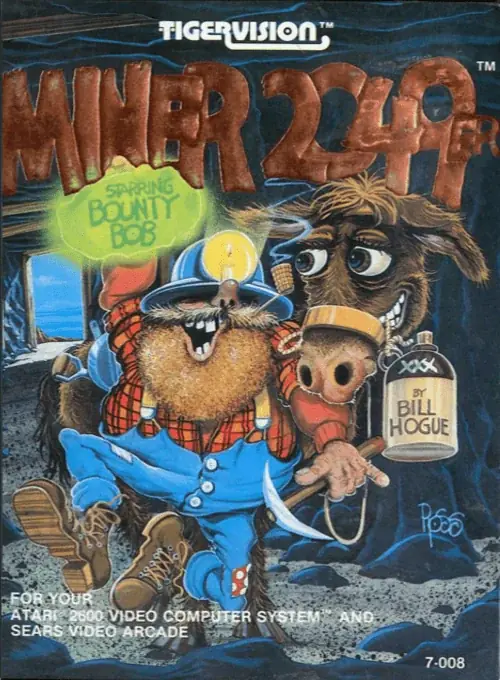
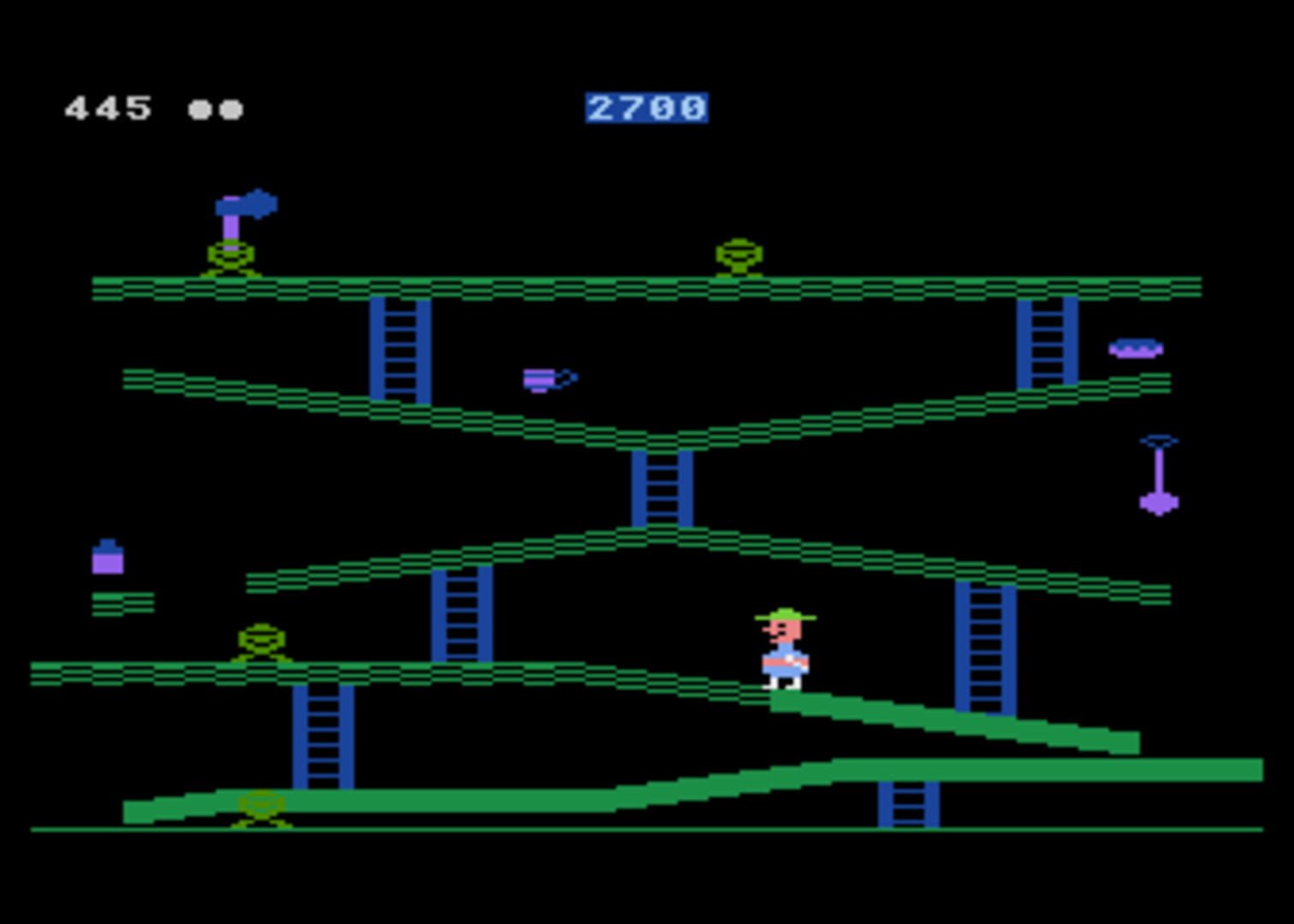
Miner 2049er features a Mountie named Bounty Bob who has been chasing a wanted criminal into a series of uranium mines. The object of the game is to complete all levels of the mine. To complete a stage, Bob must survey the mine by moving left and right across every part of the floor of each level. Each screen must be fully traversed within a set time indicated at the top of the screen to progress to the next level.
Levels feature different hazards such as gaps in platforms and radioactive waste to be avoided and slow moving platforms such as lifts. Other modes of transportation rapidly move Bob across the stage. These include transporters that warp Bob to different numbered doors, a cannon that must be powered by collecting TNT, interconnected slides which force Bob down a path. The original Atari computer and Atari 5200 versions of the game have ten different levels.
Development
Miner 2049er was programmed by Bill Hogue of Big Five Software of Van Nuys, California. The company officially formed in 1980 and made computer games that were sold through mail order for the TRS-80 line of computers. Big Five Software's games were primarily clones of popular arcade games prior to Miner 2049er.
After finding that the TRS-80 game market was in decline, and because its monochrome graphics were “limited”, the team refocused their attention to making games for the Atari 400 and 800 computer line. The game was Hogue's first published game for Atari computers. His team chose to develop for the line, as they felt it was the best combination of graphics and sound and that their cartridge games could not as easily be pirated. The graphics and audio in the game are credited to Curtis A.
Reception
Reviewers from computer publications including ANALOG Computing, Creative Computing InfoWorld, SoftSide and Softalk highlighted the games graphics. Tom Hudson of Analog Computing praised them as not simply being "just one-color graphics, but detailed multicolor objects" and that the gameplay was not abandoned in favor of them. Owen Linzmayer of Creative Computing found the game did not use the Atari computers full graphic potential, but the game included "one of the most dazzling visual effects" on the computer system, with the animation of Bounty Bob dematerializing on the elevators. Writing for SoftSide, David Plotkin also complimented the attention to detail, noting the animated moving feet on Bob and how his facial expression changes as he jumps. Boaz also discussed the color in the randomly generated palettes that were applied to levels, which he felt broke up monotony in the game.
For the gameplay, Deborah Burns of Antic and Boaz commented on the difficulty of the game, with Burns stating it was more difficult than it appears and Boaz saying the game to be a "gourmet's delight that offers many, many levels of challenge." Linzmayer echoed this, comparing the game to Donkey Kong, which had four stages, while Big Five Software's game had a "stupefying ten separate boards, each with a different scenario." In his review of the ColecoVision version of the game, George Kopp of Electronic Fun with Computers & Games "The struggle to get to the eleventh level is definitely worth it. The floating platforms here give the game all the grace and tension of a trapeze act in the Big Top." Hudson summarized that the game was "one of those rare games which looks as if it were designed, not just thrown together."
Legacy
Multiple games were directly influenced by Miner 2049er. Stanton said Miner 2049er contributed to the popularity of platform games on computers like the ZX Spectrum. This included Matthew Smith's Manic Miner (1983), one of the first major British hit computer games. Smith said that Hogue's game was a major influence on his game.
Manic Miner borrows thematic and gameplay elements from Miner 2049er, such as the underground setting and oxygen levels measured with a timer.