The articlegameplay, story, development, reception
Gameplay
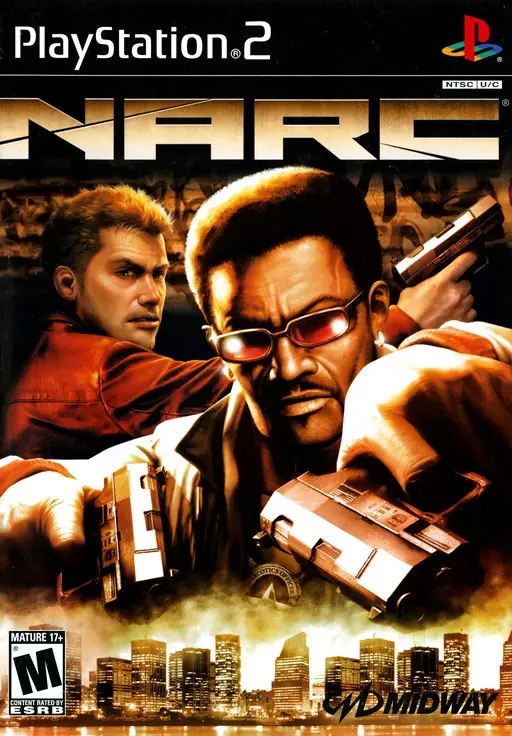
The game's main characters are Max Force and Hit Man, who have received a memo from Spencer Williams, Narcotics Opposition chairman in Washington, D.C., dispatching them on Project NARC. Their mission is to apprehend Mr. Big, head of an underground drug trafficking and terrorist organization known simply as K.R.A.K..
The player controls either Max Force or Hit Man, who shoot or arrest junkies, drug dealers, and organized crime kingpins. Max and Hit are each equipped with an automatic weapon and a missile launcher. When an enemy is dispatched using the latter, they explode in a torrent of scorched and bloody appendages. Some enemies can be arrested after they surrender and then float away with "busted" over them. This is then added to a tally at the end of the level along with drugs and money confiscated from other enemies that they dropped when gunned down (the game awards more points at the end of a round for arresting enemies without killing them).
Development
The arcade game uses what is termed a "medium resolution monitor": higher resolution than televisions and normal arcade monitors, but in a smaller physical size. This uses a 512x400 resolution.
Narc is the first arcade game to use the Texas Instruments TMS34010, a 32-bit processor with graphics-oriented instructions built-in. The chip was too slow to run the game envisaged by Eugene Jarvis, and a custom blitter chip was developed by Williams hardware engineer Mark Loffredo. The system created with these chips could use 256 palettes of 256 colours for photorealistic 2D rendering. Some of the digitized graphics were created using an AT&T image capture board, using custom software developed at Williams.
Reception
Over 3,700 units of the arcade machine were sold.
After appearing at an event shown on the Canadian Broadcasting Corp. national news the Toronto Star and Toronto Sun covered the games anti-drug message.
Legacy
In 1990, Acclaim released Narc as a handheld LCD game.
The game's main theme by Brian L. Schmidt was recorded by American alternative rock band Pixies and released as a B-side on their "Planet of Sound" single in 1990.


