
The articlegameplay, story, development, reception
Gameplay
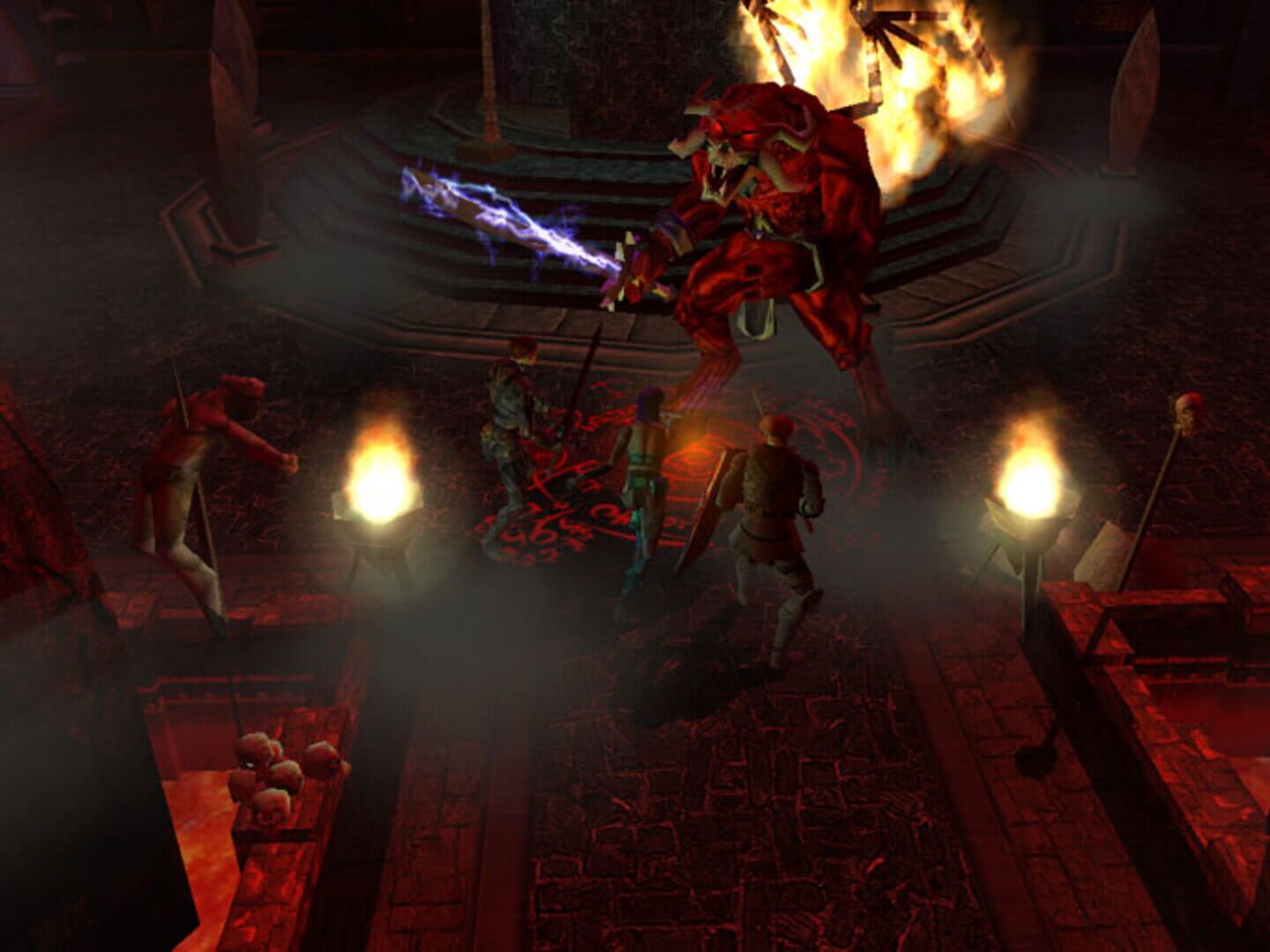
The original scenario supplied with Neverwinter Nights is the campaign. It comprises approximately sixty hours of gameplay. The gameplay centers on the development of a player character (PC) through adventuring, who ultimately becomes the hero of the story. The PC is tasked with defeating a powerful cult, collecting four reagents required to stop a plague, and thwarting an attack on the city of Neverwinter, located along the Sword Coast of Faerûn, in the Forgotten Realms campaign setting of Dungeons & Dragons.
The first and final chapters of the campaign deal with the city of Neverwinter itself, but the lengthy mid-story requires the player to venture into the surrounding countryside and travel northward to the city of Luskan. Along the way, many optional side quests are made available.
As in the Dungeons & Dragons tabletop game, the first thing a player must do is create a new character. The game provides a set of ready-made characters, or the player may create one from scratch. A series of panels are presented for selection of the character's gender, race, character class, alignment, ability scores (such as strength and intelligence), specialized abilities called skills and feats, in-game appearance, and name. This process grants significant allowance for customization; one can be, for example, an outdoorsman (ranger) or a healer (cleric), then choose skills and feats that would work well with that class in the game.
Following a small prelude, there are four chapters in the original game, with each chapter following part of the general storyline. Within each chapter, there are many quests, subquests, and mini-storylines provided to the player. Depending on the specific quests completed, and the unique items kept, some storylines are continued throughout the entire game, such as the Henchman's or Aribeth's tales. Completing many of the side quests will give the player's character more experience and special items, making them improve more rapidly and continue to make the game easier as the player progresses. These improvements come in the form of levels earned through experience points, with each level providing the protagonist with a set of enhancements as selected by the player.
The game's mechanics are based on the Dungeons & Dragons 3rd edition rule set; the outcome of most actions, such as combat and skills usage, are randomly determined by dice rolls. For example, when a fighter attacks, the computer would digitally "roll" a 20-sided die (called a d20 in-game) to determine if he hits the target. On a success, another die is rolled to determine the damage dealt, with powerful weapons assigned to dice with a greater number of sides, due to their ability to do more damage. Although the outcome of nearly all actions is determined by dice rolls, the player does not see them, with the results calculated in the background.
However, the player has the option to display the outcomes of these rolls. The player can control the game almost entirely via the mouse.
A robust multiplayer component separates Neverwinter Nights from previous Dungeons & Dragons games, as this allows players to play on many different servers hosting games. Depending on hardware and bandwidth, each server can support up to ninety-six players on the same server application, plus Dungeon Masters (DM) to run the games, if desired. Neverwinter Nights game modules are run in a variety of genres and themes, including persistent worlds (which are similar to MUD), combat arenas (player versus player modules), whole servers dedicated to sexually oriented roleplay,
and simple social gatherings similar to a chat room. BioWare requires that these persistent worlds be free of charge, primarily for reasons of copyright law.
Because Neverwinter Nights lacks a global chat function aside from the supported GameSpy, players typically join pickup games through the game's multiplayer interface, or schedule games in advance with friends. Matchmaking sites can facilitate scheduling of games, and the experience is much like traditional pen-and-paper role-playing games. Persistent worlds do this work for them by inviting players to visit their website and continue to roleplay there.
An important feature of Neverwinter Nights is the Dungeon Master Client: a tool that allows an individual to take the role of the Dungeon Master, who guides the players through the story and has complete control of the server. Previous games such as Vampire: The Masquerade – Redemption, based on the printed gamebooks by White Wolf Publishing, utilized this feature to a limited extent. When it was released, Neverwinter Nights was viewed as the first successful implementation of the feature. The DM Client allows players to participate in regular campaigns, while also allowing persistent world servers to flourish by permitting the DMs of those servers to take control of non-player characters (NPCs) in mid-game for added realism and flexibility. The Dungeon Master Client also permits the user to spawn and control masses of monsters and NPCs much in the same way as units would be controlled in a real-time strategy game.
Neverwinter Nights ships with the Aurora toolset, which allows players to create custom modules for the game. These modules may take the form of online multiplayer worlds, single player adventures, character trainers or technology demos. Additionally, several third party utilities have further expanded the community's ability to create custom content for the game. By the end of 2002, there were over 1,000 custom adventures available.
Custom content creators are known as builders in the Neverwinter Nights community. The Aurora toolset allows builders to create map areas using a tile system; the appearance and surface textures of the area are defined by the area's selected tileset. Builders can overlay placeable objects onto areas, and use the built-in scripting language NWScript, which is based on the C programming language, to run cut scenes, quests
Story
The story begins with the player character (PC), the protagonist of the story, being sent to recover four creatures (dryad, intellect devourer, yuan-ti, and cockatrice) known collectively as the "Waterdhavian creatures" under the guidance of Lady Aribeth de Tylmarande. The Waterdhavian creatures are needed to make a cure for the Wailing Death, a plague that is sweeping the city of Neverwinter and forcing a quarantine. With the help of Fenthick Moss, Aribeth's love interest, and Desther, Fenthick's friend, the PC is able to retrieve the creatures. As they collect the creatures, they are attacked by mysterious assassins from a cult that is behind the spreading of the plague.
As the cure is being made, Castle Neverwinter is attacked by the minions of Desther, who betrays the heroes. Desther takes the completed cure and escapes the castle, with the hero and Fenthick in pursuit. When they catch up to Desther, he surrenders after a short battle. Desther is sentenced to burn at the stake, and Fenthick, despite being unaware of Desther's true intentions, is sentenced to hang.
The protagonist meets up with Aribeth and Neverwinter's spymaster, Aarin Gend, to begin searching for the cult responsible for the plague and the attack on Neverwinter. The PC retrieves the diaries of dead cultists and letters from a person named Maugrim Korothir, which convince Aribeth that the cult's headquarters are in Luskan. Aribeth goes ahead to Luskan, and the hero follows after speaking once more to Gend.
After arriving in Luskan, the protagonist hears rumors that Aribeth has defected and joined the cultists. These fears are confirmed when she is found meeting with Maugrim and Morag, Queen of the reptilian Old Ones. They seek a group of magical relics called the Words of Power. The protagonist retrieves all of the Words of Power except for one held by the cult.
The hero discovers that the Words open a portal to a pocket world inside the Source Stone, where Morag and the other Old Ones sealed themselves long ago to avoid extinction during a primordial ice age. The protagonist confronts Aribeth, and depending on how the meeting is handled, she either surrenders to the PC or they are forced to kill her. The hero battles Maugrim for the final Word, then uses the Words to enter the Source Stone and battle with Morag. After Morag's death, the protagonist escapes the Stone as the world inside it implodes.
Development
The game was developed by 65 people. Development time was more than a year and the project had a multi-million dollar budget. The game was announced to use the Omen engine as a replacement for the Infinity engine which was not good enough for the new game.
BioWare intended to create a game system which emulated the interactions in a pen-and-paper version of Dungeons & Dragons including the role of Dungeon Master. They worked alongside the AD&D to ensure the game framework was faithful to the tabletop game.
A posting at the Neverwinter Nights 2 Vault on June 4, 2008 contained information from what appeared to be original Neverwinter Nights documentation. At the BioWare forums, Neverwinter lead designer Rob Bartel confirmed that the "series of excerpts from the game's design doc" were not a hoax. When asked if the plans were altered due to time constraints, Bartel referenced various legal difficulties that the company was working through.
The game was released for Windows in North America on June 18, 2002, in Europe on June 28, and in Australia on July 3. Sega released the game as its publisher on March 20, 2003. A Linux client for the game was made available on June 19, 2003. A Mac OS X port published by MacSoft was released in North America on July 30, 2003, and in Europe later the same year.
Reception
For the launch of Neverwinter Nights, publisher Infogrames shipped 1 million copies to stores, with half allocated to North America and the rest to international markets. In an experimental move, the company priced the game at $55, an increase over the $50 typical of computer games at the time. CNN Money columnist Chris Morris reported that "gamers complained loudly about" this decision. The game proceeded to sell 125,000 copies by June 27, after its release on the 18th.
It debuted at #1 on The NPD Group's computer game sales chart during the June 16–22 period, and held the position for two weeks, before being displaced by Warcraft III: Reign of Chaos. However, Neverwinter Nights continued to place in the chart's top 10 consistently for its first three months of release. By July 23, the game's global sales had surpassed 200,000 units. NPD reported North American sales of 330,000 copies by late December, which brought in revenues of $18 million.
It was ultimately the region's 11th-best-selling computer game of 2002.
Greg Zeschuk remarked in June 2003 that Neverwinter Nights had sold above 1 million copies, before the release of its first expansion pack. 2 million by August 2006. At that time, Edge declared it the country's 26th-best-selling computer game released since January 2000. It also received a "Silver" sales award from the Entertainment and Leisure Software Publishers Association, which indicates sales of at least 100,000 copies in the United Kingdom.
3 million sales in the United States alone. 2 million copies, as of 2007.
In general, Neverwinter Nights was met with positive reviews, receiving "universal acclaim" according to Metacritic. GameSpot referred to it as "one of those exceedingly rare games that has a lot to offer virtually everyone, even if they aren't already into RPGs", and praised it for its campaign, its Aurora toolset, and its graphics. The publication later named it the best computer game of June 2002. PC Gamer US called it "a total package—a PC gaming classic for the ages", and said that its "storyline [is] as persuasive as any I’ve encountered in a fantasy roleplaying game".
Chris Chan of New Straits Times said, "Neverwinter Nights is every role-playing gamer's dream". Allgame found that the game's story was "humdrum" and "mediocre". Mark Meadows of The Wisconsin State Journal agreed, saying the game was too focused on technical details. Victor Godinez of Knight Ridder/Tribune News Service did not care for the turn-based combat system, preferring to have direct control. He also said the controls were difficult to use occasionally.
GamePro noted the game's graphics as being "gorgeous" and its sound as "untouchable", and GameZone likewise praised its visuals, specifically mentioning its combat animation and spell effects as being well done. GameSpy was not as impressed by the graphics, saying "The biggest, and arguably the only, glaring flaw in the game, is its graphics. You can tell that this game has been in development for five years[...]"; however, they praised its voice acting and music. Godinez agreed, and also liked the game's audio, noting in particular the scraps of conversation that can be heard in the background throughout the city.
Allgame praised Neverwinter Night's DM tools, calling the game's level creation options "impressive" and the multiplayer options "great". GamePro thought that Neverwinter Nights is the closest that any video game has come to accurately representing the full Dungeons & Dragons rules, a statement further reinforced by Greg Kasavin of GameSpot, who said that "Neverwinter Nights isn't the first Dungeons & Dragons game for the computer to make use of the pen-and-paper game's 3rd Edition rules, but it's the first to implement them so well".
GameZone said that the Aurora Toolset was one of the "best features" of the game. John Breeden II of The Washington Post said including the tool set was "smartest thing Bioware did". He went on to say that giving such tools to the players became more commonplace, but was a bold move at the time of the game's release. Chan commented, "you could use the Aurora tools to create a dream world".
Peter Suciu of Newsweek magazine called Neverwinter Nights "possibly the richest fantasy PC experience ever created." According to GameSpy, "Neverwinter's contribution to D&D gaming is always a hot topic and a source of argument."
During the 6th Annual Interactive Achievement Awards, Neverwinter Nights was awarded with "Computer Role-Playing Game of the Year" by the Academy of Interactive Arts & Sciences (AIAS); it also received a nomination for "Computer Game of the Year". The game also won role-playing game of the year awards from PC Gamer US and GameSpot. RPG Vault declared it "Product of the Year", while Computer Games Magazine ranked it the year's second-best computer game across all genres. The latter publication's editors wrote that the "single-player game is merely passable", but they highly praised Neverwinter Nights' content-creation tools, and argued that the game is "what computer role-playing games should have been all along".
The game won special awards for its technology from Computer Games, the Game Developers Choice Awards (GDCA) and RPG Vault, the latter two for its network programming and Aurora Neverwinter Toolset, respectively. The Aurora Neverwinter Toolset was also a nominee in the AIAS's "Computer Simulation Game of the Year" category. RPG Vault's staff hailed the tool as "an unprecedented combination of power, flexibility and ease of use."
Neverwinter Nights received further nominations in the AIAS's special categories for "Outstanding Innovation in Computer Gaming" and "Outstanding Achie
Legacy
IGN ranked Neverwinter Nights No. 4 on their list of "The Top 11 Dungeons & Dragons Games of All Time" in 2014. Ian Williams of Paste rated the game #4 on his list of "The 10 Greatest Dungeons and Dragons Videogames" in 2015. The game has inspired a number of fan-made films made using machinima techniques of synchronizing video footage from a game to pre-recorded dialogue and other audio, such as BloodSpell, and Neverending Nights.
Since the original release of Neverwinter Nights, several in-game portraits have been modified in patches due to their having been copied from outside sources. In another instance, the Canadian Red Cross complained to BioWare about the appearance of the Red Cross symbol on the in-game item "Healer's Kit", as part of a long-running attempt to discourage outside usage of the symbol. This resulted in the Red Cross symbol being removed from the Healer's Kit through patches.
Star Wars: Knights of the Old Republic, a role-playing video game based in the Star Wars universe, was also released by BioWare using a modified version of the Aurora engine of Neverwinter Nights, called the Odyssey Engine. The sequel, Star Wars: Knights of the Old Republic II: The Sith Lords, also used it. Because of this, modders have been able to modify these games using some Neverwinter Nights modding tools. The Witcher, a role-playing video game by CD Projekt Red, is also based on the Aurora engine of Neverwinter Nights. BioWare used Neverwinter Nights and its toolset to develop prototypes and mock-ups of various areas and scenarios for Dragon Age: Origins.
Neverwinter Nights received an expansion pack, Neverwinter Nights: Shadows of Undrentide, in June 2003. Its story line concerns a student sent out to recover some stolen magical objects. The story begins in the Silver Marches, moving toward the desert of Anauroch and the old Netherese city of Undrentide. A second expansion Neverwinter Nights: Hordes of the Underdark was released in December 2003.
The story continued where Shadows of Undrentide ended, with a character of at least 15th level, and led into the vast subterranean world known as the Underdark. The first chapter of the story took place in the Undermountain dungeon beneath the city of Waterdeep. Neverwinter Nights: Kingmaker was released in November 2004, and features three premium modules: the award-winning Kingmaker, Shadowguard, and Witch's Wake.
Atari and BioWare helped to promote and release free downloadable hakpaks, models, and tileset expansion packs, which greatly expanded the possibilities of mod-making. The Players Resource Consortium (PRC) was released in early December 2003, and is a group of hakpaks adding classes, races, skills, and spells to the game. The PRC has roughly three times the number of prestige classes the original game had. It also adds dozens of epic spells, and many normal spells that make better use of BioWare's Aurora engine.
Psionic powers have also been included. The Community Expansion Pack (CEP), originally released in March 2004 (last updated in January 2017), is based on the Neverwinter Nights community's fan-made material. This freely downloadable expansion was compiled by members of the community. It combines a selection of previously released custom content into one group of hakpaks.
In late 2004, BioWare launched its online store and started selling what it called "premium modules" as part of its digital distribution program. This initiative was led by BioWare's Live Team Lead Designer, Rob Bartel. These smaller-scale adventures introduced new storylines and gameplay, and include new music and art that BioWare integrated into later patches to the core game. According to BioWare, the revenue generated by sales of the premium modules would be used to support their fan community and provide ongoing updates and improvements to the game.
The modules that are sold in the BioWare store require an active Internet connection to play, even when played in single player mode. The modules in the Kingmaker expansion were stripped of this requirement, but are only available for Windows systems. The modules included with Neverwinter Nights Diamond Edition do not require Internet access to play. In August 2009, BioWare discontinued its selling of premium modules due to a request made by Atari.
On June 16, 2011, the Neverwinter Nights digital rights management (DRM) authentication server was temporarily taken down as a reaction by Electronic Arts to the Neverwinter Nights store being hacked and customer data stolen. Premium modules which were purchased via BioWare's store could not be played during that time because they could not connect to the server to validate the purchase, though DRM-free modules were unaffected. The modules Kingmaker, Shadowguard, and Witch's Wake were sold as part of the Diamond Edition package.
Premium modules include Neverwinter Nights: Kingmaker, BioWare's flagship premium module, which later received the Academy of Interactive Arts & Sciences "Computer Role-Playing Game of the Year" award. In the module's story, the hero must defeat the evil at the Keep of Cyan and win the throne. Others include Neverwinter Nights: ShadowGuard, created by community member Ben McJunkin; Neverwinter Nights: Witch's Wake, a remastered version of a module by Rob Bartel; Neverwinter Nights: Pirates of the Sword Coast; Neverwinter Nights: Infinite Dungeons, a BioWare module taking place in the Undermountain area below Waterdeep; and Neverwinter Nights: Wyvern Crown of Cormyr, which features fully ridable horses, flowing cloaks, tabards and long coats, a new prestige class (the Purple Dragon Knight), and extensive new art, creatures, and tilesets.
Premium modules were eventually discontinued. Three premium modules were known to be in development before cancellation. Two of them ended up being free downloads, while the third, a planned sequel to Witch's Wake, was never released. Hex Coda by Stefan Gagne, the first cancelled premium module, was relea