The articlegameplay, story, development, reception
Gameplay
The game is presented from an isometric perspective, with character sprites and backgrounds rendered in a three-quarter perspective, and the player able to move in horizontal and vertical directions around the arena. The arcade game is controlled by a joystick and three action buttons, for punch, kick and jump. Compared to other side-scrolling games in its time, the combat system was more highly developed, with the player able to punch, kick, grab, charge, throw and stomp enemies. It also introduced the use of combo attacks; in contrast to earlier games, the opponents in Nekketsu Kōha Kunio-kun could take much more punishment, requiring a succession of punches, with the first hit temporarily immobilizing the enemy, making him unable to defend himself against successive punches.
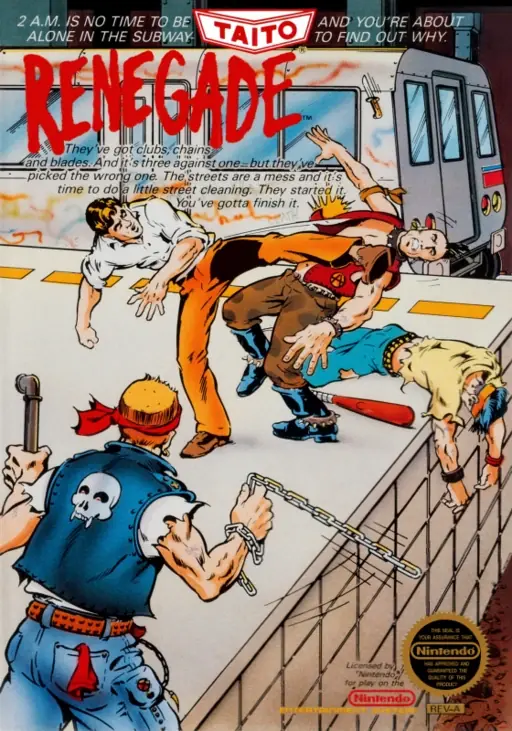
The player controls a fighter (in the NES version, he is named "Mr. K" in-game, and "Renegade" in the instruction manual) who must fight a variety of street gangs on the way to save his girlfriend from the gangsters. The controls consists of an eight-way joystick and three actions buttons; left attack, jump and right attack. Unlike previous beat-'em-ups such as Kung-Fu Master (1984), Shao-lin's Road (1985) or My Hero (1985), in which the player character's movement was limited to only left or right, in Renegade the player can also move towards or away from the background by pressing up or down in a matter similar to Technos Japan's 1985 wrestling game Mat Mania, although the battle system is still limited to only two directions.
Pressing the attack button of the character's current direction will cause him to throw punches, while the opposite attack button causes him to perform a rear kick instead. When certain enemies are stunned after a few punches or a single kick, the player character can approach him for a collar grab and kick him repeatedly with the front attack button or perform a shoulder throw with the opposite attack button. While jumping, the player can press either attack button for a jump kick towards that particular direction.
Pressing the joystick left or right twice quickly will cause the player to run, at which point pressing the front attack button will perform a running punch, jumping will automatically perform a flying kick, and the rear attack button will bring the player to a sudden halt and perform a back-kick. Pressing down over a fallen enemy will make the player sit on top of them, at which point pressing the front attack will cause the player to pummel them. All of the boss characters (with the exception of Sabu) can only be sat on or put on a collar grab if their health is low enough, otherwise they will push the player off.
The player has a limited amount of lives (which vary depending on the game's DIP settings) and no continues to complete the game. The player loses a life if they run out of health after sustaining too many enemy attacks, get knocked off the subway platform or into the sea in the first two stages or fail to complete the stage under the time limit. Health is automatically recovered at the start of each stage. Stages 2 and 4 are the only stages to have checkpoints in the middle of them.
Unlike Technos' subsequent game Double Dragon, the playing field is limited to a series of three-screen-wide areas and does not scroll continuously. The first three stages (a subway platform, a harbor and a street alley) each take place in a single area where the player must face against a gang of seven underlings with their boss watching from the background. The gang of the first two stages consists of two types of underlings: an armed thug who is easier to defeat, and an unarmed thug who can take more punishment and can grab the player character from behind.
When only three underlings remain (in any combination of the two) their boss will come in from the sidelines and join the fight. When the boss (Jack in the first stage, Joel in the second) is defeated, any remaining underling will retreat off the bottom of the screen, and the stage ends. Each boss character has their own health displayed underneath the player's. The second stage follows this same formula, but begins with a series of enemies riding motorcycles trying to run the player down.
Once a certain number of bikers have been defeated (which vary depending on the difficulty level), the normal enemies will begin to face the player. The third stage features an all female gang. Like the first two gangs, the female gang also consists of two type of underlings: a weaker chain-wielding blond-haired type and a more resistant mace-wielding redhead type. The female gang leader (Kim) is a large woman who can easily grab and slap the player around.
She is the only enemy in the game who cannot be put into a collar grab. The fourth and final stage consists of two areas and only has one type of underling, a bald knife-wielding hitman who can kill the player with a single stab. The first area is set in a parking lot where the player must fight against four of these hitmen. Once this first wave of enemies have been defeated, the player character automatically proceeds to enter a building at the far right of the stage.
Inside, he faces three more knife-wielding underlings and the final boss, a handgun-wielding mobster (Sabu) who can kill the player with a single shot. Once the final boss is defeated, the main character exits the building and is greeted by his rescued girlfriend, who proceeds to give him a kiss. The game then begins the next loop with an increased difficulty.
Development
The game was conceptualized by Yoshihisa Kishimoto at Technōs Japan. He previously worked at Data East, where he created the successful laserdisc games Cobra Command (1984) and Road Blaster (1985). Technōs Japan, which was founded by Data East alumni, attempted to recruit him and called him for a meeting. Kishimoto instead pitched a different idea he had in mind, one that did not require laserdisc technology.
He instead pitched a semi-autobiographical game based on his teenage high school years, with the protagonist Kunio loosely based on himself. Kishimoto recalled his experiences as a high school student regularly getting into fights on a daily basis, which was partly triggered by a break-up with a girl who dumped him. Kishimito was also a fan of Bruce Lee's Hong Kong martial arts films, particularly Enter the Dragon (1973). He combined elements from Lee's Enter the Dragon with that of his own life to create the concept for Nekketsu Kōha Kunio-kun.
In contrast to earlier side-scrolling martial arts action games, most notably Irem's Kung-Fu Master (1984), Kunio-kun greatly increased the amount of health available to the player and the enemies. This allowed Kishimoto to create gameplay centered around the "knock-down-drag-out" fights, as seen in Bruce Lee films such as Enter the Dragon as well as the altercations Kishimoto had himself experienced in his youth. Rather than one-hit kills, his idea was that the player needed to hit enemies multiple times, "beating them up" in order to defeat them. Compared to earlier side-scrollers, the environment was expanded to a scrolling arena-like space, while the combat system was more highly developed.
The use of an isometric perspective, combined with separate buttons for punching and kicking, also meant that the player character could no longer press up to jump like in Kung-Fu Master. To compensate, an additional jump button was added instead, resulting in the standard three-button beat 'em up control scheme.
Reception
In Japan, it was the top-grossing title on the Game Machine table arcade cabinet charts in July 1986, and became the fifth highest-grossing table arcade game during the latter half of 1986. The arcade game sold about 5,500 units in Japan.
The Famicom port sold around 400,000 units. In the United Kingdom, the home computer port went straight to the top of the Gallup weekly all-formats chart in September 1987. It also topped the ZX Spectrum charts from September to October 1987, and then it was number three the following month.
The game was voted by Your Sinclair readers as the second best game of 1987. In 1993, the Spectrum version was voted number 48 on the Your Sinclair "Readers' Top 100 Games of All Time" list.
David M. Wilson reviewed the game for Computer Gaming World, saying that the arcade feel was carried over into the personal computer versions of Renegade, in which the players feel like martial arts fighters.
Legacy
The NES port of Renegade was released for the Wii's Virtual Console in North America on May 5, 2008 at a cost of 500 Wii Points. It was re-released on February 27, 2014 both on the 3DS Virtual Console and Wii U Virtual Console.
The arcade version of the game was released by Hamster Corporation for the PlayStation 4 in 2015 and Nintendo Switch in 2018 as part of their Arcade Archives series. This port includes both the US and Japanese versions of the original arcade edition, making it the first time the original Nekketsu Kōha Kunio-kun was released in the west commercially.
Nekketsu Kōha Kunio-kun is considered the "first fully-developed beat ’em up" game, according to Andrew Williams. While elements of the genre were previously present in earlier side-scrolling martial arts action games, most notably Kung-Fu Master, Renegade introduced a number of key elements that more clearly defined the beat 'em up genre and established the standard format adopted by later games in the genre.
The game set the standard for future beat 'em up games as it introduced the ability to move both horizontally and vertically, in a scrolling arena-like space, commonly called the belt scroll action game format. Its combat system was also more highly developed than earlier side-scrolling action games, such as its introduction of combo attacks. Nekketsu Kōha Kunio-kun also introduced street brawling to the beat 'em up genre, with the international version Renegade taking it further by adding an underworld revenge plot, proving more popular with gamers than the principled combat sports of earlier martial arts games.
Nekketsu Kōha Kunio-kun spawned the separate Kunio-kun franchise. It was also the basis for Yoshihisa Kishimoto's next game Double Dragon (1987), a spiritual successor that further advanced and popularized the beat 'em up genre format established by Nekketsu Kōha Kunio-kun, with Double Dragon itself originally intended to be a sequel before becoming a separate game.
Ocean Software produced two sequels to Renegade: Target: Renegade, and Renegade III: The Final Chapter. These were released for the ZX Spectrum, Commodore 64, Amstrad CPC and MSX, but never had corresponding arcade versions. Target: Renegade was also released on the NES. Technōs Japan had no involvement in the sequels.
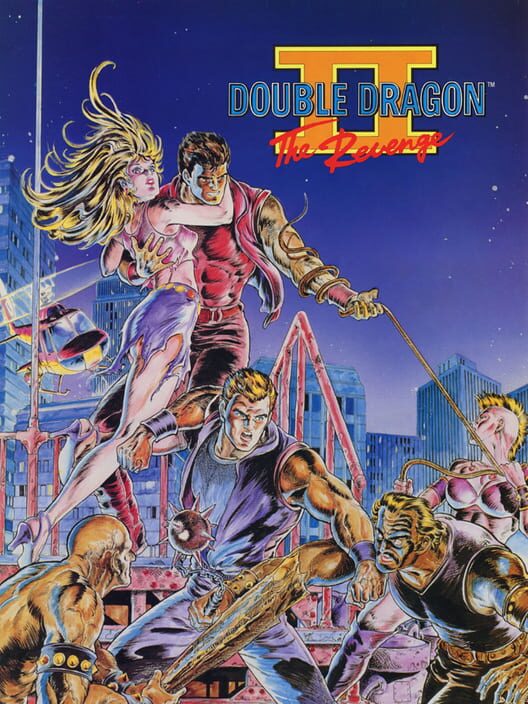
Technōs Japan was slated to release the Game Boy title Nekketsu Kōha Kunio-kun: Bangai Rantō Hen as a follow-up called The Renegades, but was eventually retooled as Double Dragon II.
Future Kunio-kun games were localized in North America without the branding as Super Dodge Ball, River City Ransom and Nintendo World Cup, the latter being a collaboration with Nintendo.
Manga artist Mizuki Kawashita has named one of the characters in her best known manga, Ichigo 100%, Misuzu Sotomura after the game character of the same first name.