
The articlegameplay, story, development, reception
Gameplay
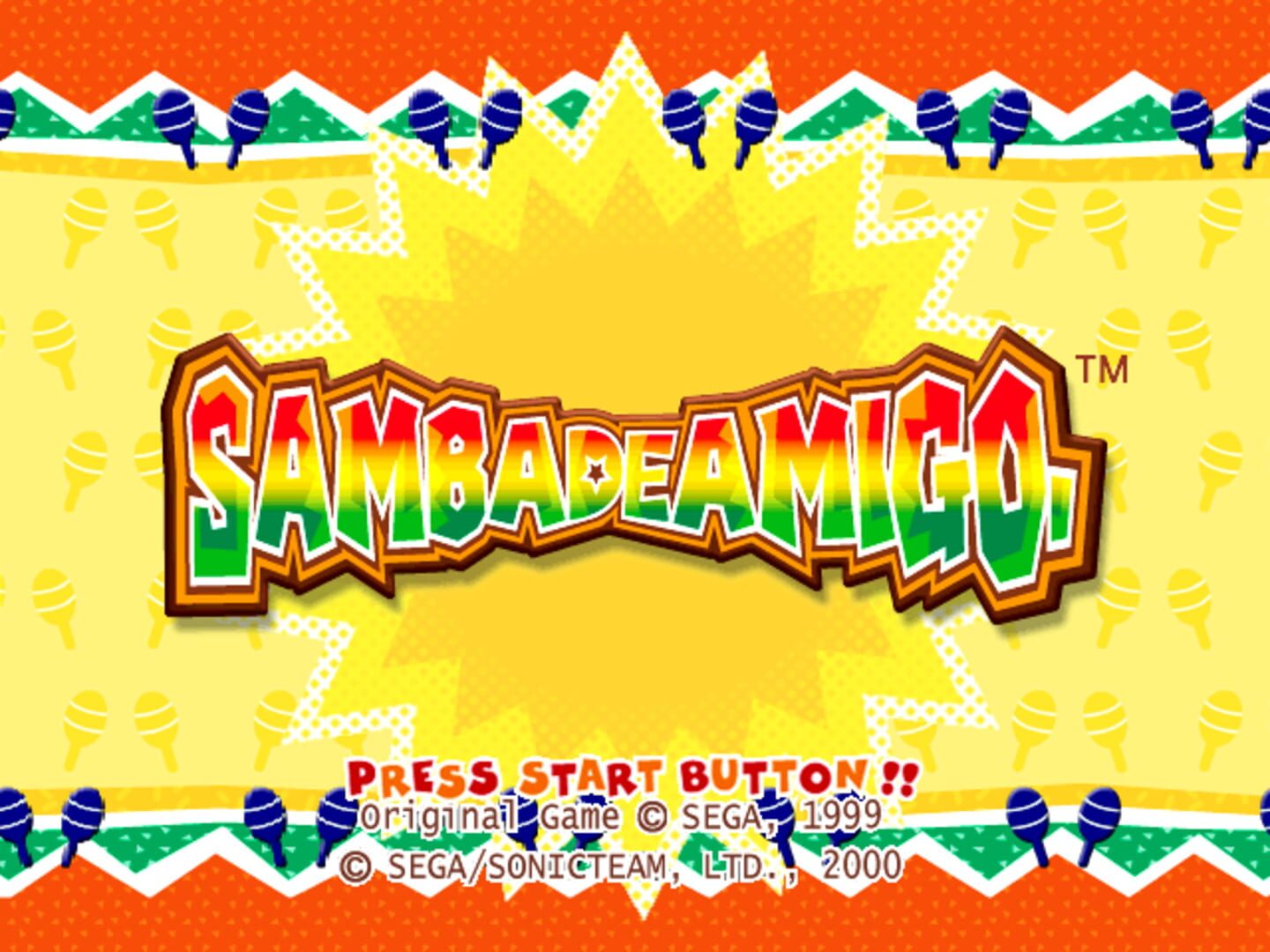
Samba de Amigo is a rhythm game that is played with a pair of maraca controllers. As a song plays, the player, guided by on-screen graphics, must shake the maracas at high, middle, or low heights with the beat of the music, or occasionally must strike poses with the maracas held in various positions. The player is represented on-screen by Amigo, a monkey. If the player does well, the scene around Amigo (usually a concert or a dance) will attract more people and become more vividly animated; if the player does poorly, characters leave and eventually all that's left is Amigo alone, looking sad.
In the primary game mode, each player has six spots arranged in a circle on the screen: two red meaning "shake high," two yellow meaning "shake middle," and two green meaning "shake low." Blue dots will appear in the center of this circle and move towards the spots; as soon as the blue dot touches a spot, the player must shake a maraca at that location. For example, if a blue dot touches the upper left spot, the player must shake either maraca above their left shoulder. If both maracas are shaken in that location, the player gets an "Amigo" bonus.
Development
Samba de Amigo was first developed as an experimental arcade game during the time of attractive music arcade games and swiftly by a team with little experience in game development. Shun Nakamura, the game's director, was more focused on creating a music game where players could have fun and enjoy the performance of music, instead of just playing music. The choice of maracas was inspired by how Japanese people would use maracas to add interest to karaoke performances. As the game was originally developed for the local Japanese market, Western songs that were familiar to Japanese audiences were chosen, as well as songs with rhythms that were easy for one to immerse into.
The main character, Amigo, was determined based on how his cheerful personality matched the typical portrayal of monkeys, and finalized by Yuji Uekawa, the character designer for the Sonic the Hedgehog series. The game received positive reception every time it was presented by the team, which would lead it to being ported to the Dreamcast.
Reception
In Japan, Game Machine listed Samba de Amigo on their February 1, 2000, issue as being the most-successful dedicated arcade game of the month. It went on to be the highest-grossing dedicated arcade game of 2000 in Japan.
Blake Fischer reviewed the Dreamcast version of the game for Next Generation, rating it five stars out of five, and stated: "It's different, it's wacky, and it's insanely fun. Just shake your Maraca's and watch the monkey dance - that's all you need."
Legacy
That same year, Sega released a spiritual successor named Shakatto Tambourine. It was very much the same game as Samba de Amigo, except played with a tambourine controller, and featuring popular J-pop music. Samba de Amigo also made a comeback of sorts in the EyeToy game Sega Superstars, where player movements recorded by the EyeToy camera were recorded in place of the original maracas. A pair of Samba de Amigo themed levels appeared in the 2012 Nintendo 3DS game, Rhythm Thief & the Emperor's Treasure, which are played using buttons and the system's gyroscope.
Samba de Amigo references have continued to appear in many of Sega's other titles. The song "Vamos a Carnival" is featured in the MMO Phantasy Star Online 2 as the game's lobby music every April as part of a yearly Easter event, which would later be re-instated as the BGM of the Easter lobby which appears every second half of April, as well as the Screenshot Studio. A Samba de Amigo-themed level appears in Sonic Pinball Party. Additionally, Amigo appears as a playable character in the crossover racing games Sonic & Sega All-Stars Racing, Sonic & Sega All-Stars Racing Transformed, and Sonic Racing: CrossWorlds.


