The articlegameplay, story, development, reception
Gameplay
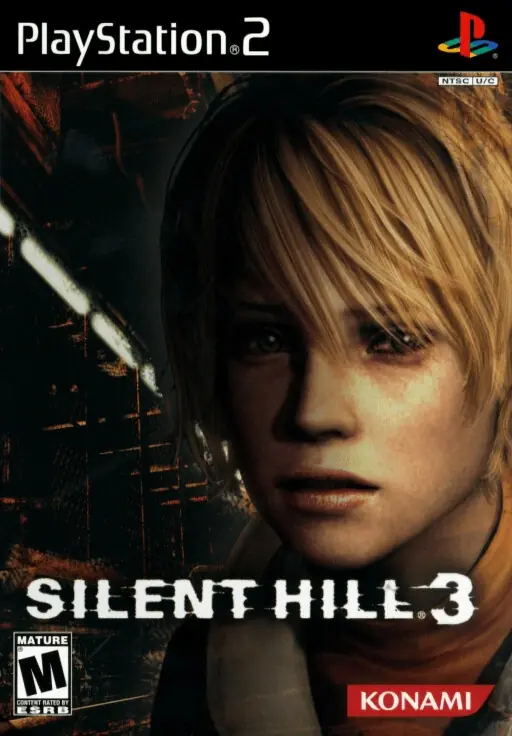
Silent Hill 3 is a survival horror video game in which the player takes control of Heather, a 17-year-old girl who awakens from a nightmare in a shopping mall restaurant and navigates environments that switch between reality and the Otherworld, a bloodier, supernatural alternate world. Gameplay in Silent Hill 3 resembles closely that of its two predecessors, set in the third-person view and divided among elements of combat, exploration, and puzzle-solving. The difficulty of both the combat and puzzle elements of the game can be selected separately. For puzzle difficulty settings, there is a considerable difference between the "medium" difficulty level and the "hard" difficulty level; one of the puzzles on the "medium" level requires only simple pattern recognition, while the "hard" difficulty level version of the same puzzle requires knowledge of Shakespeare's plays to solve.
To aid in exploration, Heather obtains a flashlight and radio early on, the latter of which crackles when monsters are in proximity. She can find "health" restoratives, such as first aid kits and energy drinks; beef jerky, used to lure monsters away from her path; and a range of firearms and melee weapons to fend off monsters. She can also block and perform side-step maneuvers to avoid enemies. Heather will also update any relevant maps of the area with notes for locked doors, inaccessible areas, and potential clues to puzzles.
Story
17 years after the events of the first game, Heather (Heather Morris) experiences a nightmare of being trapped in a derelict amusement park and killed by the roller coaster. She awakens in a burger restaurant within a shopping mall, but before she can leave the mall and return home to her father Harry Mason, private detective Douglas Cartland (Richard Grosse) confronts her, claiming to have information about her birth. Heather evades him and discovers that the mall is mostly abandoned except for monsters. She encounters Claudia (Donna Burke), a mysterious woman who hints that Heather will be instrumental in bringing about paradise on earth.
Heather soon finds herself in the Otherworld version of the mall—a monster-filled, bloodstained, and decaying alternate world—and eventually returns to the original shopping mall, where she finds Douglas again. He confesses that Claudia had hired him to find her, though he denies prior knowledge of the Otherworld or of any greater agenda of Claudia's. Heather leaves the mall and resolves to go home via the subway. When she returns home to her apartment, she discovers that her father was murdered on Claudia's orders.
Development
Silent Hill 3 was created by Team Silent, a production group within Konami Computer Entertainment Tokyo. Development on the PlayStation 2 version began after the release of Silent Hill 2 in September 2001, and was carried out simultaneously with the development of Silent Hill 4: The Room. The development team for this iteration was smaller than that working on Silent Hill 2, with around 40 people working on the game, made up of the core team from the second title and some newcomers. A smaller group of staff led by Akihiro Imamura of Team Silent, later developed a port for Windows.
Silent Hill 3 was originally planned to be a rail shooter spin-off, not a direct sequel to the first Silent Hill game, as a result of the initially slow sales of Silent Hill 2. This decision wasted considerable development time and part of the game's budget. Eventually, the plan was discarded, with most of the early work being almost completely scrapped; although the concept of a Silent Hill rail shooter was later explored with Silent Hill: The Arcade in 2007. According to Masahiro Ito, Silent Hill 3's final version was developed from scratch in 10 months.
Reception
Silent Hill 3 received positive reviews, garnering an 85/100 rating at Metacritic for the PlayStation 2 version, and a 72/100 rating for the PC version. The PC version fared less well, with some reviewers drawing unfavourable comparisons to other combat-based games found on the PC platform, while others highlighted some technical issues, such as poor gamepad controller support.
Positive reactions were given to the general horror and atmosphere of the game, including "truly horrifying sections", it "packs some genuine scares" and "the feeling of eeriness and doom is almost overwhelming". The story told as part of the atmosphere was also received positively, making for a "satisfying, coherent sequel", although its status as such meant that "it may be a little tough to follow for people who haven't played the first game", despite "a laudable effort to help people catch up". In addition, the graphics, audio and production values were all credited with adding positively to the atmosphere.