
The articlegameplay, story, development, reception
Gameplay
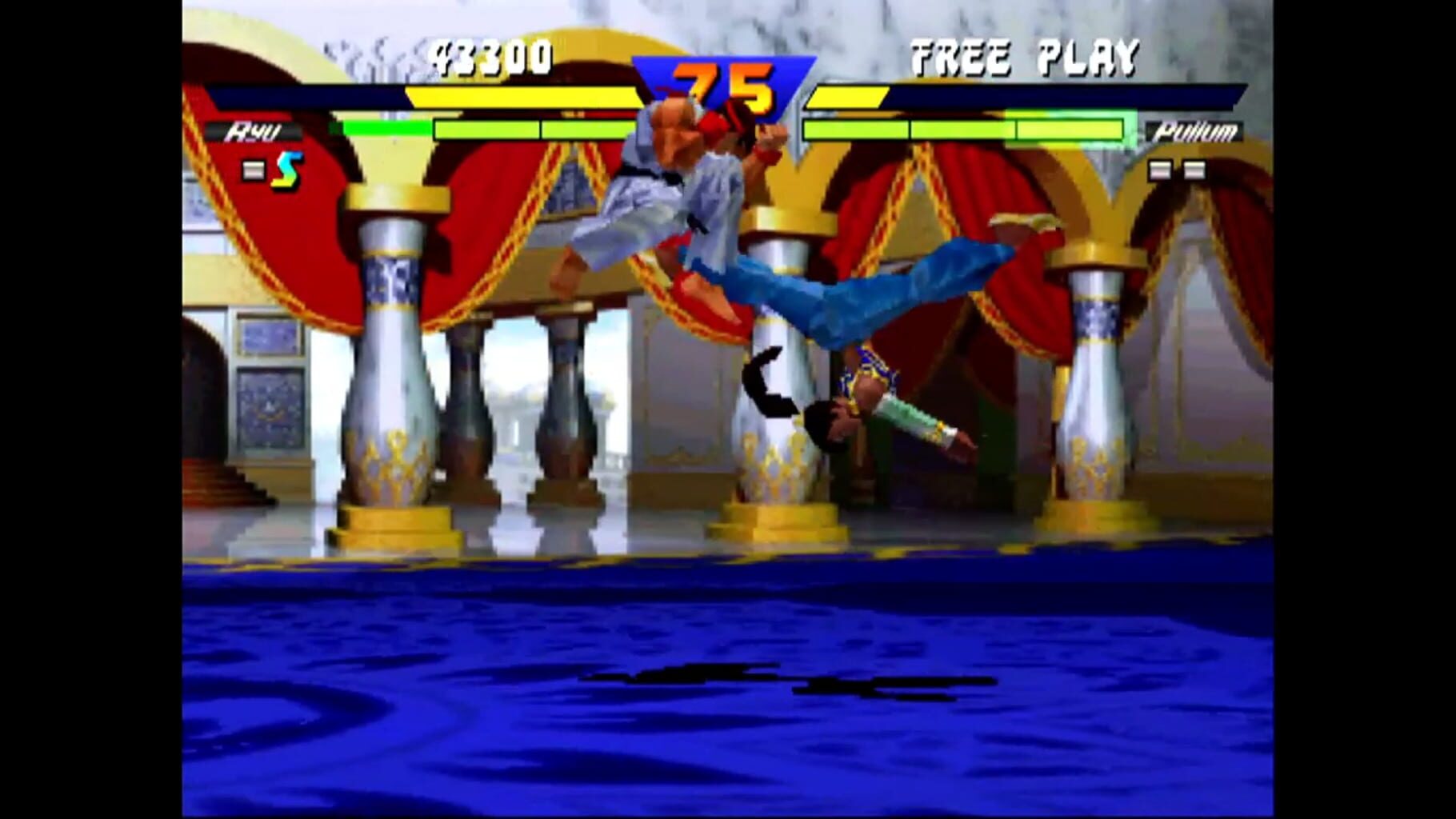
The Street Fighter EX fighting system uses fighting systems from the Street Fighter II and Street Fighter Alpha series, but also has some original ones. In many ways, EX still plays like a 2D fighting game, but the linear plane in which characters fight often changes along a 3D arena. The game uses special moves and super combos familiar or similar to previous games in the series. Unlike in the Street Fighter Alpha titles or Darkstalkers, the EX series features a super meter with three separate sections, not levels, which is unique to this spinoff game series.
Aside from throwing the opponent or wearing away their health by using special moves, a way to fight blocking is the "Guard Break". The Guard Break is a move that, if it connects with the blocking opponent, breaks the block and makes the opponent dizzy. The Guard Break can be used at any time with one level of the Super Combo gauge. This is also a SF mechanic but in Alpha, the guard break simply results in an opening, while EX guard break is more like a stun.
A special move can be done after a regular move or another special move; this is called "Canceling". In the process of doing a Super Combo, another Super Combo can be performed. This is called "Super Canceling" and can be done with Super Combos. This allows a player to string multiple super combos together for monumental damage.
Development
Development of the game was headed by Akira Nishitani, best known for his work on Street Fighter II. Though the gaming media had widely perceived Capcom's first in-house polygonal fighting game, Star Gladiator, as a warm-up for their first polygonal Street Fighter game, Arika did not consult with the Star Gladiator team in making Street Fighter EX. Arika vice president Ichiro Mihara explained, "In specific terms, it's a different development line. In addition, technically, it's completely different.
The know-how we're using for this 2D/3D fighting game has no relation to Star Gladiator. Fundamentally, Arika is not a subsidiary company of Capcom. ... Some people may be under the impression that as we came from Capcom, there's some sort of link between us but in reality it's a different team making a different game.
The concept is new and the know-how is new."
A Nintendo 64 port was also announced for release in 1997, but later cancelled.
Reception
A reviewer for Next Generation commended Capcom for bringing the Street Fighter series into 3D, but judged Street Fighter EX to be an ultimately failed attempt. He remarked that while the characters are evenly balanced and have a handful of innovative moves, "The game plays more like a distant cousin to the Street Fighter series" and is simply not as fun. He also found the animations and backgrounds to not be up to Street Fighter standards.
The expanded PlayStation version was much more positively received. Next Generation explained that it had far exceeded the arcade version by adding new characters and new gameplay modes, as well as correcting the feel, and called it "an outstanding title even non-SF devotees will enjoy." Both Next Generation and GameSpot assured readers that the look of the old characters had been faithfully translated to polygonal form, and critics generally approved of the series' transition to polygonal graphics. Dan Hsu of Electronic Gaming Monthly said it was "What should've been called Street Fighter III" rather than the sprite-based game released under that name, and co-reviewer Howard Grossman said it "has the attraction of 3-D looks, 2-D playability and great options!"
GameSpot described it as "a fun game with great gameplay, better than average aesthetics, and a large number of characters" and "a 3D Street Fighter game worthy of its heritage." The Official UK PlayStation Magazine said that the "gameplay is as recognisable as the Taj Mahal", and that it was "the most fun we've ever had with Streetfighting since Turbo", rating the lifespan as 10/10. They concluded "this is like a second honeymoon. The true master of martial arts games remains unrivalled."
IGN's Jason Boor stated "this is one of the best Street Fighters I've ever played, and I think it's a good switch. It's still a 2D fighter, but it looks a whole lot better." GamePro similarly said that it "adds a cool polygonal 3D look to the classic game while keeping the fun, basic gameplay that's made the series one of the fighting genre's all-time best."
Critics also overwhelmingly liked the new characters the game introduced, with Next Generation describing them as "very playable and distinct" and Ed Lomas writing in Computer and Video Games that they "start to grow on you before long - especially Skullo." The most common reservation critics had was that the game did not do quite enough to change up the technique from previous Street Fighter games. Hsu said that while there were enough changes in the moves and timing to challenge Street Fighter veterans, he was disappointed that the new characters all used the traditional fireball and dragon punch joypad motions, and GamePro likewise opined that it made them feel like "Ken and Ryu clones."
The PlayStation version was a runner-up for "Fighting Game of the Year" (behind Street Fighter Collection) at Electronic Gaming Monthly's 1997 Editors' Choice Awards. In 1998 PlayStation: The Official Magazine listed it as number 9 on their "best PlayStation games of all time". The PlayStation version also received a nomination for "Console Fighting Game of the Year" during the AIAS' inaugural Interactive Achievement Awards.
In Japan, Game Machine listed Street Fighter EX on their February 15, 1997 issue as being the second most-successful arcade game of the month. Game Machine also listed Street Fighter EX Plus on their May 15, 1997 issue as being the sixth most-successful arcade game of the month. In North America, the arcade version saw limited distribution.
The PlayStation version sold over 400,000 total copies worldwide after its first year on sale, qualifying for the Platinum Range.


