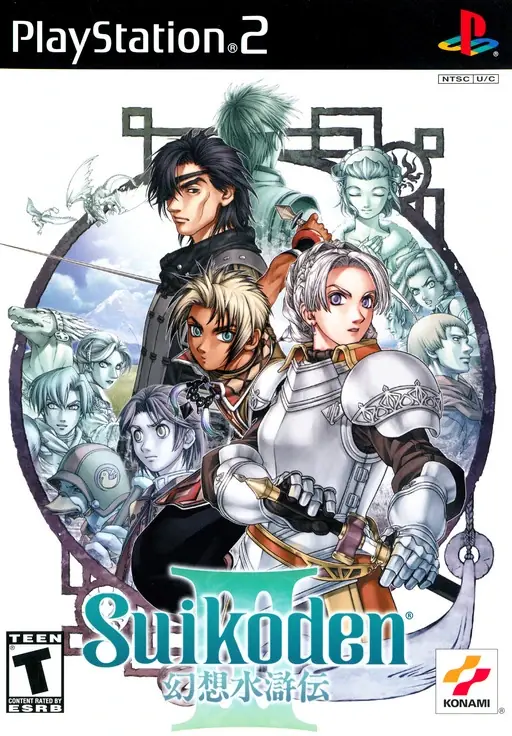
The articlegameplay, story, development, reception
Gameplay
Suikoden III shares many elements with other role-playing video games. The player controls the current protagonist and travels with them around the world map, advancing the plot by completing tasks and talking with other characters. In towns, they can gather information, sharpen their weaponry, learn new skills, and buy equipment; wilderness areas generally feature random encounters with monsters. Aside from the main plot, after a certain point in each main character's chapters, they may recruit new characters to go to Budehuc castle.
Recruiting a character often requires a short sidequest or other mission. Unlike Suikoden II and Suikoden V, Suikoden III has no "time limits" for character recruitment; assuming certain plot decisions are made "correctly," it is always possible to recruit all 108 Stars of Destiny.
As in other RPGS, characters in Suikoden III possess a variety of statistics that determine in-game combat ability. However, characters can also learn specific skills; for instance, the "Parry" skill allows a character to defend against attacks more often, while other skills may increase damage output or hasten the casting of spells. Different characters have affinities for different skills, and their own maximum limit on the number of skills they can learn. Parties may consist of up to 6 characters who participate in combat and one "support" character who adds a special skill to the party, such as minor healing after battle.
If all 6 characters lose all their hit points (and are thus incapacitated), it is game over and the player must restart. Exceptions exist for certain plot battles in which winning is optional; the player can lose and the plot continues on, albeit in a slightly different fashion.
Battles in Suikoden III take place on a continuous field of battle, unlike the static front and back rows of earlier Suikodens. Characters are still aligned in rows at the onset of battle, but the front and back character in each row are controlled as a pair. For example, selecting to cast a rune spell with the character in the back row of the pair will cause the character in the front row to defend them while they are casting. On the other hand, choosing to attack will cause a character in the front row to move towards the enemy and strike.
Runes, the primary source of magic in the world of Suikoden, are generally handled similarly to other Suikoden games. Characters have a certain number of spell usages per "spell level;" for instance, a character with 4 level 1 spell slots and a Water Rune could cast "Kindness Drops" (the level 1 Water Rune spell) 4 times. Other runes offer different benefits, and some may be used as often as desired. Since Suikoden III's combat takes place on a free movement field, some of the rune effects were reinterpreted from other games to strike areas.
For example, some Fire rune effects that only struck enemies in earlier Suikoden games now strike a generalized area, meaning they could affect allies who moved in too close. The rune spells cause the caster to begin chanting. While in this state the character can be struck to slow or halt the casting time. The time required for chanting varies depending on the abilities of the character and the magnitude of the spell.
At certain points in the game, armies clash and a strategic battle system is used, similar to those seen in military turn-based strategy games. These are set on a graph, a set of connected vertices. Certain places on the map offer special advantages for units occupying them, such as a defense bonus for a forest or castle ramparts, or automatic free healing for a base of operations. When attacking, units in other nodes adjoining the attacked space can aid, giving a bonus to the attack.
When army units engage in combat (generally by one unit moving into a space occupied by a hostile unit), the standard Suikoden III battle system is used, albeit an extremely sped-up variety in which no orders are issued and characters act on a simple AI. Leaders can aid their army units with a variety of special abilities and rune magic. Each side also requires a strategist; the better the strategist, the more moves that side can take before their turn is over. Strategy battles end when the pre-set mission objectives are completed, generally either to take a node on the map for offensive missions, or to successfully hold a node or escape for defensive engagements.
Alternatively, they can end in failure if a main character is defeated.
Suikoden III also features a number of minigames, such as gambling on dice, card games, and horse racing. These minigames are generally accessible from Budehuc castle.
Story
Suikoden III is set in IS 475, roughly 16 in-game years after the events of Suikoden II. The game takes place in the diverse Grasslands region, an area to the northwest of Dunan from Suikoden II (which itself was to the north of the Toran area from Suikoden). Politically, the Grasslands are mostly controlled by the Six Clans, a loose coalition between the Karaya, Lizard, Duck, Chisha, Safir and Alma Kinan clans. The clans are considered rather backward and barbaric by neighboring powers, and the clans have comparatively smaller towns than the cities seen elsewhere in the Suikoden universe.
On the western coast, the merchant nation of Zexen thrives. The Zexens were an ignored offshoot of the Grassland clans long ago, and have since grown to be powerful and independent. Their architecture, politics, and citizenry are similar to Renaissance Western European civilizations. To the east lie imposing mountains and eventually Harmonia, a gigantic and populous nation.
Harmonia maintains outposts along the border, notably the submissive, conquered town of Le Buque, formerly a clan from the Grasslands, and the trading citadel Caleria.
All magic in the world of Suikoden comes from Runes. Any person can have a rune inscribed on them, although some people are more talented in their use, and others can inscribe more than one rune (with three as the general maximum). In turn, all power from individual carved runes ultimately descends from the 27 True Runes, which created the world in Suikoden's mythology. Bearers of a True Rune gain tremendous power and do not age; these Runes are thus hotly contested.
Around 50 years prior to the start of Suikoden III, Harmonia attempted to extend its control over the Grasslands, and eventually invaded. Resistance was fierce, and eventually a successful leader known as the Flame Champion emerged from among the clans who was said to bear the True Fire Rune. His followers—considered bandits by the Harmonians—raided the Harmonians constantly and became known as the Fire Bringer. Eventually, a titanic clash was fought between the combined armies of the Grasslands and Harmonia.
In it, the Flame Champion unleashed the full power of the True Fire Rune, and both sides suffered tremendous casualties in the resulting raging fire. The battle was a draw, but Harmonia withdrew nevertheless, unwilling to pay any more lives for the land, and a truce was signed.
Development
Suikoden III was developed by the same team as Suikoden II, for the most part. In June 2002, just a month before its release, some of Suikoden III's team left Konami, including series creator Yoshitaka Murayama. Programmer Keiichi Isobe took over as Senior Director after Murayama's departure. With the removal of Murayama and the other's names from the end-credits, fans speculated that a case of corporate meddling had caused him to leave, but Murayama himself denies this and claims their relations remain amicable, and that the omission of credits were due to a Konami company policy of not crediting former employees. The opening video sequence for Suikoden III was developed and produced by the team responsible for animating the Suikogaiden games; following the second Suikogaiden game's completion, the Suikogaiden team and Suikoden III team merged and went on to develop Suikoden IV and Suikoden V.
Reception
By the end of 2002, 377,729 copies of Suikoden III were sold in Japan. American sales were 190,000 copies in total.
Konami did not release Suikoden III in PAL territories. A European version was announced but cancelled a few months before release, allegedly due to problems with the conversion tools. Konami's policy at that time was that all PAL games had to be fully translated to the respective languages and that only releasing the game in English was not an option. Petitions to change Konami's decision on the matter were unsuccessful. Suikoden III would finally be released in European territories on June 23, 2015, as a PS2 Classic on PlayStation Network.