

- 60/100
- Players17 ratings
- 70/100
- Critics1 review

1978 · Arcade · Breakout clone
Super Breakout
Super Breakout is an arcade game released by Atari in 1978. It utilizes a Motorola M6502 (running up at 375 KHz) and, as the name suggests, is the sequel to Breakout, which was released two years earlier. There are three different modes to choose from: Double Breakout, the playfield for which contains in fifty-two orange blocks (5-14 points), fifty-two green blocks (1-6 points), two paddles and two balls, Cavity Breakout, which contains in forty-four orange blocks (7-21 points), and fifty-two green blocks (1-9 points), one paddle, and three balls (the second and third of which have to be freed before they come into play) and Progressive Breakout which contains fifty-two blue blocks (7 points) and fifty-two green blocks (5 points), one paddle, and one ball - and the blocks shall be lowered down towards the paddle, at a rate determined by the number of times the ball lands on your paddle, but as the ball destroys them, additional rows of blocks shall appear at the top of the screen and be lowered down towards the paddle at an increasing rate. This is also the only mode for which it's possible for a player to receive an infinite amount of points by playing, but the score display shall roll over at 10000.
- Released
- 1 September 1978
- Platforms
- ArcadeAtari 2600Atari 5200Atari STGame BoyGame Boy Color
- Genres
- ArcadeBreakout clone
- Developers
- —
- Publishers
- Atari, Inc.Subelectro Ltd
- Series
- Breakout
- Modes
- MultiplayerSingle-player
- Perspective
- Side view
- Country
- United States
- Age ratings
- ESRB E
- Languages
- English
About
Super Breakout is a 1978 action video game developed and published by Atari, Inc. for arcades. It was released by Namco and Esco Trading in Japan. The game, originally designed by Ed Rotberg and Ed Logg, is a sequel to Atari's 1976 game Breakout, and uses the same mechanics while also allowing the selection of three distinct game modes, two of which involve multiple, simultaneous balls in play. As with its predecessor, the arcade version of Super Breakout is displayed in black and white, with monitor overlays to add color.
The arcade game was commercially successful in Japan and the United States. Atari published home versions of the game–in color–for most of its consoles and computers, and the game was the pack-in title for the Atari 5200 console when it was released in 1982.
Keywords
- breakout
Media
The articlegameplay, story, development, reception
Gameplay
The fundamental gameplay—use a paddle to bounce a ball into a wall of destructible bricks—is the same as Breakout, but Super Breakout contains three different game modes. "Double" gives the player control of two paddles at the same time—one placed above the other—with two balls in play simultaneously. "Cavity" has initially only one ball, but two others are contained in pockets inside the wall and can be freed. "Progressive" advances the entire wall downward step by step, gaining in speed the longer the ball is in play.
Development
The game was written by Ed Rotberg, who later designed Battlezone (1980) for Atari. Ed Logg assisted Rotberg in designing Super Breakout after hearing that Atari co-founder Nolan Bushnell wanted Breakout updated; Logg would later help design the highly successful Asteroids (1979) for Atari. While the original Breakout was constructed with discrete logic instead of a microprocessor, Super Breakout uses a MOS Technology 6502 CPU. Like its predecessor, Super Breakout uses a black and white display with overlays to simulate color.
Reception
In Japan, it was the ninth highest-earning arcade video game of 1978. In the United States, it was the eighth highest-earning arcade video game of 1979. Atari sold a total of 4,805 Super Breakout arcade cabinets.
In regard to Super Breakout being included with every Atari 5200, David H. Ahl of Creative Computing Video & Arcade Games wrote in 1983:We thought this a somewhat curious choice since it hardly uses the higher resolution of the 5200 to great advantage. The screen, for example, has the same number of bricks as Super Breakout on the Atari VCS. However, users of the VCS will like the much better representation of alphanumerics on the 5200.
Legacy
In 1982, John Braden recorded a 7-in 331⁄3 RPM record for Kid Stuff Records, telling the story of Super Breakout. This science fiction story dealt with NASA astronaut Captain John Stewart Chang returning from a routine mission transporting titanium ore from Io to space station New California. He encounters a rainbow barrier, presumably a force of nature, that seems to have no end on either side. He has three lobbing missiles of white light that he can bounce off the hull of his shuttle, and they prove able to break through the layers of the force field. With his life support systems failing, what follows is a test of endurance turned game as he strives to break through the barrier in space.
Glu Mobile released a licensed mobile phone version. In 2008, Atari released the game for the iPhone and iPod Touch via Apple's App Store.
Releases by platformdates and regions as published
Editions and related releases
- Included in
- Atari Arcade Hits: Volume 1Atari VaultAtari: 80 Classic Games in One!Atari Classics: EvolvedAtari Flashback Classics Vol. 2Atari Arcade 1Millipede / Super Breakout / Lunar LanderAtari Flashback ClassicsArcade's Greatest Hits: The Atari Collection 1Atari 50: The Anniversary CelebrationAtari Anniversary AdvanceAtari Masterpieces Vol. IAtari Greatest Hits: Volume 2Atari Anniversary EditionAtari Anniversary Edition ReduxAsteroids & Super BreakoutPong 4 Player Pub TableAtari Classics GamesSuper Pocket: Atari EditionAtari Anthology
- Follows
- Breakout Deluxe
- Ported as
- Super Breakout
- Remade as
- Super Breakout: Evolved
- Built on it
- Super BreakoutSuper Breakout: Evolved
In the same series

Games like this

Pinball
1980 · Microvision, TRS-80 +1
Arcade · Breakout

Monkey Magic
1979 · Arcade
Arcade · Breakout clone
 Nintendo exclusive80
Arkanoid - Revenge of Doh
1987 · Amiga, Amstrad CPC +11
Arcade · Breakout clone
 57
Breakout: Recharged
2022 · Remake · Xbox Series X/S, PlayStation 4 +6
Arcade · Breakout
 Sega exclusive
Woody Pop
1987 · Game Gear, Master System +1
Arcade · Breakout clone
 48
Devilish: Ball Bounder
2005 · Nintendo DS, Sega Genesis
Breakout clone
 Nintendo exclusive80
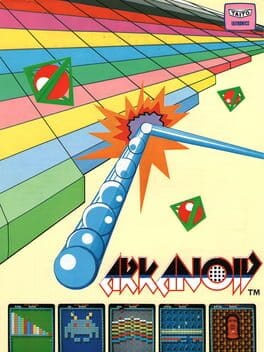
Arcade Archives 2: Arkanoid
1986 · Amstrad CPC, Apple IIGS +12
Arcade · Breakout clone
 Atari exclusive
Off the Wall
1991 · Arcade, Atari 2600
Arcade · Breakout clone
Collections7 collections
Platform libraries
- Atari ST gamesCommercial games
- Game Boy gamesList of games
- Super Game Boy gamesList
- Super Game Boy gamesList
- Game Boy Color gamesLicensed games (released) › List of games
- Atari 2600 gamesRetail game releases
- Atari 5200 gamesGames
Publishers
Description adapted from its source, CC BY-SA 4.0.