

1993 · Codemasters · Platformer · Arcade
Super Robin Hood
Nintendo console exclusive
Super Robin Hood is a side scrolling puzzle platformer developed by Codemasters, published by Camerica and was on the Quattro Adventure multicart released for the NES in 1993.
- Released
- 31 December 1993
- Platforms
- Amstrad CPCNESZX Spectrum
- Genres
- PlatformerArcade
- Developers
- Codemasters
- Publishers
- Camerica
- Modes
- Single-player
- Perspective
- Side view
- Themes
- Action
About
Super Robin Hood is a 1986 platform game developed by brothers Andrew and Philip Oliver and published by Codemasters as a budget title for home computers in the United Kingdom. Based on the folklore of Robin Hood, the game takes place in the Sheriff of Nottingham's castle where Maid Marian is held captive. The player controls the eponymous hero, encountering enemies and navigating through the castle's ladders and platforms to rescue Marian.
After graduating secondary school, the developers devised the game's concept to solicit publishers at the 1986 Personal Computer World Show. The Oliver twins met the Darling brothers, who had just founded Codemasters, at the trade event and struck a deal. Originally developed for Amstrad CPC computers, the game was ported to Commodore and Spectrum platforms soon after. Years later, the Oliver twins recreated the game for the Nintendo Entertainment System as part of their foray into the North American market.
Keywords
- unlicensed game
Media
The articlegameplay, story, development, reception
Gameplay
Super Robin Hood is an action platform game in which the player navigates Robin Hood through the Sheriff of Nottingham's castle to rescue Maid Marian. The medieval castle, which is populated with enemies like archers and spiders, consists of a large labyrinthine space visually divided into several floors with moving platforms and ladders. The player navigates the castle via flip-screening, viewing a fixed screen-sized area at a time. In later versions, this was changed to a side-scrolling view of each floor.
Collectable items within the castle consist of tablets, which replenish health, red hearts, which provide a point bonus, and keys, which activate platforms in the castle that allow further progress. The player must collect all the red hearts to be able to free Marian.
Development
During their secondary school years, Andrew and Philip Oliver had developed several video games as a hobby, some of which were published. After completing their Advanced Level examinations, the twins had committed to studying electrical engineering in higher education. During an advising meeting, however, the two expressed their desire to create computer games rather than pursue post-secondary education. The brothers' advisor, Terry Hall, recommended to their parents that the twins take a year off to "get it out of their system."
Their parents, Malcolm and Jenny Oliver, agreed with the stipulation that Andrew and Philip aim to seriously operate as a business; their father, also stated they could forego college if the two could generate a successful income. Through the United Kingdom's Enterprise Allowance Scheme, the Oliver twins set up a company, Complex Computer Software, to develop video games.
Reception
By February 1987, the game had sold over 10,000 units. 67 in 2024). Video game magazines such as Amstrad Action praised the value of the game as a budget title but had a mixed response to the gameplay. The magazine's editor, Bob Wade, praised the gameplay for being easy to pick up and having a good sized world.
While he rated the game high in the "grab factor" and "staying power" categories, Wade noted that the platforming action was "unoriginal" and the problems lacked variety, respectively. He summarised his review stating that it is a "very enjoyable game at a marvellous price." Three of Amstrad Computer User magazine's staff—Nigel, Liz, and Colin—overall viewed the game favourably, calling it "OK", a "jolly little game", and "enjoyable", respectively. Nigel rated the game the lowest of the three, noting that better platform games are available.
Legacy
The brothers used the money they earned from Super Robin Hood's profits to purchase a second Amstrad CPC computer with a Maxam ROM, so they could write code simultaneously. The game's success was the beginning of a regular partnership between the Oliver twins and Codemasters. The Darling brothers requested another game soon after, and the twins reused the game design from Super Robin Hood to create a spiritual sequel with two-player gameplay: Ghost Hunters. The pair also continued working with Eldridge on their Codemasters games.
Releases by platformdates and regions as published
Box artone per regional release we hold art for
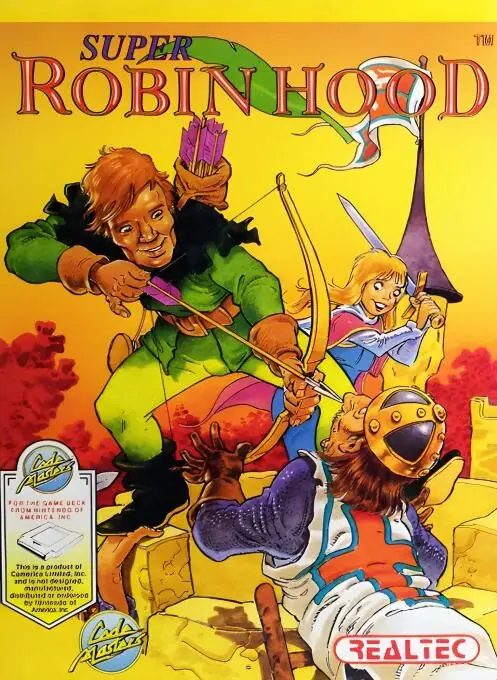
NES
Games like this
 Nintendo exclusive
Classic Kong
2012 · SNES
Platformer · Arcade
 Atari exclusive
Mountain King
1983 · Atari 2600, Atari 5200 +5
Platformer · Arcade
 60
Gods
1991 · Remaster · Acorn Archimedes, Atari ST +13
Platformer · Arcade

Peter Pack Rat
1985 · Amstrad CPC, Arcade +4
Platformer · Arcade
 Nintendo exclusive
Door Door
1983 · FM-7, MSX +6
Platformer · Arcade

Cannonball Blitz
1982 · Apple II, Commodore VIC-20 +2
Platformer · Arcade

Canyon Climber
1982 · Apple II, Atari 8-bit +3
Platformer · Arcade

Turmoil
1984 · MSX, ZX Spectrum
Platformer · Arcade
Collections2 collections
Platform libraries
Description adapted from its source, CC BY-SA 4.0.