
The articlegameplay, story, development, reception
Gameplay
The Elder Scrolls V: Skyrim is a fantasy action role-playing game, playable from a first- or third-person perspective. The player may freely roam over the land of Skyrim, an open world environment based on Scandinavia consisting of wilderness expanses, dungeons, caves, cities, towns, fortresses, and villages. Players may navigate the game world more quickly by riding horses, paying for a ride from a city's stable, or utilizing a fast-travel system that allows them to move their character immediately to a previously discovered location.
At the beginning of the game, players select their character's sex and race, with 10 choices for the latter: Nords, Imperials, Orcs/Orsimer, Bretons, Redguards, Altmer (high elves), Dunmer (dark elves), Bosmer (wood elves), Khajiit, and Argonians. The player chooses the character's appearance; this is not necessarily permanent, however, as an in-game mechanic allows for changing the appearance later. Characters have three primary attributes: health is how much damage the character can take before dying, magicka is depleted to cast spells, and stamina allows the character to perform heavy "power attacks" or sprint. A status bar for each attribute appears onscreen when the attribute falls below its maximum value.
Attributes regenerate over time and can be refilled faster by drinking potions, casting regenerative spells, or through various enchantments. Characters gain experience indirectly, via leveling up skills. The 18 skills are divided evenly among the three schools of combat, magic, and stealth. Each skill has its own experience bar, which increases when the character performs an action in-game related to the skill.
For example, crafting a dagger increases the Smithing skill, and dealing damage with a bow increases the Archery skill. When a skill's experience bar fills, the skill levels up and the bar is reset. After enough skills level up, the character levels up, enabling the player to increase the maximum value of one of the three attributes and providing a perk point. Perk points can be spent immediately on a skill-specific perk or stored for later use.
Non-player characters (NPCs) populate the world; the player may engage them in conversation (potentially leading to new quests or map locations), marry one from a predetermined set, or engage them in lethal or nonlethal combat. As in previous games in the series, killing certain individuals can make some quests or items unobtainable. Certain NPCs essential to the narrative cannot be killed by the player and will survive attacks of any magnitude. Committing a crime like murder or theft accrues the player a bounty if the crime is witnessed, leading to confrontations with guards. Depending on some factors, including how serious the crime was, the player can choose to go to jail, pay the guard off, persuade the witness to forget about it, declare that one is a thane of a certain hold (which leads the guard to pardon the player if their bounty is less than 3,000), 'pacify' the guard or silence witnesses through killing them.
NPCs frequently offer the player side-quests; some have parameters adjusted based on nearby unexplored areas. Some NPCs who are befriended or hired by the player may act as companions who will accompany the player and aid them in combat. Some individuals have quests that the player needs to complete in order to gain their services as a companion. The player may choose to join factions, organized groups of NPCs—for example, the Dark Brotherhood, a band of assassins. Each of the factions has an associated quest path to progress through.
Weapons, shields, and magic are assigned to each hand allowing for dual-wielding, and can be swapped out through a quick-access menu of favorite items. Some weapons and spells require both hands. Shields can be used to fend off enemy attacks and reduce incurred damage or offensively through bashing attacks. Blunt, bladed, and hacking weapons can be used in close combat and each have specific advantages and roles.
Power attacks expend stamina to temporarily stun/stagger an enemy and deal increased damage. g. g. showing the way to an objective, illuminating a dark room or turning iron into silver).
Bows are used for long-range combat and can be used to bash enemies in melee combat. The player can enter sneak mode to pickpocket or deliver powerful sneak attacks to unsuspecting enemies.
When exploring the game world the player may encounter wildlife. Many creatures in the wilderness, such as wolves or bears, are immediately hostile towards the player, while other species are docile and will run away. Skyrim is the first entry in The Elder Scrolls to include dragons in the game's wilderness, although dragons are frequently referenced/mentioned in several of the other games. Like other creatures, dragons are generated randomly in the world and will engage in combat with NPCs, creatures and the player.
Some dragons may attack cities and towns when in their proximity. The player character can absorb the souls of dragons in order to use powerful spells called "dragon shouts" or "Thu'um". Each shout contains three words in the language spoken by dragons, and the strength of the shout will vary depending on how many words have been spoken. Some words to shouts can be learned by visiting "word walls" in dungeons or around the wilderness, while other words can be taught by different characters.
The words to each shout are unlocked for use by spending the absorbed souls of slain dragons. A regeneration period limits the player's use of shouts in gameplay.
Story
Skyrim is set in the year 201 of the Fourth Era, which started just after the upheaval of the so-called "Oblivion Crisis" from the previous game. Skyrim is a cold and mountainous region in the north of the continent of Tamriel. It has traditionally been divided into nine administrative sections, called "holds", each governed by a jarl from a larger town. Of these settlements, Solitude, Windhelm, Markarth, Riften, and Whiterun are larger and more powerful.
The landscape is littered with forts, camps, and ruins, some of which were built by the now-extinct race of the Dwemer, or Dwarves. The Nords, one of the human races, view Skyrim as their homeland, though members of other races populate Skyrim as well. Most ubiquitous are Dark Elf refugees from the neighboring land of Morrowind, which was devastated by a volcanic eruption; and the Reachmen, a tribal faction of barbaric savages that occupy a large western portion of Skyrim known as the Reach. Various Orc strongholds are also located throughout Skyrim, having been allowed to settle in the region at the behest of the Nords.
Skyrim is a province of the much larger Empire, which at one point comprised all of Tamriel. The Empire has recently fought a war with the elvish Aldmeri Dominion, who believe that they are racially superior to humans. While the conflict, known as the Great War, ended in a military stalemate after a hard-fought battle at the imperial capital, the greatly weakened Empire was forced to sign a humiliating peace treaty called the White-Gold Concordat. This treaty led to the Dominion annexing the Bosmer province of Valenwood.
Large parts of Hammerfell, home of the Redguards, was also to be given to the Dominion as part of the Concordat, but the native Redguards promptly seceded from the Empire in response and drove the Dominion out, becoming an inward-looking rogue state. The Argonians of the Black Marsh, having lost faith in the Empire as an institution, seceded as well and established their own nationalist faction that took control of Tamriel's southeastern territories. By the game's events, the Empire is a vestigial organization which only maintains control over Cyrodiil, Skyrim, and the northwestern province of High Rock.
While most of Tamriel worship a religious pantheon of eight deities, the Nords of Skyrim are accustomed to worshiping a ninth god, Talos, the deified human general who founded the Third Empire. The Dominion, led by the intolerant Thalmor sect, rejects this notion and its implication that a man became greater than any elf. They instituted a clause in the Concordat forbidding Talos worship in the Empire. Motivated in part by this condition, Ulfric Stormcloak, the jarl of Windhelm, leads a rebellion against Imperial rule, with the holds divided between the two sides.
In the ancient past, dragons ruled over vast swaths of Tamriel. Their hegemony was overthrown when three human warriors threw the dragon ruler, Alduin, forward in time using an Elder Scroll, a powerful and mysterious artifact. When Skyrim begins, the survival of the last known dragon, the sage Paarthurnax, is a secret kept by an order of monks called the Greybeards. Within their monastery atop the Throat of the World, Skyrim's highest mountain, the Greybeards dedicate their lives to the Way of the Voice, a discipline founded by Jurgen Windcaller for the Thu’um (dragon shouts).
A line of heroic "Dragonborn", gifted by the god Akatosh with the ability to learn shouts intuitively by absorbing the souls of dead dragons, is long thought to be dead. Ancient prophecy maintains that Alduin will return to consume the world, and a "Last Dragonborn" will defeat him. Many Nords believe this will come true, though there are just as many skeptics.
The player character is the mythic Last Dragonborn and is typically referred to as such. The Dragonborn can be male or female, from one of ten races. Each of the ten races has, in addition to a bonus for certain skills, a power specific to their race – for example, Nords start with a bonus to several martial skills, and the ability to intimidate enemies for a short period. The player can recruit one NPC at a time as a follower, who can travel and fight alongside the Dragonborn; there are forty-five available followers in the base game, with thirteen more added in the downloadable expansions.
Outside of followers and Alduin (the primary antagonist), NPCs prominent to the plot of Skyrim include Balgruuf the Greater, Jarl of Whiterun, a city in the center of Skyrim; Arngeir, the leader of the Greybeards; Delphine and Esbern, two of the last members of the Blades, an order of warriors sworn to help the Dragonborn but nearly wiped out after the Great War; and Paarthurnax, the last surviving dragon and grandmaster of the Greybeards. Also notable are General Tullius and Ulfric, who command the Imperial Legion and Stormcloaks, respectively. During the course of the game, the Dragonborn can join and assist either side to gain victory in the civil war. Other factions that the Dragonborn can elect to join include the Companions, a noble order of warriors; the College of Winterhold, an institution dedicated to the mystic arts and magic; the Thieves Guild, a league of burglars who have fallen on hard times; the Dark Brotherhood, a fellowship of assassins; and the Bard's College, a group consisting of bards, poets, writers, and public speakers.
Imperial soldiers have captured Ulfric Stormcloak and are preparing to execute him, along with the player who was caught up in the skirmish and mistakenly identified as a rebel. The executions are disrupted when the dragon Alduin appears and attacks the imperial outpost. The player escapes and warns Jarl Balgruuf of Whiterun of the dragon attack. When another dragon attacks and is slain, the dragon's soul flows into the player character, causing the nearby guards to call them "Dragonborn." The Greybeards summon the Dragonborn to the Throat of the World with a deafening shout, where the
Development
Having completed work on The Elder Scrolls IV: Oblivion in 2006, Bethesda Game Studios began work on Fallout 3. It was during this time that the team began planning the next entry in The Elder Scrolls series. From the outset, they had decided to set the new game in the land of Skyrim, incorporating dragons into the main theme of the game. Full development began following the release of Fallout 3 in 2008; the developers considered Skyrim a spiritual successor to both Fallout 3 and previous Elder Scrolls games.
The game was developed by a team of roughly 100 people composed of new talent as well as of the series' veterans. The production was supervised by Todd Howard, who has been the director of several titles released by Bethesda Softworks.
The team set the game in the province of Skyrim, designing it by hand. While similar in size to Oblivion's game world of Cyrodiil, the mountainous topography of the world inflates the game space and makes it more difficult to traverse than Cyrodiil, which was relatively flat. In designing Skyrim's world, the team opted for a different approach to what was taken with Oblivion; art director Matt Carofano considered the "epic-realism" of Skyrim's world design as a departure from Oblivion's generic representation of classic European fantasy lore. Howard expressed the team's desire to re-encapsulate the "wonder of discovery" of Morrowind's game world in Skyrim, as the return to the classic fantasy of Arena and The Elder Scrolls II: Daggerfall in Oblivion meant sacrificing a world with a unique culture. As a way of creating diversity, the team divided the world into nine sectors, known as holds, and attempted to make each hold feel topographically unique from one another; in addition, the team wanted to reflect the socioeconomic background of the NPCs by making some locations elaborate and wealthy while others are poorer and lower-tech.
The team sought to make each of the game's ten races feel unique; Howard considered the player's choice of race at the beginning of the game a more important decision than it had been in previous The Elder Scrolls games because the culture of Skyrim's world contains more racism. However, he reiterated that the player's choice of race does not have major game-affecting consequences as it adds "flavor" to different NPCs' dispositions towards the player, and is not meant as a way of locking players out of particular quests. Efforts to make Skyrim's world feel hand-crafted extended to the team abandoning the use of generated landscapes as they had done in Oblivion. While just one team member was charged with designing dungeons in Oblivion, Skyrim's 150 dungeons were designed by a group of eight people. Skyrim features 244 quests, over 300 points of interest with a map marker and numerous unmarked locations.
Skyrim is powered by Bethesda's Creation Engine, forked from the Fallout 3 codebase specifically for Skyrim. After Fallout 3's release, the team devised numerous design objectives to meet for Skyrim, and according to Howard, the team "got all those done and kept going". Had the team not been able to meet their design goals with seventh generation of video game consoles, they would have waited for the next generation and released Skyrim then, but Howard felt that the technology of the time did not hold the team back at all. The Creation Engine allows for numerous improvements in graphical fidelity over Bethesda's previous efforts.
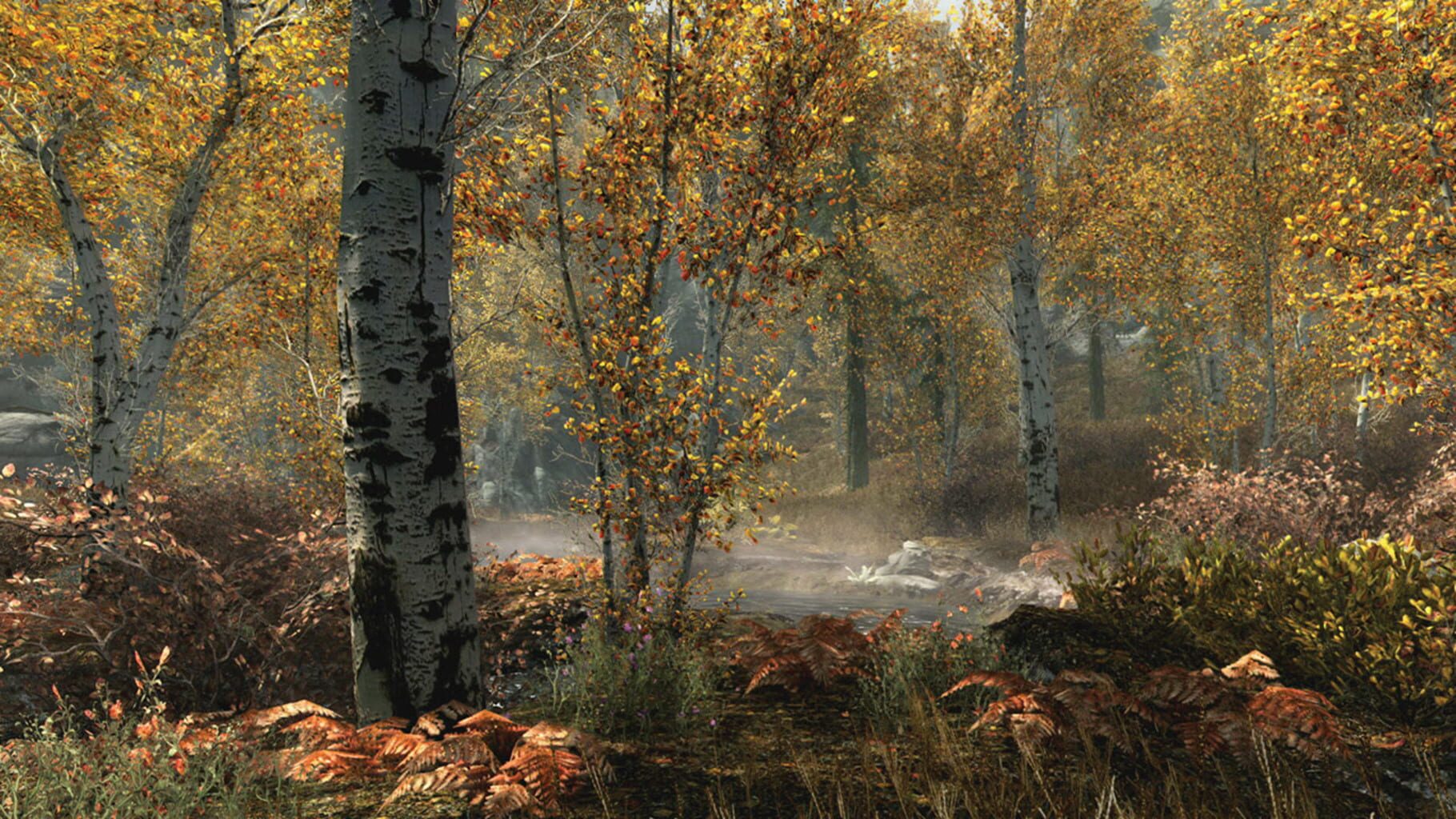
For example, the draw distance renders farther than in previous The Elder Scrolls games; Howard provided an example where the player can stare at a small object such as a fork in detail, and then look up at a mountain and run to the top of it. Dynamic lighting allows shadows to be created by any structure or item in the game world, and the Creation Engine allowed for greater detail in flora production than SpeedTree had in previous Bethesda games. For example, with Bethesda's own technology, developers were able to give weight to the branches of trees, which affects how trees blow in the wind. In addition, the technology allows wind to affect the flow of water in channels such as rivers and streams.
Because of the large presence of snow in Skyrim's game world, the technological upgrades were applied to weather effects and allow for dynamic snowfall upon the terrain, instead of snow that was rendered as a textural effect in previous games.
The team used Havok's Behavior toolset for character animation, which allows for a greater fluidity between the character's movements of walking, running and sprinting, and also increases the efficiency of the third-person camera option, which had been criticized in Oblivion. The toolset allows interactions between the player and NPCs to take place in real time; in Oblivion, when the player went to interact with an NPC, time would freeze and the camera would zoom in on the NPC's face. In Skyrim, NPCs can move around and make body gestures while conversing with the player. Children are present in the game, and their presence is handled similarly to Fallout 3 in that they cannot be harmed by the player in any way.
Skyrim uses the Radiant AI artificial intelligence system that was created for Oblivion, and it has been updated to allow NPCs to "do what they want under extra parameters". The updated system allows for greater interaction between NPCs and their environments; NPCs can perform tasks such as farming, milling, and mining in the game world, and will react to each other.
The team employed Jeremy Soule to compose the music for Skyrim, who previously worked on Morrowind and Oblivion. The game's main theme "Dragonborn" was recorded with a choir of over 30 people singing in the fictional dragon language. Creative director Todd Howard envisioned the theme for Skyrim as The Elder Scrolls theme sung by a choir of barbarians. This became a reality when the idea was passed by Soule, who recorded the 30-man choir and layered three separate recordings to create the eff
Reception
Skyrim received critical acclaim upon release. It received a combined 40/40 score from four editors of the Japanese video game magazine Famitsu, the first Western-developed game to do so. The removal of the character class system, present in previous The Elder Scrolls entries, was generally well received by reviewers. Billy Shibley of Machinima's Inside Gaming and Charles Onyett of IGN praised its removal because it allowed players to experiment with different skills without having to make decisions about a class early in the game.
John Bedford of Eurogamer stated that by removing the character class system, the game tailored itself to players who wanted to build an all-around character, while still letting other players specialize in a preferred play-style. Steve Butts of The Escapist considered the addition of perks to the character advancement system "a great method to make your character feel even more unique and personal". Kevin VanOrd of GameSpot praised the way perks allowed for the player's preferred skills to become more powerful over time, stating that the perk system "forms around the way you play, but allows for tweaking so that you retain a sense of control". The user interface was also praised by reviewers for its accessibility; Bedford complimented its "elegant design" which succeeded Oblivion's comparatively complex interface.
The art style of the game world drew acclaim from many reviewers, who welcomed the departure from Oblivion's Cyrodiil. Jason Schreier of Wired described the land of Skyrim as a "Viking-inspired treasure trove of flavor and charm", noting its contrast to Cyrodiil, which he considered generic by comparison. The Staff at Edge magazine described Cyrodiil as a "patchwork of varying terrains", praising the more consistent design of Skyrim. Shibley praised "the lack of copy-and-paste level design that's plagued Bethesda's previous games, ...
giving a lived-in and handcrafted look to the world". Bedford noted that the improved graphical fidelity over Oblivion allowed the game world to feel more lifelike, praising the "misty mountain setting, complete with swirling fog and high-altitude snowstorms". An editor for PC PowerPlay praised the diversity of the dungeon design. Andrew Reiner of Game Informer cited criticisms that Oblivion faced for repetitive dungeons, noting that "the composition of each dungeon is largely unique and individualized" in Skyrim.
He also favored the design choice to have a quick route out of a dungeon leading from its last room, eliminating a problem he identified Oblivion as having, where the player would clear a dungeon and then have to go all the way back to the beginning to exit it. Many reviewers praised the large number of things to do in the world outside of the main story. Tom Francis of PC Gamer noted that it was difficult to explore the world without becoming distracted by things to do, stating that, "it's hard to walk for a minute in any direction without encountering an intriguing cave, a lonely shack, some strange stones, a wandering traveller, [or] a haunted fort".
Reviewers welcomed the ability to dual-wield weapons and magic. An editor for PC PowerPlay felt that the dual-wielding ability "transforms the tactical scope of each combat encounter". Shibley noted that the dual-wielding option gave the player more freedom to experiment with combat, writing that, "the ability to apply a spell to each hand ... generates huge potential for getting creative with your spell combinations".
However, reviewers were critical of the melee combat, feeling that it had not been improved upon as much as other areas in the game. Justin McElroy of Joystiq felt that "what should be thrilling fights in Skyrim are often weighed down by the same clunky melee system Oblivion suffered from". Onyett described the melee combat as "flat" and "floaty", and that "many times it feels like you're slicing air instead of a mythical creature's flesh". Francis agreed with this sentiment, stating that, "too much of the time, you wave your weapon around and enemies barely react to the hits".
The game received minor criticism in several other areas. The quality of the main quest divided some reviewers. While Reiner praised the main quest as "superbly penned" and "Bethesda's best effort to date", Butts and Francis criticized the fact that the story was delivered primarily through conversations and quest journals, rather than through the player's own interactions. While the dragon battles were well-received, some reviewers observed flaws in the AI for dragons.
Onyett pointed out their "predictable attack patterns", which Francis agreed with, claiming that "fighting them never changes much: you can just ignore them until they land, then shoot them from a distance when they do". Reiner felt that, due to the repetitiveness of their attack patterns, the dragons were not challenging enough for low-level players. Edge pointed out a curve in difficulty for players who favored archery and magic, as dragons were difficult to attack while airborne. Many reviewers noted glitches while playing Skyrim, some game-breaking.
Nick Cowen of The Guardian pointed out that the game's glitches were a trade-off for its ambitious scope, and that he had experienced glitches that forced him to reload earlier saves. Edge began their review by criticizing the lack of polish, while still acknowledging many areas in the game that made up for it.
At the launch of Skyrim, many technical issues of varying severity were reported. Some examples include a texture down-scaling issue on the Xbox 360 version when the game was run from the hard drive; crashes, slowdown and frame rate issues on the PlayStation 3 version when save files exceeded 6 MB, commonly occurring due to extended gameplay times; and various crashes and slowdowns on the Windows version. According to Skyrim's director Todd Howard, the notion that bugs were caused by "restrictive RAM" is incorrect. Howard said, "It's literally the t